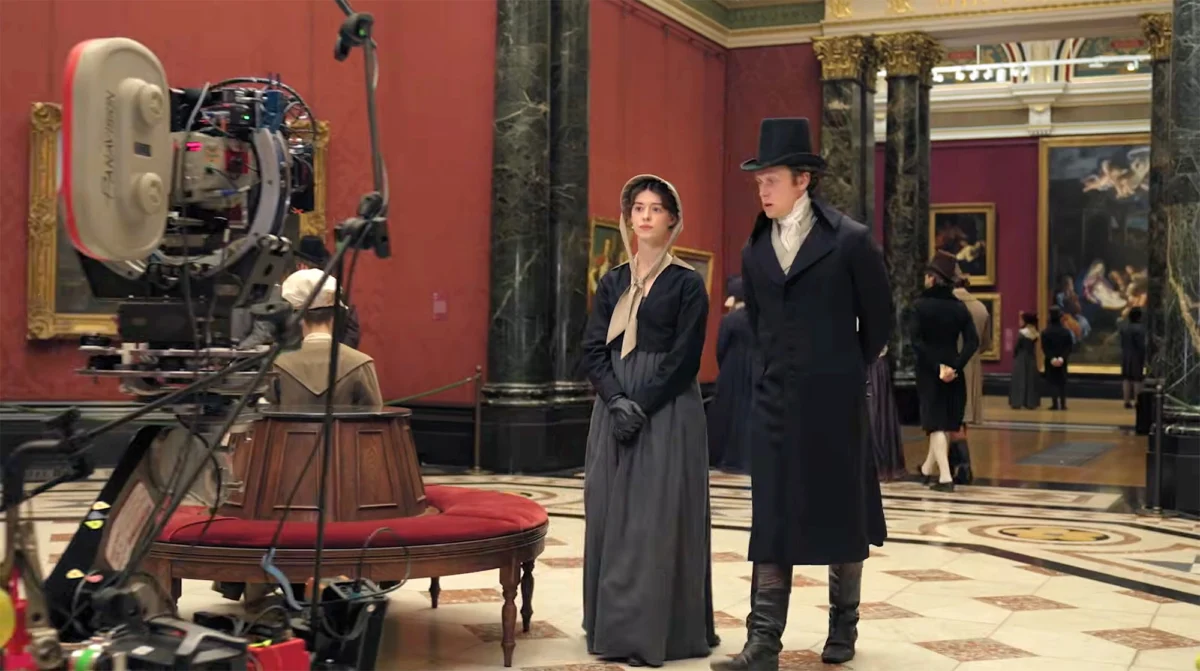
Focus Features has released an official behind-the-scenes featurette titled "A Look Inside" for its upcoming cinematic adaptation of Jane Austen’s classic 1811 novel, Sense and Sensibility. Directed by British filmmaker Georgia Oakley, known for her critically acclaimed work on the 2022 feature Blue Jean, the new film aims to inject a contemporary yet period-accurate perspective into one of English literature’s most enduring narratives. The promotional video highlights Oakley’s directorial vision, featuring commentary from the cast and crew, and offers a glimpse into the production design, tone, and character dynamics of the upcoming project.
The film stars Daisy Edgar-Jones and Esmé Creed-Miles as the central Dashwood sisters, Elinor and Marianne, respectively. Supported by an extensive ensemble cast that includes Caitríona Balfe, George MacKay, Frank Dillane, Herbert Nordrum, Fiona Shaw, and Bodhi Rae Breathnach, the project represents a high-profile collaboration between Focus Features and Working Title. As anticipation builds for the theatrical rollout, the newly published featurette provides context regarding how the creative team approached modernizing a text that has seen numerous theatrical and television adaptations over the past century.
Background and Literary Context
Jane Austen’s Sense and Sensibility, published anonymously "by a Lady" in 1811, was the author’s first published novel. The story centers on the Dashwood sisters, whose lives are upended following the death of their father. Because English property inheritance laws of the Georgian era heavily favored male heirs, Mr. Dashwood’s estate passes entirely to his son from a previous marriage, leaving his second wife and three daughters in precarious financial circumstances.

The family relocates to Barton Cottage in Devonshire, courtesy of a generous relative. There, the pragmatic and reserved Elinor and the deeply emotional and romantic Marianne navigate the complexities of social class, financial insecurity, and romantic entanglement. The novel explores the tension between rational judgment (sense) and emotional impulse (sensibility), a thematic dichotomy that continues to resonate with contemporary audiences.
Over the decades, Austen’s work has been adapted across various mediums. The most notable cinematic predecessor remains Ang Lee’s 1995 adaptation, scripted by and starring Emma Thompson alongside Kate Winslet, Hugh Grant, and Alan Rickman. That film achieved widespread critical acclaim, earning seven Academy Award nominations and winning the Oscar for Best Adapted Screenplay. Given the cultural footprint of Lee’s version and subsequent television adaptations by the BBC, any new cinematic treatment faces high expectations regarding its artistic differentiation.
Chronology of Production and Distribution
Development on Georgia Oakley’s Sense and Sensibility progressed steadily through the mid-2020s, spearheaded by production powerhouse Working Title in partnership with Focus Features. The screenplay was penned by screenwriter Diana Reid, adapting Austen’s text to highlight specific social dynamics inherent to the early 19th-century setting.
The promotional campaign for the film accelerated in late 2026 with the release of the official trailer, followed shortly by the "A Look Inside" featurette on September 29, 2026. Focus Features has established a staggered international and domestic release schedule to maximize theatrical visibility. The film is slated to premiere in United Kingdom cinemas on September 25, 2026, distributed by Focus Features, before expanding to the United States theatrical market on October 16, 2026.

Director’s Vision and Creative Approach
In the newly released featurette, director Georgia Oakley discusses her rationale for returning to Austen’s source material. Oakley notes that Austen’s structural understanding of power dynamics and gender roles within historical hierarchies provided a compelling framework for a fresh interpretation.
"It was exciting to have the chance to tell it in my way," Oakley states in the promotional material. Cast members similarly praise the director’s distinct aesthetic and narrative focus, emphasizing that the adaptation retains the wit and social critique characteristic of Austen’s writing while grounding the emotional performances of the principal actors in authentic psychological realism.
The production design team, operating under the oversight of producers Tim Bevan, Eric Fellner, India Flint, and Jo Wallett, utilized authentic Georgian-era locations and period-specific wardrobe to construct the visual landscape of Sussex and Devonshire. Cinematographic choices emphasize natural lighting and intimate framing to underscore the psychological interiority of the Dashwood sisters as they confront economic displacement and societal judgment.
Cast and Character Breakdown

The casting choices reflect a deliberate blending of established dramatic actors and rising contemporary talent. Daisy Edgar-Jones, widely recognized for her breakout role in Normal People and subsequent performances in Where the Crawdads Sing and Twisters, portrays Elinor Dashwood. Elinor is characterized by her emotional restraint, responsibility, and unwavering devotion to her family amidst financial ruin.
Esmé Creed-Miles, acclaimed for her lead performance in the television series Hanna, takes on the role of Marianne Dashwood. Marianne serves as her sister’s foil, defined by intense romantic idealism, artistic passion, and a refusal to conform to conventional social niceties regarding courtship.
The supporting ensemble features an array of prominent international talent. Caitríona Balfe, known for her work in Belfast and Outlander, joins the cast alongside George MacKay, who gained international recognition for his role in 1917. Veteran stage and screen actress Fiona Shaw brings institutional authority to the ensemble, while Frank Dillane, Herbert Nordrum, and young actor Bodhi Rae Breathnach round out the principal players involved in the intricate web of courtship and social maneuvering central to the plot.
Industry Implications and Market Position
The release of a major literary adaptation by a specialty studio like Focus Features underscores ongoing industry interest in elevated period drama. In an increasingly fragmented theatrical distribution landscape, well-known literary intellectual property paired with recognizable contemporary casts remains a reliable strategy for capturing both older demographics and younger arthouse audiences.

By selecting Georgia Oakley—whose previous feature, Blue Jean, explored historical socio-political prejudice in 1980s Britain—Focus Features signaled an intent to infuse traditional costume drama with modern directorial sensibilities. Critical reception and box office performance during the late 2026 release window will determine whether this iteration of Sense and Sensibility achieves the enduring cultural resonance of its 1990s predecessor while establishing a distinct identity for 21st-century cinema.