What begins as a seemingly minor domestic annoyance on the eve of a long-awaited summer holiday quickly escalates into a full-scale social and political reckoning in Ground Floor, the latest feature film directed by acclaimed Hungarian filmmaker Gábor Reisz. Co-written by Reisz and Éva Schulze, the 108-minute tragicomedy uses a patch of black mold discovered behind a closet to hold up a mirror to the political apathy, systemic corruption, and cultural fatigue defining modern urban life in Central Europe. Featuring a powerhouse lead performance by Ádám Tompa alongside an ensemble cast that includes Rodrigo Crespo, Bettina Józsa, Tünde Bacskó, György Gazsó, Juli Kindl, Éva Tímár, and international star Marcello Fonte, the film has emerged as a vital cultural touchstone following its debut and its timely alignment with the April 2026 Hungarian elections.
The Main Facts and Narrative Premise
The narrative of Ground Floor centers on Kristóf (played by Ádám Tompa), an intellectual who is already grappling with personal grief following the death of his father. Just as he and his wife, Vera, are preparing to leave for their summer vacation, Kristóf uncovers a menacing patch of black mold spreading across the wall behind their bedroom closet. Convinced that the infestation stems from an active water leak somewhere within the multi-story residential building, Kristóf sets out to locate the source.
What should be a straightforward maintenance inquiry transforms into an increasingly frantic odyssey. Kristóf finds himself navigating the labyrinthine hallways, petty power dynamics, and institutional inertia of his apartment complex. Each door he knocks on introduces a familiar, finely observed archetype: from overbearing neighbors who weaponize building bylaws to residents who have long surrendered to the belief that structural decay is an inevitable facet of daily life.
Director Gábor Reisz deftly translates this mundane domestic crisis into a razor-sharp political satire. The apartment complex functions as an effective micro-model of contemporary Hungary, compressing broader societal issues—such as intimidation, administrative incompetence, and the redirection of accountability—into a shared residential space where everyone recognizes that something is profoundly broken, yet no one is willing to take responsibility.
Chronology of Production and Political Backdrop
Conceived and written well in advance of the pivotal April 2026 national elections, Ground Floor captures a precise historical atmosphere characterized by political fatigue and systemic silencing. Reisz has openly discussed how the screenplay was born out of an environment where critical thought was systematically discouraged, leading citizens to retreat into private spheres of non-involvement.
By the time the film was completed and presented to audiences, the political landscape had undergone a tangible shift. The April 2026 elections reflected the exact kind of civic awakening and fracture of silence that originally inspired Reisz to write the script. Consequently, the film transitioned from a speculative contemporary critique into a vital cinematic archive of an era defined by quiet endurance.
The structural pacing of the film mirrors Kristóf’s psychological deterioration. Reisz initiates the narrative with a micro-realist, documentary-influenced aesthetic. However, as Kristóf’s encounters with his neighbors grow increasingly absurd, the film adopts the restless, escalating rhythms of Franz Liszt’s Hungarian Rhapsody No. 2. The physical deterioration of the building—manifested in spreading mold, widening wall cracks, and neglected foundational damage—operates in tandem with Kristóf’s transformation from an anxious, detached intellectual into an obsessive crusader.
Supporting Data, Cast, and Production Metrics
Running at precisely 108 minutes, Ground Floor represents a focused exercise in spatial confinement and character-driven escalation. The film’s production metrics highlight a tight, highly collaborative European co-production model designed to maximize psychological tension within a localized setting.
The ensemble cast anchors the film’s allegorical ambitions in grounded human behavior:
- Ádám Tompa delivers a career-defining performance as Kristóf, serving as the anxious psychological anchor of the film.
- Rodrigo Crespo, Bettina Józsa, and Tünde Bacskó provide the disruptive neighborly friction that drives the narrative forward.
- György Gazsó, Juli Kindl, and Éva Tímár flesh out the older generation of residents who embody systemic resignation.
- Marcello Fonte adds a distinct international flavor to the supporting ensemble, enriching the film’s socio-political tapestry.
Behind the camera, the creative partnership between director-writer Gábor Reisz and co-writer Éva Schulze ensures that the dialogue remains rooted in authentic interactions. Even the therapeutic vernacular deployed by characters—who awkwardly discuss their feelings while failing at basic human communication—serves as a rich source of dark comedy.
Official Responses, Critical Reception, and Stylistic Shifts
Critical reception to Ground Floor has largely centered on its bold tonal ambition, though reviewers have noted distinct stylistic shifts across the film’s runtime. In its earlier passages, the picture excels through subtle, everyday absurdism, accurately skewering the bureaucratic deadlocks familiar to urban renters and homeowners alike.
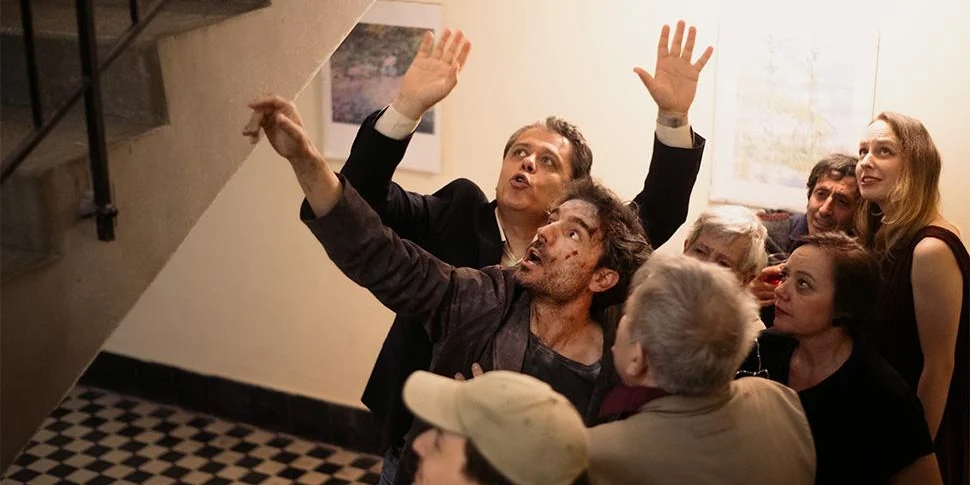
However, as the narrative progresses into its final act, the film leans heavily into overt farce. When the residents engage in a cacophonous, chaotic collective confrontation, some critics have observed that the political allegory becomes slightly less incisive due to its sheer volume. By sacrificing subtlety for directness, the screenplay occasionally over-explains its central metaphors, risking didacticism in moments where a lighter touch might have retained a sharper satirical bite.
Despite these minor tonal overreaches, industry analysts and festival reviewers have praised Reisz for refusing to soften the film’s underlying anger. The central philosophical question posed by Kristóf’s descent into obsession remains potent: At what point does remaining uninvolved become a form of active participation in a broken system?
Broader Socio-Political Implications and Legacy
The broader implications of Ground Floor extend far beyond the borders of Hungary, touching upon universal anxieties regarding civic responsibility in the face of institutional decay. By using the apartment block as a microcosm for national governance, Reisz constructs an enduring argument against the temptations of apathy.
In public statements regarding the film, Reisz noted that while the political reality surrounding the project shifted between its inception and its premiere, its core message remains entirely relevant. The film acts as a permanent snapshot of a society grappling with the consequences of enforced silence, shady administrative arrangements, and the exhausting burden of demanding accountability.
Ultimately, Ground Floor transcends its modest premise of a domestic plumbing mystery. The black mold hidden behind Kristóf’s closet is merely the visible symptom of a deeper rot. Through precise character work, restless musical framing, and an unflinching examination of collective denial, Gábor Reisz has delivered a timely and provocative cinematic statement. The film reminds viewers that while ignoring dysfunction is always the easier path, the cracks in the foundation will eventually demand a reckoning.