The independent film landscape in Japan has long served as a pressure valve for creators seeking to escape the rigid, production-committee-driven structures of the mainstream anime industry. With the recent release of Cherry and Virgin, directed by former Gainax talent Masanao Kojiri, the medium has received its most significant entry in the adult-oriented romantic comedy genre since the seminal 2004 series Genshiken. Developed over a arduous five-year period that spanned the height of the COVID-19 pandemic, the film represents a departure from traditional industry practices, having been brought to fruition through a successful crowdfunding initiative rather than corporate backing.
A Departure from Industry Standards
For decades, the anime industry has primarily focused on the idealized, often ephemeral experiences of adolescence. While titles such as Wotakoi: Love Is Hard for Otaku have touched upon the intersection of professional life and subculture fandom, critics and audiences alike have frequently noted a lack of narrative depth regarding the long-term psychological impact of otaku culture on adult relationships.
Cherry and Virgin addresses this vacuum by centering its narrative on two protagonists in their thirties: Ryo, an independent creator who has prioritized his professional autonomy over mainstream social acceptance, and Ami, a talented artist navigating the tension between her creative passions and societal expectations. Their story is framed by the universal pressures of adulthood, specifically the societal expectation of marriage, which often forces individuals to reconcile their personal identities with the desire for companionship.
Chronology of Production and Development
The gestation of Cherry and Virgin is a testament to the resilience of independent creators. The project’s timeline can be broken down into several critical phases:
- 2019: Conceptualization and Crowdfunding: Director Masanao Kojiri, leveraging his experience at Gainax, initiated the project to create a mature love story that resonated with the demographic that grew up during the golden age of 90s anime. The crowdfunding campaign was launched to ensure total creative control.
- 2020–2022: The Pandemic Challenge: Like many independent productions, the film faced significant delays due to COVID-19. These constraints necessitated a more deliberate, artistic approach to animation, leading to the strategic use of rotoscoping and stylized character designs to maximize impact with limited frames.
- 2023: Finalization and Distribution: Post-production concluded, with the team focusing on intricate sound design and visual layering.
- 2024: Official Release: The film debuted to critical acclaim, noted specifically for its refusal to rely on tropes common in contemporary "trend-hopping" anime series.
Stylistic Innovations and Artistic Merit
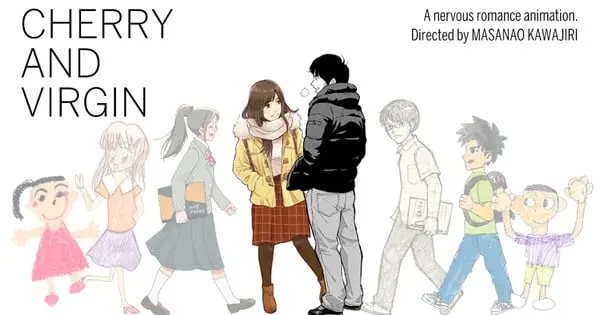
One of the most striking elements of Cherry and Virgin is its visual dichotomy. The film employs two distinct character designers to emphasize the disparate backgrounds of the leads. Ami is depicted through a soft, pastel palette, reflecting her aspirations and the curated, idealized life she presents to the world. Conversely, Ryo is rendered in a monochromatic, scruffy style, underscoring his identity as an individual struggling with social failure and color blindness.
This visual strategy extends to the film’s depiction of memory. As the characters recount their histories, the animation style shifts—moving from primitive crayon scribbles representing childhood, through the rebellious, hyper-stylized "how-to-draw" manga aesthetics of their teenage years, to the refined, character-specific designs of their adulthood. This technique provides a visual shorthand for the characters’ growth and their changing perceptions of themselves and one another.
Analytical Context: The Otaku Experience
The film’s dialogue and narrative depth benefit significantly from an authentic understanding of subculture history. Unlike mainstream productions that utilize references as mere marketing tools or "easter eggs," Cherry and Virgin integrates its references into the character psychology. For instance, the film’s approach to the Comiket experience and the candid discussions regarding BL (Boys’ Love) and yuri reflect a nuanced understanding of how these subcultures have shaped the romantic lives of modern Japanese adults.
The film serves as an analytical piece on the "otaku" identity. It posits that the consumption of fiction—be it in the form of manga, anime, or idol culture—has become a foundational element of how these individuals perceive reality. When the protagonists discuss works such as Ghost in the Shell 2: Innocence or Macross: Do You Remember Love?, they are not merely reciting titles; they are accessing a shared linguistic framework that defines their worldview.
The Role of Independent Filmmaking
Director Masanao Kojiri has been vocal regarding the necessity of stepping outside the traditional anime industry to tell this specific story. In recent interviews, Kojiri stated that contemporary romcom anime often prioritize the intensity of youth-oriented angst, which, while marketable, fails to capture the complexity of a relationship between two jaded, mature adults. By moving away from the committee-led production model, Kojiri was able to sustain a tone that remains intimate and, at times, unflinchingly honest about the less-than-flattering aspects of human connection.
The film’s refusal to shy away from the "degenerate" aspects of its characters’ pasts—and the accountability required to move past them—is a rarity in the medium. It explores the idea that artistic inspiration should be drawn from lived experience rather than treated as a mere commodity, a lesson that is central to the protagonists’ character arcs.
Broader Impact and Industry Implications
The success of Cherry and Virgin suggests a shifting demand among global anime audiences. As the generation that grew up consuming anime reaches middle age, there is an increasing appetite for narratives that mirror their own life stages. The film’s ability to achieve high production values while maintaining an independent, auteur-driven sensibility offers a potential roadmap for future projects.
Furthermore, the film’s soundtrack—which utilizes jazz-inspired compositions to lend a sense of gravity and sophistication to the narrative—marks a departure from the high-energy, pop-centric scores that define the majority of the current market. This deliberate pacing creates a "safe space" for the audience to engage with the characters’ growth, effectively mimicking the slow-burn intimacy of classic American romantic comedies like When Harry Met Sally.
Conclusion: A New Standard for Maturity
Cherry and Virgin stands as a landmark release that challenges the industry to broaden its scope. By focusing on the intersection of artistic failure, personal baggage, and the genuine desire for connection, it provides a mature, thoughtful look at what it means to be an adult in the modern age. It is a work that does not discard the otaku interests of its characters’ pasts but rather integrates them into the complex, often messy reality of their present.
As the industry continues to evolve, the impact of independent, director-led films like this one will likely be felt in the coming years. Whether this will lead to a broader shift in corporate-backed content remains to be seen, but for now, the film serves as a definitive argument for the importance of authorship, patience, and the value of telling stories that reflect the actual, rather than the idealized, lives of the audience.