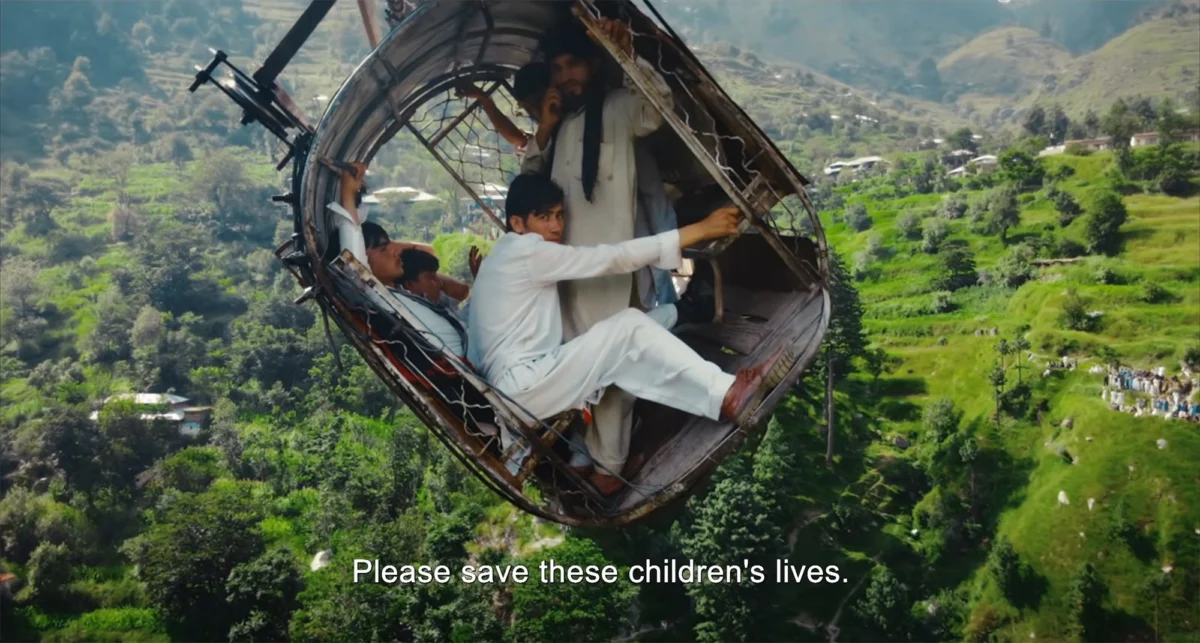
The distribution company Abramorama has officially released the first trailer for Hanging by a Wire, a documentary feature that reconstructs the high-stakes rescue of eight individuals trapped in a disabled cable car in the remote mountainous regions of Pakistan. Directed by the critically acclaimed filmmaker Mohammed Ali Naqvi, the film arrives as a definitive cinematic account of the August 2023 incident that captured global headlines. Following a successful festival run that included premieres at the 2026 Sundance Film Festival, as well as screenings in Seattle, Sydney, and at Tribeca, the documentary is scheduled for a limited theatrical release in the United States starting August 28, 2026.
The documentary focuses on the precarious survival of six schoolchildren and two adults who became stranded approximately 900 feet above a deep ravine in the Allai valley of the Battagram district. The incident occurred when one of the two cables supporting a makeshift chairlift—a common but unregulated mode of transport in the Khyber Pakhtunkhwa province—snapped during a routine commute to school. For over 15 hours, the passengers remained suspended by a single remaining wire, facing high winds and the constant threat of a total structural failure.
The Chronology of the Allai Valley Crisis
To provide a comprehensive understanding of the events depicted in Hanging by a Wire, it is necessary to examine the timeline of the rescue operation as it unfolded on August 22, 2023. The crisis began at approximately 7:00 AM local time when the cable car, known locally as a "dolly," was midway across the ravine. The sudden snapping of the primary cable left the car tilted at a precarious angle, immediately sparking a localized panic that soon escalated into a national emergency.
By mid-morning, the Pakistan Army had initiated a high-risk aerial rescue mission involving multiple Special Services Group (SSG) helicopters. However, the operation was complicated by several factors: the extreme altitude, the downdraft from the helicopter rotors which threatened to destabilize the remaining cable, and the encroaching darkness as the day progressed. The film utilizes remarkable on-the-ground footage and cockpit recordings to illustrate the technical difficulties faced by the military pilots.

As night fell and aerial operations became too hazardous to continue, the focus shifted to a civilian-led ground effort. Local zipline experts and community members from the surrounding villages took the lead, utilizing manual pulleys and harnesses to reach the stranded passengers. The final passenger was brought to safety late that night, concluding a 15-hour ordeal that tested the limits of both military technology and local ingenuity.
Technical Data and Infrastructure Realities in Rural Pakistan
Hanging by a Wire serves not only as a thriller but also as a socio-economic analysis of the infrastructure gaps in rural Pakistan. The documentary provides data regarding the prevalence of these makeshift cable car systems. In the mountainous northern regions of the country, where formal bridge construction is often delayed by budgetary constraints and difficult terrain, hundreds of these "dollies" serve as essential lifelines for thousands of residents.
According to regional reports cited in the film’s background research, these cable cars often lack official safety certifications and regular maintenance schedules. The Allai valley incident prompted the Pakistani government to order immediate safety inspections of all such private lifts across the country. The documentary highlights that for many students in the Khyber Pakhtunkhwa province, the choice is between a hazardous 10-minute cable car ride or a four-hour trek across treacherous mountain paths to reach the nearest educational facility.
The film meticulously documents the technical specifications of the cable car involved, noting that the single remaining wire was subjected to stress levels far exceeding its rated capacity. The visual evidence presented in the trailer suggests that the documentary will focus heavily on the mechanical fragility of the situation, utilizing CGI recreations to supplement the archival footage of the snapping cables.
Directorial Vision and Production Background
Mohammed Ali Naqvi, the director behind Hanging by a Wire, is a veteran of the documentary format, known for his ability to weave personal narratives into broader political and social contexts. His previous works, including Among the Believers and The Accused: Damned or Devoted?, have explored the complexities of Pakistani society, religious extremism, and the judicial system. With this latest project, Naqvi shifts his lens toward a survival narrative that doubles as a critique of class disparity.

"This film is a tribute to the ordinary people who became extraordinary when it mattered most," Naqvi stated during the film’s promotional rollout. "To have Abramorama bring Hanging by a Wire to theaters means this story will reach audiences as we intended—together, in the dark, holding their breath as a real-life disaster thriller unfolds through the voices and footage of the people who lived it."
Produced by Naqvi alongside Bilal Sami, the documentary spent several years in production to ensure the inclusion of firsthand testimonies from the survivors, the rescuers, and the military personnel involved. The production team reportedly conducted extensive interviews to reconcile the various accounts of the rescue, particularly the tension between the official state-led narrative and the grassroots efforts of the local community.
Official Responses and Socio-Political Implications
The documentary explores the official government response to the crisis, which was characterized by a mixture of high-level mobilization and logistical challenges. At the time of the incident, the Pakistani government faced scrutiny over the lack of safety regulations governing private transport in remote areas. Hanging by a Wire includes footage of official briefings and analyzes the rhetoric used by national leaders to frame the rescue as a triumph of national unity.
However, the film also gives voice to critics who argue that the necessity of such a dangerous rescue operation was a symptom of systemic neglect. By highlighting the class divides that complicated the rescue effort—specifically the delay in mobilizing resources to a marginalized rural area versus the immediate media attention the event garnered—Naqvi provides a nuanced look at the politics of disaster management.
Related parties, including the families of the schoolboys involved, provide emotional weight to the narrative. Their testimonies reflect a sense of resignation toward the daily dangers they face, contrasted with the sudden, fleeting spotlight of international fame. The documentary posits that while the rescue was a success, the underlying issues of poverty and lack of infrastructure remain largely unaddressed.

Critical Analysis and Global Reception
Since its debut at the 2026 Sundance Film Festival, Hanging by a Wire has been praised for its pacing and its refusal to simplify a complex event. Critics have noted that the film avoids the pitfalls of "poverty porn," instead opting for a rigorous, fact-based approach that honors the agency of the local rescuers. The inclusion of the "dolly" owners’ perspectives—individuals who often provide these services at a loss to help their community—adds a layer of moral complexity to the story.
The film’s selection for major international festivals such as Sydney and Tribeca underscores its universal appeal. While the setting is specific to the Pakistani Himalayas, the themes of community resilience, the failure of state systems, and the courage of ordinary citizens resonate globally. Industry analysts suggest that Abramorama’s decision to release the film in late August—coinciding with the anniversary of the actual event—is a strategic move to capitalize on the historical significance of the date.
Broader Impact on Documentary Cinema
Hanging by a Wire represents a growing trend in documentary filmmaking that utilizes "disaster thriller" tropes to engage audiences while delivering profound social commentary. By combining high-definition cinematography with grainy, immediate cell phone footage recorded by bystanders during the 15-hour ordeal, the film creates a visceral sense of "being there" that few scripted features can replicate.
The documentary also serves as a historical record of a specific moment in Pakistani history, documenting the intersection of modern military technology and ancient survival techniques. As the film prepares for its US theatrical debut in New York City, it is expected to spark discussions regarding international aid, infrastructure development, and the ethics of reporting on disasters in the Global South.
In conclusion, Hanging by a Wire is positioned as more than a simple retelling of a miraculous survival story. It is a comprehensive examination of the factors that lead to such crises and the human spirit that manages to overcome them. Through the lens of Mohammed Ali Naqvi, the 2023 cable car rescue becomes a microcosm of the challenges and triumphs of contemporary Pakistan. The film’s release on August 28, 2026, will provide Western audiences with an intimate look at a story that, while it ended in safety, continues to hang in the memory of those who witnessed it.