South Korean auteur Hong Sang-soo has returned with his 35th feature film, Nowhere to Lay My Eyes, an economical yet conceptually dense 72-minute drama that investigates the fault lines of family, artistic integrity, and generational expectations. Regarded within his filmography as one of his signature "miniatures"—a classification previously associated with works like his notoriously out-of-focus, roughly hour-long 2023 release In Water—this latest project packs a remarkable density of philosophical and sociopolitical debate into a compressed runtime.
The film also marks a notable milestone for its leading lady, Kim Min-hee, representing her first major leading role since giving birth to a son last year with her long-term partner and frequent collaborator, director Hong. Alongside Kim, the cast features Choi Myung-gil, Kwon Hae-hyo, Shin Seok-ho, and Park Mi-so. As the film makes its rounds in the international festival circuit, it has already prompted critical discussion regarding Hong’s stylistic evolution, particularly his rare foray into contemporary geopolitics and a departure toward a cautiously optimistic cinematic resolution.
The Narrative Premise: Family Dynamics on Jeju Island
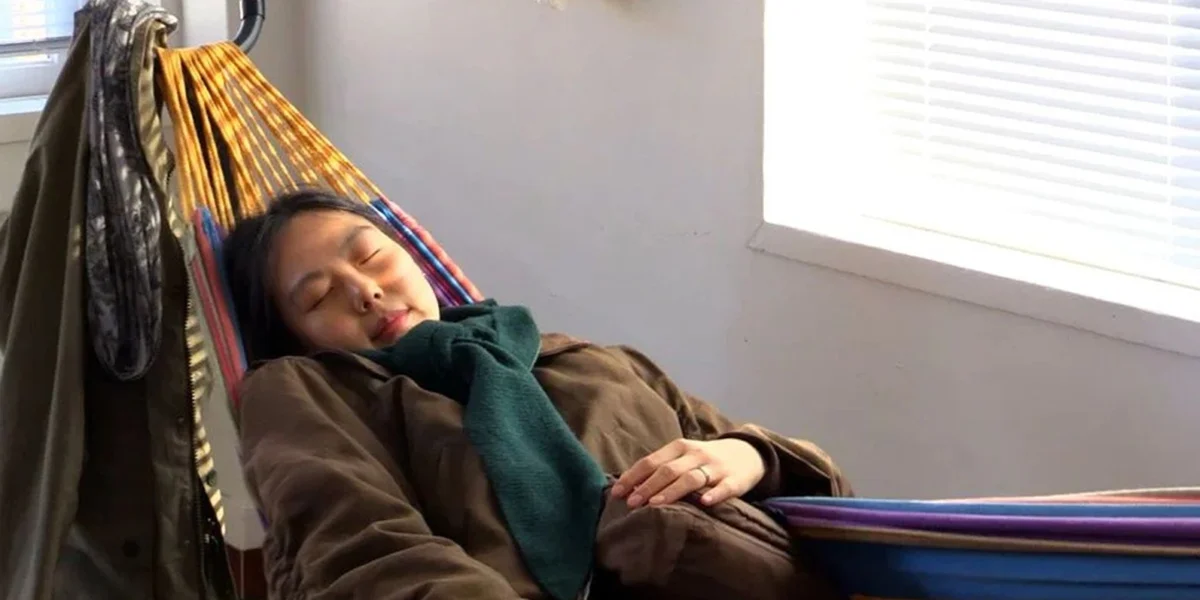
The central narrative of Nowhere to Lay My Eyes follows Sang-hee, portrayed by Kim Min-hee. By day, Sang-hee works a conventional job at a snack company; by night, she identifies as an experimental filmmaker, producing micro-shorts distributed via YouTube. Driven by a desire to mend a fractured relationship, Sang-hee and her younger brother, played by Shin Seok-ho, embark on a blustery journey to Jeju Island to visit their mother, played by Choi Myung-gil.
The siblings have been semi-estranged from their mother for over a decade, a division exacerbated by their parents’ bitter divorce during their youth, which subsequently forced Sang-hee to be raised by her grandparents. Upon arrival, Sang-hee confronts an unexpected reality: her mother has remarried. Her new husband is a veteran documentary filmmaker—played by longtime Hong Sang-soo regular Kwon Hae-hyo—whom Sang-hee finds herself entirely unable to address as "Dad."
Rather than fostering reconciliation, the family reunion immediately exposes deep-seated resentments. The mother remains largely oblivious to Sang-hee’s emotional overtures, choosing instead to lavish praise on the brother’s conventional, stable life choices while deploying passive-aggressive criticisms against Sang-hee’s creative pursuits. While Sang-hee has found a precarious equilibrium in balancing financial survival with artistic passion, her mother views life strictly through a capitalist lens. Operating on the premise that a lack of monetary profit renders an endeavor pointless, the mother makes her ultimate objective explicit: she expects Sang-hee to abandon her "silly filmmaking hobby" in Seoul, relocate permanently to Jeju Island, and take over the family’s lucrative chain of restaurants.
Physical Comedy and Ideological Clashes
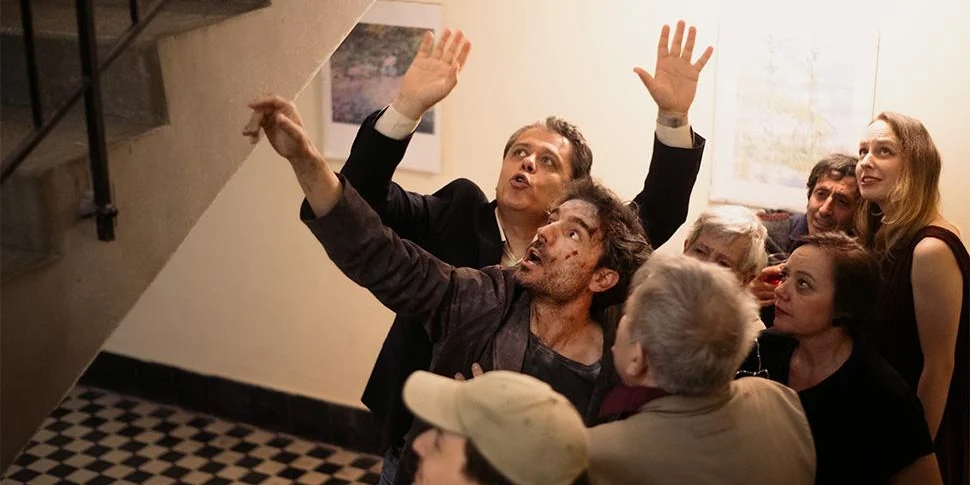
The domestic tension is further complicated by the film’s newly introduced stepfathefigure. Kwon Hae-hyo makes an indelible and memorable entrance when he attempts to greet his new stepdaughter, only to suffer a sudden, jarring face-plant down the porch stairs. Kwon’s physical acting is so precise that the accidental tumble appears entirely authentic, instantly establishing an atmosphere of awkward vulnerability.
This introductory mishap gives way to sharper ideological friction when the mother highlights perceived commonalities between the stepfather and Sang-hee as fellow filmmakers. Sang-hee fiercely rejects the comparison, initiating a debate on the definition and ethics of cinema. She challenges her stepfather’s lifework—a ten-year documentary project centered on grass tombs and human mortality—questioning whether an extended focus on death constitutes valid filmmaking compared to her own micro-shorts, which capture living, blooming phenomena in the wild.
In a surprising narrative pivot, Hong Sang-soo introduces contemporary geopolitics into the domestic debate—a domain the director has historically avoided in his extensive filmography. During her argument against the legitimacy of traditional documentaries, Sang-hee references the ongoing war in Gaza. She posits that competing Israeli and Palestinian documentary projects, designed to champion opposing viewpoints, function primarily as political propaganda rather than objective art. This sudden injection of Middle Eastern geopolitical discourse represents a startling departure for a filmmaker traditionally known for micro-budgeted, intensely localized character studies.
Supporting Players and Counterbalances
Amidst the familial friction, the sole oasis of relative warmth that Sang-hee encounters is Ju-won, the biological daughter of her new stepfather, portrayed by Park Mi-so. Ju-won has recently navigated a period of severe clinical depression, utilizing painting as a therapeutic outlet to construct a sense of personal agency and self-worth previously denied to her.
Recognizing Ju-won as a kindred spirit within the suffocating economic pragmatism of her mother’s household, Sang-hee finds a supportive artistic ally. Nevertheless, Sang-hee’s inherent emotional caution prevents her from fully reciprocating Ju-won’s eager affection, privately noting her complex internal resistance: "I wish I liked her more." Meanwhile, Sang-hee’s brother remains a peripheral presence; despite a game performance by Shin Seok-ho, the character’s narrative arc is left underdeveloped, functioning primarily as a foil for the mother’s preferential treatment.
Stylistic Trademarks and Structural Analysis
True to the signature aesthetic of Hong Sang-soo, Nowhere to Lay My Eyes relies heavily on dialogue-driven sequences. Characters converse during prolonged walks or across dining tables, frequently lubricated by copious amounts of alcohol that dissolve social inhibitions and amplify interpersonal drama.
However, the film diverges from Hong’s typical structural conventions regarding its climax. While the auteur’s previous works customarily favor open-ended conclusions or unresolved ambiguity, Nowhere to Lay My Eyes introduces an element rarely witnessed in Hong’s filmography: tangible hope and calibrated optimism.
Much of this emotional resonance is attributed to the creative synergy between Hong and Kim Min-hee. Whether influenced by their well-documented real-life partnership or purely professional rapport, Kim demonstrates an intuitive grasp of Hong’s worldview. She navigates Sang-hee’s psychological complexity, self-doubt, and guarded resilience with such thoroughness that audiences are compelled to invest in the character’s pursuit of happiness.
Analytical Critique: The Constraint of Compression
Despite its artistic achievements, critics have noted a structural vulnerability stemming directly from its abbreviated 72-minute running time. By packing an extensive array of thematic concerns—ranging from familial estrangement and capitalist pragmatism to artistic medium-specificity and international political propaganda—into a scant hour and twelve minutes, the film occasionally risks narrative compression at the expense of its supporting ensemble.
The necessity to service multiple high-level debates leaves certain characters, notably the brother, underwritten, and denies the central relationships the breathing room required for maximum emotional impact. A marginally extended runtime featuring additional exploratory scenes between Sang-hee and her extended family network could have elevated the project from a dense miniature to a fully realized dramatic canvas.
Broader Implications for Hong Sang-soo’s Filmography
Nowhere to Lay My Eyes stands as a calculated exercise in tonal control by one of contemporary cinema’s most prolific directors. By concluding an intrinsically tense narrative on a note of hard-won optimism that avoids sentimentality or pandering, Hong demonstrates a willingness to subtly recalibrate his stylistic parameters.
Whether this cautious embrace of hope signals a permanent thematic evolution in Hong’s later career remains to be seen. For now, the film serves as a compelling entry point into his recent output—proving that even within the constrained format of a miniature, the director retains an uncompromising ability to provoke intellectual and emotional discourse.