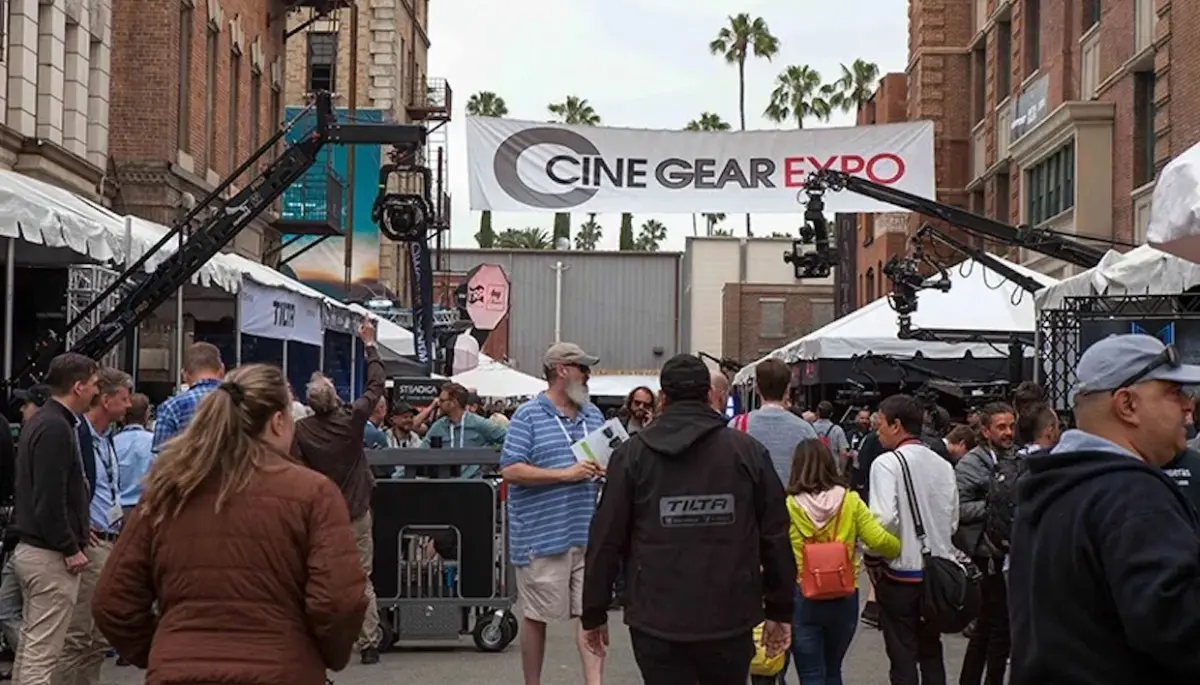
The annual Cine Gear Expo returned to the iconic Universal Studios Lot for a two-day gathering that brought together thousands of cinematographers, gaffers, lighting technicians, and equipment manufacturers from across the global film industry. Unlike broader broadcast and digital video conventions that often spark existential debates regarding cinema’s diminishing market share, Cine Gear maintained a steadfast, optimistic focus on the art and science of filmmaking. Set against the backdrop of a historic Hollywood studio lot, the 2026 edition highlighted a thriving community of industry professionals examining state-of-the-art lighting systems, pioneering optical engineering, and experimental hybrid camera technologies.
Background and Historical Evolution of Cine Gear Expo
Established decades ago as a localized trade show for Southern California camera and lighting professionals, Cine Gear Expo has grown into the premier premier cinematic technology exhibition in North America. While events like the National Association of Broadcasters (NAB) Show in Las Vegas cater to a sprawling ecosystem encompassing broadcast television, streaming infrastructure, and corporate media, Cine Gear remains tightly tethered to the aesthetic and technical demands of narrative motion pictures.
Historically hosted on various Southern California studio grounds—including previous years on the Warner Bros. lot—the event serves as an essential networking and educational hub. It bridges the gap between legendary members of the American Society of Cinematographers (ASC) and the next generation of independent filmmakers, film school graduates, and union-card-carrying studio technicians. The 2026 iteration continued this tradition, though the expansive Universal Studios layout presented logistical challenges, requiring attendees to navigate long shuttle rides between the sun-drenched vendor tents on the backlot and the high-demand seminar stages.
Day One: The Pulse of Independent Filmmaking and Industry Demographics
The opening Friday of Cine Gear 2026 captured a vibrant energy driven largely by independent creators, film students, and early-career freelancers. Conversations across the Universal backlot reflected recent shifts in independent cinema, heavily influenced by breakout successes in micro-budget and genre filmmaking. Attendees circulated through vendor booths inspecting the latest gear, collecting industry swag, and discussing the viability of shooting on film versus digital mediums.
Among the early attendees was filmmaker Alec Moeller, who noted the strong presence of young cinephiles navigating the studio lot. For many independent practitioners attending without corporate backing or studio mandates, the expo functions as an ethnographic study of the tools shaping modern visual storytelling. While Friday’s crowd skewed toward film school undergraduates and freelance personnel, organizers anticipated the traditional influx of union gaffers, camera operators, and studio executives for the weekend sessions.
Masterclasses and Insights from the American Society of Cinematographers
The second day commenced with the signature American Society of Cinematographers (ASC) panel, a marquee event featuring fifteen prominent members of the organization. The panel opened with a comprehensive montage celebrating more than a century of artistry by ASC cinematographers, highlighting landmark works such as John Toll’s Oscar-nominated cinematography on The Thin Red Line (1998).
Given the sheer size of the panel, individual speaking windows were concise, yet the participating cinematographers delivered profound insights into their creative processes. Steven Fierberg emphasized the importance of "body consciousness" on set, noting how physical intuition often dictates camera placement. Meanwhile, Natasha Braier discussed how her upbringing under a military dictatorship in Argentina and her background with psychoanalyst parents informed her attraction to subtext, psychological framing, and the unconscious mind.
Advancements in LED Lighting and Control Systems
On the exhibition floor, lighting technicians and rental house operators focused heavily on the rapid evolution of solid-state illumination. Drew Moe and Jeffrey Taylor, Local 728 gaffers and co-founders of the boutique rental house Canary Yellow, surveyed Stage 17 to evaluate new products for their inventory.
Moe noted that the technological timeline of Hollywood lighting has accelerated dramatically in recent years. While the industry relied on tungsten, HMI, and fluorescent fixtures for the better part of a century, LED technology now undergoes annual iterations featuring new chipsets and color engines. Moe highlighted Aputure’s continued development of advanced color engines, such as the proprietary Blair CG technology, as a significant step forward for on-set color fidelity.
Integration of hardware and software was further demonstrated at the Blackout Lighting Console booth, where Ian Peterson previewed V3, the latest iteration of their lighting control software. Designed to transition lighting commands from traditional numerical values to intuitive visual control interfaces, the update leverages iPad integration to streamline complex lighting cues. Industry analysts note that advancements of this scale could redefine on-set efficiency for gaffers managing increasingly intricate LED arrays.
Innovations in Optical Engineering: Vintage Rehousing and Anamorphic Glass
The market for specialized cinema optics experienced robust representation at Cine Gear 2026, marked by significant breakthroughs in both vintage lens restoration and modern anamorphic design.
Zero Optik, a prominent lens rehousing firm, showcased its ongoing preservation of historical photographic glass. Operations manager Alex Baxter explained that photography lenses from the 1930s through the 1980s—once abandoned in basements and attics because their mechanical designs were incompatible with traditional mirror-shutter film cameras—have found a lucrative second life in digital cinema. Zero Optik’s restoration work includes rare Bausch & Long Ultra Baltar lenses utilized by cinematographer Ed Lachman on films such as El Conde (2023) and Maria (2024). Furthermore, the company detailed its collaboration with the ASC to restore a rare set of 1950s Todd-AO 65mm prime lenses initially used on classic Hollywood productions like Oklahoma! (1955) and The Sound of Music (1965). Restored in partnership with cinematographer Greig Fraser, these exclusive optics are now available for rental through Keslow Camera.
Concurrently, Atlas Lens Co. co-founder Dan Kanes discussed the trajectory of his company, which emerged from his previous work developing wireless HD video transmission systems. Channeling resources into anamorphic optics rather than commercial luxuries, Atlas introduced three distinct product lines: Orion, Mercury, and the newly launched Kaizen series. Kanes highlighted that the flagship Orion series departs from traditional vintage anamorphic lenses by minimizing high field curvature. This engineering choice allows cinematographers to capture wide multi-subject frames without experiencing significant edge-to-edge focus drop-off. The Kaizen series, designed specifically for large-sensor digital cameras such as the Arri Alexa 265, Fujifilm GFX Eterna 55, and Blackmagic Design Ursa Cine 17K, began shipping following its initial preview at the NAB Show.
Pioneering the First Hybrid Film and Digital Camera
Perhaps the most disruptive hardware development on display was a prototype from Cinelux Cinema Tools. Chief engineer Caz Voorhees introduced the Cinelux Sixteen, a 16mm motion picture camera designed to bridge the gap between traditional celluloid workflows and modern digital efficiency.
Developed over a two-and-a-half-year period by a small engineering team, the Cinelux Sixteen is engineered to record physical film and digital video simultaneously. The camera captures digital proxies to an SD card at 3.2K resolution, complete with an applied film-emulation LUT to closely mirror the physical footage. This dual-capture capability is intended to alleviate producer hesitation regarding celluloid shooting budgets while drastically accelerating the delivery of dailies.
Technical challenges for the project centered primarily on the complex mechanics of the internal film magazine. Voorhees noted that managing zero-friction film transport within an extremely tight spatial footprint required extensive prototyping. To foster industry adoption and community resilience, the engineering team announced plans to open-source the magazine schematics, allowing users to 3D-print replacement parts if necessary. While the third prototype drew significant crowds at the CSLA rental house booth, Voorhees estimated that the camera requires two additional developmental iterations before a commercial release targeted for mid-2027.
Educational Panels and Community Implications
Cine Gear 2026 concluded with specialized educational seminars, including a detailed technical breakdown by cinematographer M. David Mullen, hosted by Red Digital Cinema. Mullen walked audiences through the intricate blocking and multi-camera choreography of complex tracking shots from television productions such as The Marvelous Mrs. Maisel (2019), demonstrating the pedagogical value that underpins the expo’s mission.
The event officially adjourned with the annual ASC Clubhouse barbecue in Hollywood. Gathering industry veterans, rising independent directors, rental house executives, and union technicians over a traditional spread of barbecue and networking, the closing reception underscored the enduring sense of community that sustains the motion picture industry through technological transitions and economic shifts.