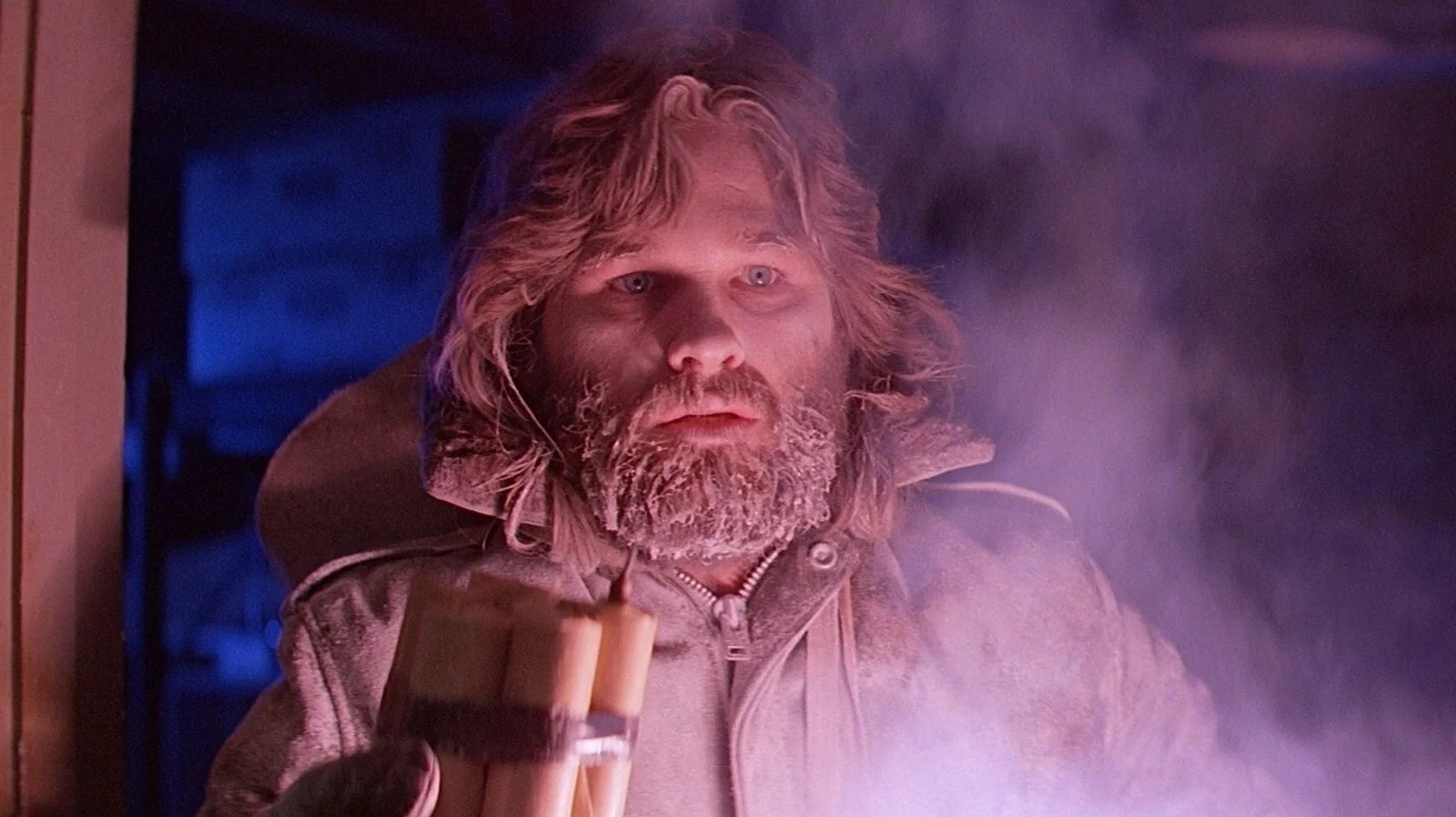
For over four decades, the final moments of John Carpenter’s 1982 science-fiction horror masterpiece, The Thing, have served as one of the most debated sequences in cinematic history. The film concludes with R.J. MacReady, portrayed by Kurt Russell, and Childs, played by Keith David, sitting amidst the smoldering ruins of their Antarctic research station. As the base burns around them, the two men share a bottle of J&B scotch, waiting for the inevitable onset of hypothermia or the manifestation of the extraterrestrial parasite that has decimated their team. Despite 44 years of forensic-level analysis by fans, film scholars, and critics, the true nature of that final scene remains a mystery—at least, according to the director himself.
The Director’s Recent Clarification
In a recent interview with Reece Feldman for the Academy of Motion Picture Arts and Sciences, John Carpenter addressed the enduring speculation surrounding the finale. While the discourse has typically centered on visual cues—such as the presence or absence of breath, the reflective light in the characters’ eyes, or the subtle movements of the actors—Carpenter dismissed these prevailing theories as incorrect.
“Every idea people have is not the right one. I know the right one,” Carpenter stated during the discussion. When pressed on whether anyone in the public sphere had successfully deciphered the sequence, he remained firm: “It’s right in the movie too. There is a big clue. No one has guessed it.” This assertion complicates a narrative that has been scrutinized through frame-by-frame analysis and even digital color-correction tests for decades.
A Chronology of Speculation
The history of The Thing’s ending is a timeline of evolving audience engagement. Upon its release on June 25, 1982, the film was a critical and commercial failure, largely overshadowed by the family-friendly optimism of Steven Spielberg’s E.T. the Extra-Terrestrial. Critics at the time, such as Roger Ebert, were initially divided, with many failing to appreciate the nihilistic tone of the finale.
However, as the film found a massive cult following through home video and cable television in the mid-1980s, the "What happens at the end?" question became a foundational pillar of horror fandom. By the 2000s, with the advent of high-definition home media, the debate shifted to the technical level.
- The "Breath" Theory: Fans noted that in the freezing Antarctic air, characters typically exhale visible vapor. In the final scene, some viewers argue that Childs does not produce a breath cloud, implying he is a synthetic imitation of the Thing, which may not require the same respiratory functions.
- The "Eye-Light" Theory: Another popular hypothesis suggests that the "human" characters possess a distinct glint in their eyes, caused by the reflection of light. Enthusiasts have attempted to compare the reflection in the eyes of MacReady and Childs to earlier scenes where characters are confirmed as human.
- The "Gasoline" Theory: This theory posits that the bottle MacReady hands to Childs contains gasoline rather than scotch. If Childs drinks it without reacting to the chemical burn, he must be the creature. Carpenter has famously ignored or debunked these theories in various forums over the years, noting that the production environment—often filmed on soundstages—did not account for the meticulous physics fans now attribute to the scenes.
Production Context and Creative Intent
To understand the ambiguity, one must look at the production environment of 1982. Screenwriter Bill Lancaster and producer Stuart Cohen have previously weighed in on the intent behind the script. In his written account of the production, Cohen noted that Lancaster’s original draft assumed both characters were human, merely waiting for the cold to take them.

Carpenter, however, has provided a more nuanced perspective on the thematic weight of the scene. In a 2014 interview with Creative Screenwriting, he described the ending as an act of existential heroism. "I thought that was the ultimate heroic act, but audiences didn’t see it that way," he remarked. The director’s vision was not necessarily to create a "whodunit" puzzle, but to portray a scenario where the characters choose to die as human beings rather than surrender to the encroaching threat. By sacrificing themselves to ensure the creature does not escape to the mainland, they achieve a grim, silent victory, regardless of their individual status as human or host.
Fact-Based Analysis of the Narrative Implications
The ambiguity serves as a narrative device that effectively cements the film’s legacy. By refusing to provide a definitive "winner," the ending forces the audience to confront the paranoia that defined the characters’ journey. The psychological toll of the film is rooted in the erosion of trust—the idea that the person sitting next to you, even a long-time colleague, could be a hostile entity.
From a structural standpoint, if the film provided a definitive answer, the impact of the final scene would be diminished. The terror of The Thing is not merely the creature itself, but the uncertainty of identity. Whether MacReady or Childs is the "Thing" is secondary to the fact that they have reached a state of total isolation where truth is no longer verifiable.
Broader Impact on the Horror Genre
The longevity of this debate has had significant implications for the horror genre. The Thing is frequently cited as a pinnacle of practical effects and suspense-building. The fact that the director can still stir global discussion after 44 years speaks to the film’s status as a foundational text in science fiction.
The film’s reception has also mirrored the evolution of film criticism. Initially dismissed as a "gory" spectacle, it is now studied for its masterclass in pacing, character development, and bleak atmospheric tension. Carpenter’s latest comments serve as a reminder that even when a film is considered "solved" by the internet, the creator’s original vision may remain entirely separate from the consensus reached by the audience.
As it stands, the community of fans remains undeterred. Carpenter’s confirmation that a "big clue" exists within the film suggests that, despite four decades of intense observation, the secret remains hidden in plain sight. Whether it involves a subtle background detail, a line of dialogue, or an intentional visual inconsistency, the enigma of MacReady and Childs continues to drive engagement, ensuring that The Thing remains as relevant today as it was in 1982. For now, the world waits for the day a viewer identifies the specific detail that has eluded them for nearly half a century.