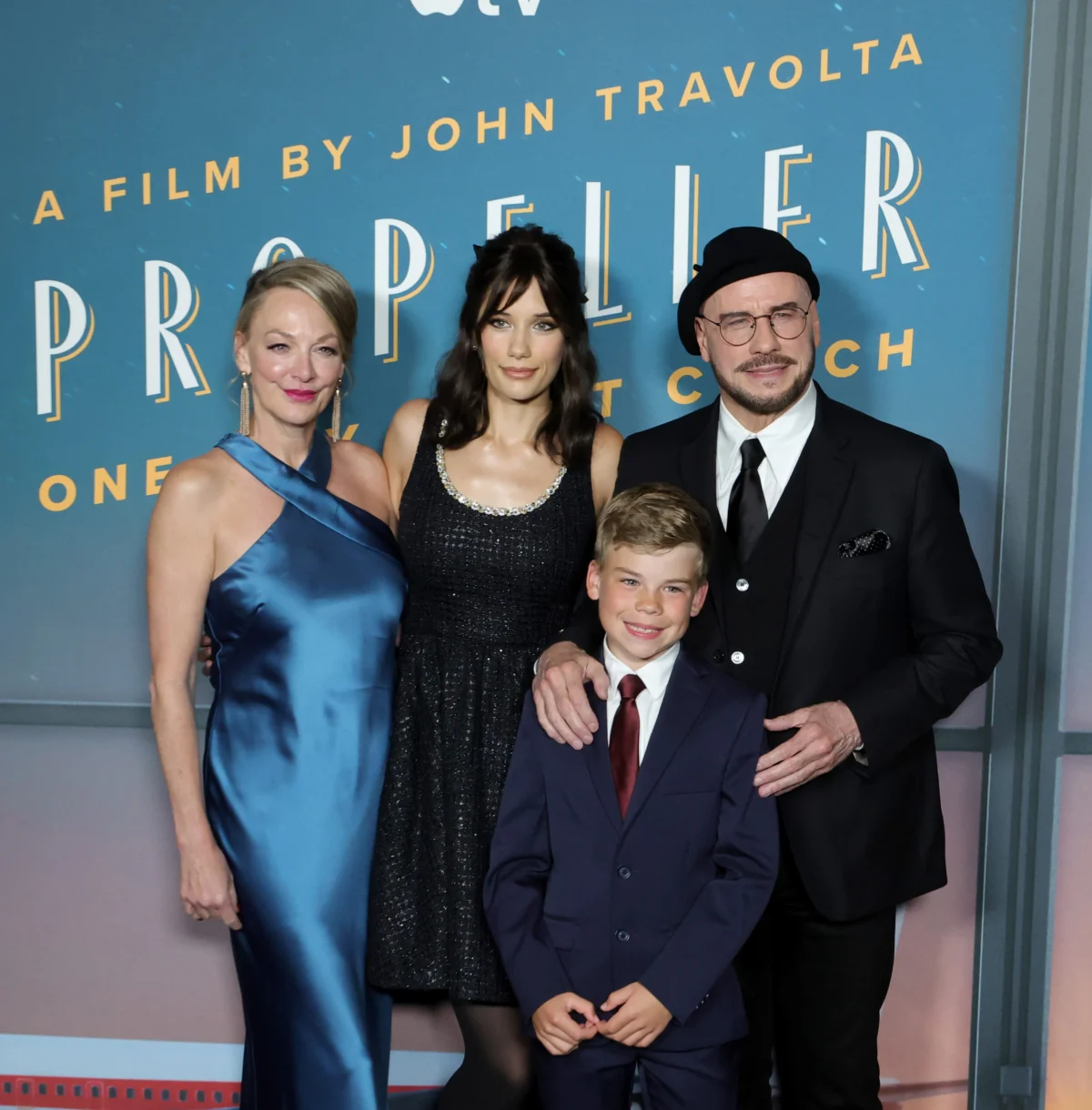
After a prolific career spanning over five decades, establishing him as an iconic figure in cinematic history, John Travolta has ventured behind the camera for his latest project, Propeller One-Way Night Coach. This hour-long film marks Travolta’s directorial debut, bringing to life an adaptation of his own 1997 children’s novel of the same name. The movie, which recently celebrated its Los Angeles premiere, is a deeply personal endeavor for the actor, intertwining his profound passion for aviation with his vast experience gleaned from working alongside some of the industry’s most revered filmmakers.
The Genesis of a Lifelong Passion Project
Travolta’s connection to aviation is not merely a hobby but a fundamental aspect of his identity. A licensed pilot since the age of 22, he has owned multiple aircraft, including a Boeing 707, and famously designed his Florida home to include two runways and a taxiway directly to his front door. This lifelong fascination with flight served as the direct inspiration for his 1997 children’s novel, Propeller One-Way Night Coach. The book, a whimsical tale of a young boy’s dreams of flight, has now found its visual form under Travolta’s guidance.
The journey of bringing Propeller One-Way Night Coach to the screen has been a protracted one, spanning many years during which various producers and directors expressed interest. However, Travolta ultimately felt compelled to take the reins himself. "Only I can connect these dots the way it should be connected," he asserted, emphasizing the deeply personal nature of the narrative, which is rooted in his own flying experiences and dreams. This conviction underscores a common thread among artists who transition to directing: a singular vision and an unwavering belief that they are uniquely positioned to translate their story authentically to the screen. For Travolta, this wasn’t just another film project; it was the culmination of a personal odyssey, marrying his two great loves – cinema and aviation – into a cohesive artistic statement.
A Directorial Debut Forged in Observation
Travolta’s approach to directing was not impulsive but rather a meticulously distilled culmination of five decades spent on film sets. Speaking at the L.A. premiere, he revealed his systematic method: "I feel that in the 50-plus years I’ve watched directors, I’ve watched great ones, I’ve watched good ones, I’ve watched OK ones, I’ve watched mediocre ones and I’ve watched bad ones, and you sift out what they did right, what they did wrong." This observational learning process allowed him to create a directorial philosophy based purely on successful actions. He meticulously absorbed the techniques of filmmaking titans, citing an impressive roster of influences: Robert Altman, Mike Nichols, Quentin Tarantino, Tony Scott, John Woo, and Brian De Palma.
Each of these directors represents a distinct school of cinematic thought, and Travolta’s ability to draw from such diverse talents speaks volumes about his discerning eye. From Robert Altman, known for his sprawling ensemble casts, naturalistic dialogue, and often improvised scenes, Travolta might have absorbed lessons in creating an organic, lived-in feel, particularly important for a children’s story focusing on human connection. Mike Nichols, celebrated for his sharp character studies, psychological depth, and incisive wit in films like The Graduate and Who’s Afraid of Virginia Woolf?, could have offered insights into guiding performances and crafting poignant emotional beats for the young protagonist and his mother.
Quentin Tarantino, a master of stylized dialogue, non-linear narratives, and bold visual storytelling, while seemingly an unconventional influence for a children’s film, might have inspired Travolta in areas of pacing, dynamic scene construction, or infusing distinct personality into every frame. Tony Scott, with his signature kinetic energy, sleek visuals, and mastery of action sequences, especially in aviation-themed films like Top Gun, would have provided invaluable lessons in capturing the thrill and grandeur of flight. John Woo, known for his balletic action, slow-motion artistry, and themes of loyalty and heroism, could have contributed to the film’s visual poetry or its underlying sense of adventure. Finally, Brian De Palma, a director celebrated for his elaborate set pieces, suspenseful narratives, and homage to Hitchcockian visual language, might have informed Travolta’s staging and ability to build anticipation and wonder within the film’s aerial journey.
Travolta humorously summarized his extensive apprenticeship: "It’s funny because you let them do all the work for 50 years and you go, ‘OK, this works, that works, that works, that doesn’t work, that doesn’t work,’ and then you put it in a totality, and then finally you go, ‘That’s how you direct a movie, that’s what should be done.’" This pragmatic, experience-driven approach allowed him to confidently step into the director’s chair, armed with a comprehensive understanding of what makes a successful cinematic endeavor. Further validating his efforts, Travolta revealed that he "showed an early cut to a very famous person who’s also director and they gave me one note, which was excellent," though he politely declined to identify this esteemed colleague. This anecdote reinforces the idea that Travolta’s transition into directing was not a whimsical experiment but a seriously undertaken craft.
The Narrative and Its Heart: A Cross-Country Flight
Propeller One-Way Night Coach centers on a young aviation enthusiast and his mother as they embark on a transformative cross-country flight to Hollywood. The film’s plot, while seemingly simple, carries the weight of a personal journey, both literal and metaphorical. Travolta not only directed but also served as the film’s narrator, lending his distinctive voice to guide audiences through the story. He also makes a brief on-camera appearance, further cementing his omnipresent involvement in the project.

The casting reflects the personal nature of the film. Newcomer Clark Shotwell takes on the pivotal role of the young boy, bringing a fresh innocence to the screen. Kelly Eviston-Quinnett portrays his mother, grounding the fantastical journey with a relatable human element. In a delightful family affair, Travolta’s daughter, Ella Bleu Travolta, plays a flight attendant aboard the plane. Her involvement adds another layer of intimacy to the production, echoing Travolta’s desire to keep the project close to home.
Ella Bleu Travolta offered insights into her father’s directing style, praising his clarity and efficiency on set. She noted that he brought "excitement and confidence to the set," and "knew exactly what he was looking for for all of these performances so he knew exactly what to ask for." Her observation that "he’d never do more than two or three takes, he knew exactly when he had it" speaks to a director with a clear vision and decisive execution, a testament to his years of careful observation. This efficiency suggests a director who understands the rhythm of a set and respects the time and talent of his cast and crew, a quality often admired in veteran filmmakers.
Beyond his daughter, the production became an even larger family affair, with all five of Travolta’s siblings also making appearances in the movie. Ella described this as "the coolest thing ever," drawing a parallel to their family’s informal theatrical traditions: "we do plays and shows at home all the time, so now we’re just doing it in a different setting." This element of familial collaboration underscores the film’s origins as a passion project, a labor of love shared among those closest to the director, lending an authentic warmth to the production that might be difficult to replicate in a more conventional Hollywood setting.
A Prestigious Premiere and Industry Context
The journey of Propeller One-Way Night Coach included a prestigious international debut at the Cannes Film Festival. While the film itself was not in competition, Travolta received a surprise Honorary Palme d’Or at the festival. This significant recognition, presented by the festival for a lifetime of achievement in cinema, resonated deeply with Travolta, arriving as he unveiled a new facet of his artistic capabilities. The timing of the award, coinciding with his directorial debut, highlighted his enduring impact on the film industry and underscored the respect he commands among his peers. The Cannes premiere and subsequent L.A. event, where Travolta engaged with The Hollywood Reporter, served as crucial platforms to introduce his new role to both critics and the public.
Travolta’s transition from an actor of immense stature to a director is a path trodden by many before him, with varying degrees of success. Historically, Hollywood has seen numerous actors successfully make the leap, from Clint Eastwood, whose directorial prowess has earned him multiple Academy Awards, to Ben Affleck, Jodie Foster, and more recently, Greta Gerwig, whose directorial ventures have garnered critical acclaim and commercial success. These examples demonstrate that a deep understanding of performance and narrative, cultivated over years in front of the camera, can be a powerful asset behind it. Travolta’s decision to adapt his own work, rooted in a personal passion, aligns him with those who seek to tell stories that resonate deeply with their own experiences, rather than merely seeking a new career avenue. This self-funded, independently produced approach differentiates it from many large-scale studio productions.
Themes of Optimism and Future Horizons
At its core, Propeller One-Way Night Coach is imbued with a message of enduring optimism. Travolta articulated this theme, noting that the movie is about always having "something to look forward to and see the world glass half-full, not half-empty." This philosophy, he revealed, is a personal creed: "that’s how I view life. I still view life that way." This thematic resonance elevates the film beyond a simple children’s story, positioning it as a reflection of Travolta’s own positive outlook and his continuous search for new experiences and challenges. The film becomes a vehicle for sharing a deeply held belief, encouraging audiences, particularly younger ones, to embrace hope and maintain a forward-looking perspective.
Looking ahead, Travolta has been candid about the possibility of his directing experience being a singular event. Having meticulously brought his passion project to fruition, he expressed a sense of fulfillment, indicating that he might not actively seek further directorial roles. "So, I’m ready for life to invite me to do something that I might find more interesting than things I’ve done in the past," he concluded. This statement suggests an artist driven by genuine inspiration rather than a strategic career pivot. It implies that while he has successfully conquered this new artistic frontier, his future endeavors will continue to be guided by curiosity and the pursuit of compelling new challenges, whether in front of or behind the camera. This perspective adds to the narrative of Propeller One-Way Night Coach as a deeply personal, almost cathartic, creative expression rather than the launch of a new professional chapter.
Accessibility and Legacy
In a nod to modern distribution trends, Propeller One-Way Night Coach is now available for streaming on Apple TV. This choice ensures widespread accessibility for audiences worldwide, allowing Travolta’s deeply personal story to reach a broad demographic, from families with young children to long-time fans eager to witness his directorial vision. The move to a major streaming platform highlights the evolving landscape of film distribution, where personal projects can bypass traditional theatrical releases to find their audience directly.
John Travolta’s career has been marked by remarkable versatility and an enduring presence in popular culture, from the disco-era sensation of Saturday Night Fever and Grease to his career resurgence with Pulp Fiction, and iconic roles in action films like Face/Off. Now, with Propeller One-Way Night Coach, he adds another significant dimension to his legacy. This directorial debut is not merely an actor trying his hand at a new craft; it is the culmination of a lifelong passion, a testament to decades of careful observation, and a deeply personal sharing of his optimistic philosophy through the universal language of film. It is a cinematic journey that truly takes flight, guided by the seasoned hand of an enduring Hollywood icon.