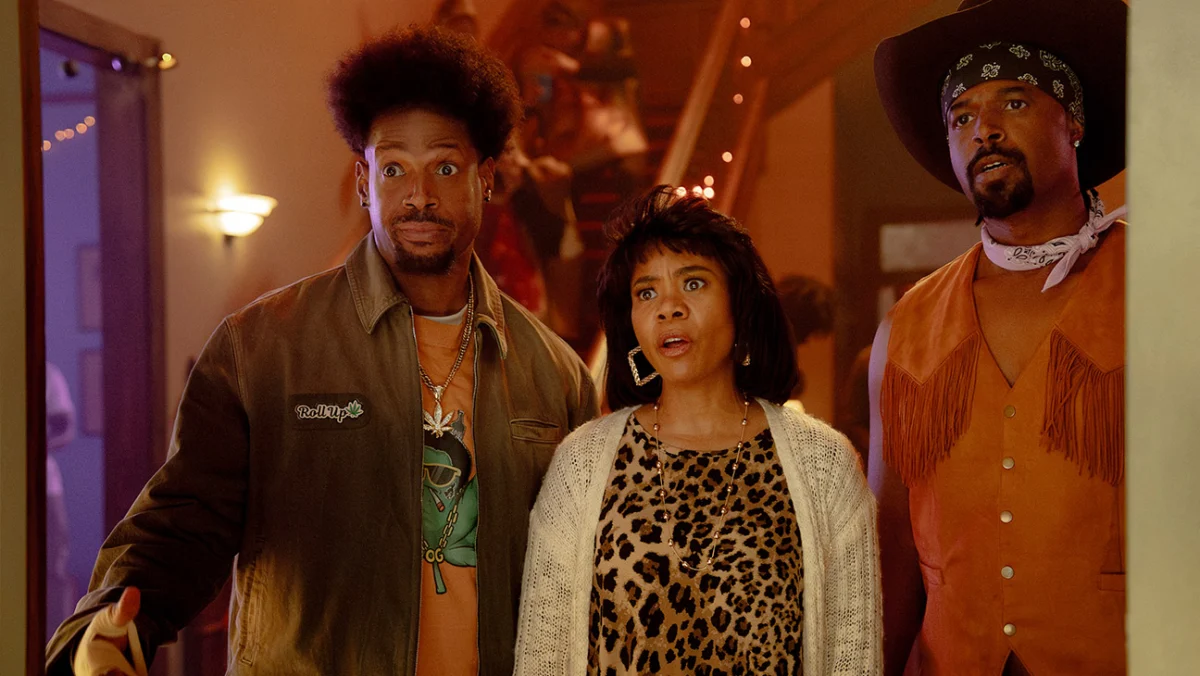
Paul Michael Glaser, the seasoned director behind Shaquille O’Neal’s 1996 musical comedy Kazaam, has offered a candid response to the recent Scary Movie reboot’s satirical jab at his film. The new Paramount comedy, which swiftly climbed to the top of the box office charts following its June 5 debut, features a pivotal moment where O’Neal is revealed as the iconic Ghostface killer. The scene culminates in a humorous yet brutal takedown of the NBA legend, with franchise stalwart Shorty Meeks, portrayed by producer and co-writer Marlon Wayans, quipping, "But I never got over Kazaam," before dispatching O’Neal for his role as a rapping genie in the Disney production that notoriously underperformed nearly three decades ago.
The Punchline Unveiled: Scary Movie‘s Satirical Return
The latest installment in the Scary Movie franchise continues its tradition of lampooning popular culture, with Kazaam serving as a prime target. In a memorable cameo, Shaquille O’Neal, initially disguised as Ghostface, is unmasked, only for Shorty Meeks to impersonate him as a mumbling NBA commentator. The punchline, delivered with characteristic Wayans’ comedic timing, directly references O’Neal’s much-maligned turn as a magical being. This self-aware humor underscores the franchise’s enduring appeal, which lies in its ability to tap into collective cinematic memories, both celebrated and infamous.
Glaser, speaking to The Hollywood Reporter, admitted he was entirely unaware of the forthcoming joke. "I had no clue," he stated, adding diplomatically, "It’s nice that something you worked on has some resonance." This initial reaction reflects a professional detachment, acknowledging that any cultural imprint, even one derived from mockery, signifies a degree of lasting impact. However, upon hearing a detailed description of the scene, the director, also widely recognized for his acting as Detective Dave Starsky in the iconic series Starsky & Hutch, confessed to having "mixed feelings." With a chuckle, he quipped, "It sounds to me that when they said, ‘I never got over Kazaam,’ and they killed him, that’s because Kazaam was such a terrible movie." His candor, tinged with self-deprecating humor, reveals an awareness of his film’s critical reception and its subsequent status in pop culture.
The Enduring (and Endured) Legacy of Kazaam
Kazaam, released in 1996, centered on a 12-year-old boy who discovers a magical genie (Shaquille O’Neal) trapped in a boombox. The film, a blend of fantasy, comedy, and musical elements, aimed to capitalize on O’Neal’s burgeoning popularity beyond the basketball court. However, its ambitions far outstripped its execution and critical reception. Produced on an estimated budget of $20 million, Kazaam grossed a meager $18.9 million worldwide, firmly cementing its status as a box office flop.
Critically, the film fared even worse. Review aggregators like Rotten Tomatoes show an abysmal approval rating, with critics universally panning its simplistic plot, lackluster performances, and often jarring musical numbers. Common criticisms highlighted the film’s clichéd narrative, its reliance on O’Neal’s celebrity rather than genuine storytelling, and its perceived inability to connect with either its target child audience or adult viewers. This widespread critical panning contributed significantly to Kazaam‘s reputation as one of the most infamously bad films of the 1990s, a distinction that has paradoxically granted it a peculiar form of cult status, often discussed in "so bad it’s good" contexts or as a nostalgic curiosity.
Shaquille O’Neal’s Hollywood Foray: A Mid-90s Phenomenon
The mid-1990s marked a unique period for Shaquille O’Neal, who was then one of the most dominant and charismatic figures in the NBA. Beyond his athletic prowess, Shaq cultivated a vibrant public persona that extended into music and acting. His rap career, which began in 1993 with the platinum-selling album Shaq Diesel, saw him release several more albums, including Shaq Fu: Da Return (1994) and You Can’t Stop the Reign (1996), the latter coinciding with Kazaam‘s release. His musical ventures, though critically mixed, were commercially successful and showcased his broader entertainment ambitions.
Kazaam was not O’Neal’s first foray into acting; he had previously starred in the 1994 basketball drama Blue Chips alongside Nick Nolte, a film that received a warmer critical reception. Following Kazaam, he also starred in the ill-fated superhero film Steel (1997), which similarly struggled at the box office and with critics. These attempts to parlay his immense sports celebrity into a successful acting career largely failed to yield critical acclaim, though his undeniable screen presence and larger-than-life personality made him a memorable, if not always effective, leading man. The Scary Movie joke about Kazaam specifically targets this period of O’Neal’s career, highlighting a moment when his off-court ventures were met with more skepticism than his on-court dominance.

Paul Michael Glaser: A Diverse Career Beyond the Genie Bottle
Paul Michael Glaser’s directorial and acting career is far more extensive and varied than his association with Kazaam might suggest. Before stepping behind the camera for the rapping genie film, Glaser had already established himself as a versatile talent. His most iconic role remains Detective Dave Starsky in the groundbreaking 1970s television series Starsky & Hutch, a performance that cemented his place in pop culture history.
As a director, Glaser demonstrated his range with several notable projects. He helmed the 1987 dystopian action film The Running Man, starring Arnold Schwarzenegger, which became a cult classic and explored themes of media manipulation and reality television long before they became mainstream concerns. He also directed the beloved 1992 ice skating romantic comedy The Cutting Edge, a critical and commercial success that remains a fan favorite. These directorial achievements underscore that Kazaam was an outlier in a career marked by more successful and well-regarded projects, adding a layer of ironic detachment to his reaction to the Scary Movie jab.
The Genesis of Kazaam: A Flipped Comment Turns into a Feature Film
The origins of Kazaam are as whimsical as the film’s premise itself. Glaser recounted how a casual conversation led to the project. A family friend, working on O’Neal’s management team, extended an invitation for Glaser and his son to attend the NBA All-Star Game. During the call, a seemingly innocuous question arose: "Do you know of any good film roles for Shaq before he goes back to basketball camp at the end of the summer?" Glaser’s initial response was a quick, almost flippant suggestion: "I said, ‘No, he ought to play a genie,’ and I hung up the phone."
However, the idea began to percolate. "The more Glaser mulled it over, the more he saw genuine potential in the concept. He envisioned a narrative about "a genie who lost his power, and [through] experiencing the caring and love of a good friendship, he rediscovers his power." He remains steadfast in his belief in the core concept, stating, "I still believe that was a really good idea." Yet, he candidly acknowledges the film’s shortcomings in execution: "I don’t think we executed it as well as we could have." This self-critique offers valuable insight into the filmmaking process and the challenges of translating a promising concept into a compelling final product. The decision to make the genie a rapper was a direct nod to O’Neal’s then-active hip-hop career. "At the time, Shaq fancied himself a rap musician, so I wrote it as a rap musical," Glaser explained, also noting O’Neal’s amiable demeanor on set: "But he was a lovely guy and great to work with."
Parody’s Power: Nostalgia, Reintroduction, and Lingering Resonance
Glaser’s diplomatic acceptance of the Scary Movie joke highlights the peculiar longevity of cultural artifacts, regardless of their initial reception. While Kazaam may not have achieved critical acclaim, its very notoriety has ensured its place in cinematic discourse. The Scary Movie franchise, known for its irreverent and often brutal humor, thrives on targeting films that have either achieved massive commercial success or, conversely, have become memorable for their perceived lack of quality. Kazaam falls squarely into the latter category, making it a perfect candidate for parody.
The director even mused about the potential for the joke to spark renewed interest in his film. When asked if younger viewers might be prompted to seek out Kazaam, he responded, "Who knows? It might jog a few memories." This observation points to the cyclical nature of pop culture, where old references can be recontextualized and introduced to new generations through satire. In an era dominated by reboots, revivals, and nostalgic callbacks, films like Kazaam, once relegated to the dustbin of cinematic history, can find new life as ironic touchstones or even objects of curious rediscovery. The Scary Movie reboot, by referencing a film from nearly three decades ago, effectively bridges generational gaps, inviting both those who remember Kazaam‘s original release and those encountering its legacy for the first time to share in the humor.
Ultimately, the Scary Movie joke serves as a testament to Kazaam‘s unexpected, if unconventional, cultural endurance. It underscores that even films widely considered failures can attain a unique form of immortality through collective memory, comedic reinterpretation, and the diplomatic, good-humored acceptance of those who brought them to life. Paul Michael Glaser’s reaction encapsulates this phenomenon, offering a blend of professional pride in his work’s "resonance" and a candid acknowledgment of its comedic legacy.