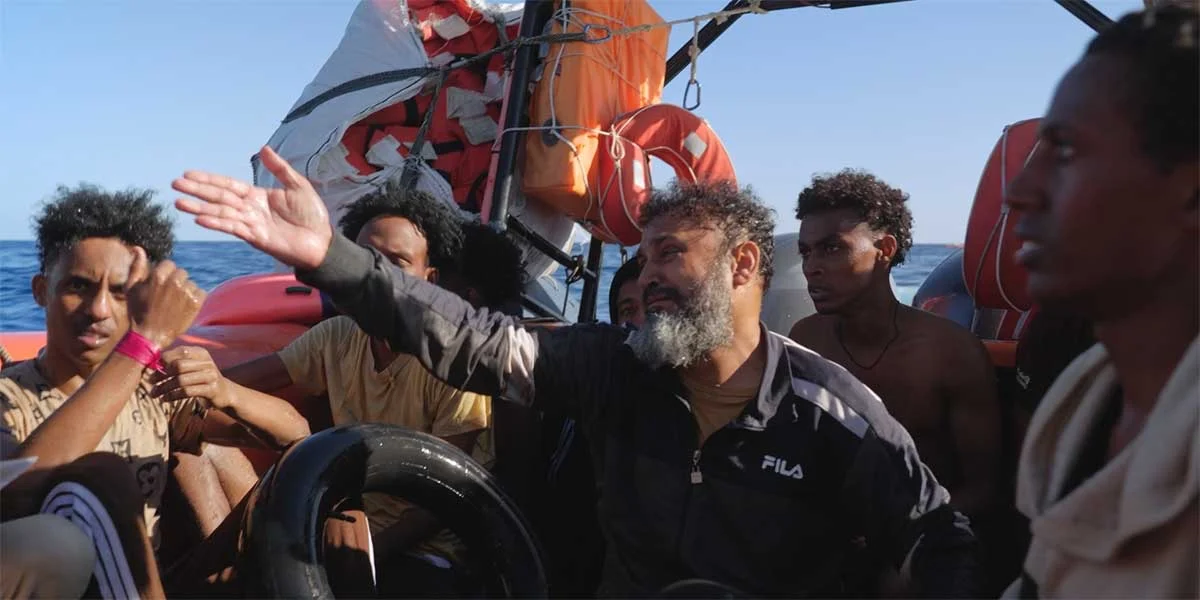
Amid the dark, restless swells of the Mediterranean Sea off the coast of Libya, inflatable rubber boats and wooden fishing vessels routinely bob against the horizon, carrying desperate migrants seeking refuge and economic opportunity in Europe. These watercraft exist in a perpetual state of liminality, suspended between the profound hardships of the African and Middle Eastern continents they have fled and the uncertain, heavily policed borders of the European Union. Sine Plambech’s feature-length documentary, Rescue, plunges directly into this geopolitical and humanitarian flashpoint. With a runtime of 90 minutes, the film examines the modern migration crisis through an unsparing lens, highlighting the devastating mechanics of European containment policies, the operational challenges faced by humanitarian NGOs, and, most crucially, the shattered lives of a single Yemeni family torn apart by the very systems designed to manage human movement.
The central narrative follows Hani Ghaleb Othman Al-Shehab, his wife Rawa Mohammed Hazaea Ahmed Qasem, and their young child, Nejma. Their story encapsulates the agonizing micro-level realities of a macro-level crisis dictated by international pacts, naval blockdowns, and systemic exploitation. Plambech, an acclaimed filmmaker and anthropologist, utilizes her academic background to ensure the documentary avoids superficial tropes or generalizations, anchoring complex socio-political phenomena in the raw, unfiltered experiences of her subjects.
The Anatomy of a Broken Crossing: Chronology and Operational Realities
The maritime route across the central Mediterranean remains one of the deadliest migration corridors in the world. The journey begins long before families board unseaworthy vessels in Libya, often stemming from protracted conflicts, such as the devastating civil war in Yemen that has displaced millions since 2014. Driven by the absence of viable local futures, families pay exorbitant sums to smugglers to secure passage north toward Italian ports of entry.
However, the maritime landscape these voyagers encounter is heavily militarized and legally fraught. Under controversial European Union agreements—notably financial and logistical support provided to the Libyan Coast Guard—North African patrol vessels actively intercept migrant boats in international waters. Rather than being rescued to safety in Europe, intercepted individuals are routinely towed back to Libya, where human rights organizations have extensively documented systemic abuses, including arbitrary detention, torture, extortion, and sexual violence.
Contesting this containment strategy are humanitarian search-and-rescue organizations. Ships like the Geo Barents, operated by Doctors Without Borders (Médecins Sans Frontières, or MSF), patrol these perilous waters to pull drowning individuals from the sea. Rescue captures a tense, high-stakes operational dynamic in which humanitarian crews must navigate strict protocols dictated by European maritime authorities and hostile state actors. In one pivotal sequence, the crew of the Geo Barents defies direct operational instructions to execute an unauthorized third rescue mission, plucking desperate men from the sea at the risk of jeopardizing future authorizations and alienating state cooperation. This moral dilemma—choosing between immediate life-saving interventions and long-term operational sustainability—illustrates the impossible compromises forced upon humanitarian workers operating within a fractured legal framework.
Family Separation at Sea: The Ordeal of Hani and Rawa
The human cost of these intersecting forces is starkly demonstrated when the Geo Barents intercepts Hani and his family. During the chaotic rescue operation, standard maritime protocols and Libyan interception tactics frequently result in the forced separation of families. Men are often separated from women and children during transfer operations, driven by divergent paths of processing and detention.
Hani boards the MSF rescue vessel alone, enduring a state of psychological agony as he searches frantically for Rawa and Nejma. In the documentary, his initial despair is fueled by a total lack of information regarding their whereabouts—a common reality for families fractured during Mediterranean crossings. When he eventually learns that Rawa and Nejma have been intercepted and pulled southward into the Libyan detention apparatus, the psychological toll deepens.
Determined to reunite his family, Hani embarks on an arduous secondary migration overland and through legal loopholes after reaching European soil. Describing his strategy to evade suspicion—such as shaving his beard to counter anti-migrant profiling ("we look like terrorists," he observes)—he utilizes illicit methods, including communication smuggled via a diaper, to maintain contact with his wife. He navigates refugee camps and evades authorities to reach Germany, drawn by its comparatively robust asylum framework.
Meanwhile, Rawa endures an infinitely harsher reality inside North African detention infrastructure. The film exposes the deeply entrenched vulnerabilities faced by women and children in these environments, where the lack of institutional protection leaves them highly susceptible to sexual exploitation, assault, and systemic extortion by guards and criminal networks funded indirectly to curb migration flows.
Broader Socio-Political Implications and Humanitarian Data
Rescue serves as a microcosm of a much larger, quantifiable crisis. According to data compiled by the United Nations High Commissioner for Refugees (UNHCR) and the International Organization for Migration (IOM), tens of thousands of migrants attempt the central Mediterranean crossing annually. Thousands have perished or gone missing attempting the journey, turning the sea into a mass grave and highlighting the failure of existing regional migration management strategies.
The financial architecture underpinning these dynamics involves billions of Euros allocated by the European Union and individual member states to border security, externalized border management, and third-country capacity building. Critics and human rights advocates argue that these funds prioritize deterrence over human rights, effectively outsourcing border enforcement to regimes with documented records of human rights abuses.
From an analytical standpoint, Plambech’s documentary raises critical questions regarding the efficacy and morality of contemporary asylum policies. By focusing intensely on the micro-narratives of Hani and Rawa, the film challenges audiences to reconcile abstract political debates with tangible human suffering. The reliance on cell phone footage, covert recordings, and intimate verité cinematography provides empirical weight to the testimonies of those subjected to the migration apparatus.
Critical Reception and Cultural Impact
Rooted in Denmark’s rich and storied tradition of socially conscious, cinematically rigorous non-fiction filmmaking—a lineage that includes internationally acclaimed works exploring global conflict and migration—Rescue has garnered significant critical praise following its festival circuit premieres. Reviewers have lauded Plambech and co-writer Janus Metz for their refusal to simplify complex geopolitical realities, noting that the documentary deliberately resists offering neat resolutions.
Instead, the film concludes by confronting the viewer with the unresolved trauma of its subjects. The fractured state of Hani and Rawa’s family mirrors the broader geopolitical deadlock surrounding global migration governance. By forcing audiences to witness the finite individuals behind infinite statistical datasets, Rescue transforms an otherwise incomprehensible global crisis into an urgent human appeal.
Ultimately, the documentary functions not merely as a journalistic record of contemporary maritime migration, but as an ethical challenge to international lawmakers, humanitarian agencies, and the public at large. It compels viewers to reflect on the systemic structures of exclusion that govern the modern world, asking a fundamental question: what obligations do societies bear toward those drowning at their borders, and what compromises are acceptable in the name of border security?