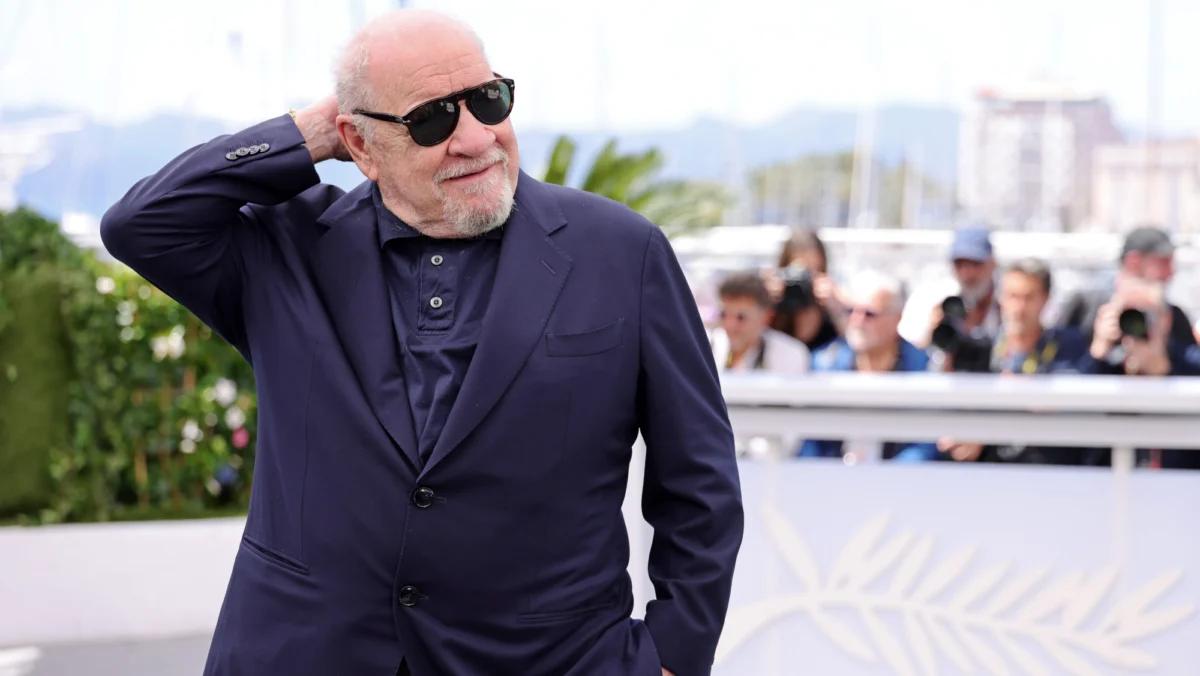
Paul Schrader, the veteran screenwriter and director acclaimed for his deep explorations of the human condition in films such as First Reformed and Taxi Driver, has signaled a provocative shift in his outlook on the future of cinema, suggesting that the era of the human movie star may eventually give way to fully synthetic, AI-generated protagonists. Speaking at Amazon’s "AI on the Lot" event in Culver City, California, on Thursday, the 79-year-old filmmaker delivered a keynote address that balanced technical enthusiasm with a blunt assessment of the economic and creative realities facing the modern film industry. Schrader’s remarks underscore a growing divide in Hollywood between traditionalists who view artificial intelligence as a threat to the "soul" of cinema and pragmatists who see it as an inevitable evolution of the medium.
During his address, Schrader articulated a vision where generative AI tools move beyond mere assistance—such as de-aging or visual effects—to the creation of entirely original "silicon-based" entities that command the same level of audience empathy as human actors. He described this transition as the "tip of the spear" for the industry, positing that the moment a fully synthetic protagonist carries a commercially successful film, the fundamental structure of Hollywood will be permanently altered.
The Vision of the Synthetic Protagonist
Schrader’s argument hinges on the convergence of creative output and economic efficiency. He proposed a scenario in which a filmmaker prompts an AI tool to create a leading man with the rugged gravitas of a young Clint Eastwood, without ever explicitly referencing the actor’s name. According to Schrader, the resulting "star" would possess the aesthetic and charismatic qualities required to engage an audience, yet would exist entirely within the digital realm.
"The movie comes out and us carbon-based fools spend our money empathizing and caring about silicon-based creations," Schrader told the assembly of tech executives and filmmakers. "And they want the next one. They want the follow-up one. Well, we know where that actor lives and he works for nothing and he works for 24 hours a day and he’s available right now."
This perspective highlights a radical departure from the traditional star system, which has historically relied on the personal brand, physical presence, and scarcity of human talent. Schrader suggested that the "workhorse" nature of AI—its ability to produce content without the logistical overhead of human labor—presents an irresistible value proposition for studios.
Internal Industry Debate: Schrader vs. Amazon MGM
The filmmaker’s comments also revealed internal friction within the industry regarding the pace of AI adoption. Schrader noted that he had engaged in a disagreement the previous day with Albert Cheng, the head of AI studios at Amazon MGM. While Cheng reportedly expressed skepticism or caution regarding the audience’s willingness to embrace non-human stars, Schrader dismissed these concerns as being rooted in fear rather than foresight.
"I think he’s just afraid," Schrader remarked. "I think it is going to happen. I think we are going to have a non-hybrid protagonist in the arts."
The distinction between a "hybrid" (a human actor augmented by AI) and a "non-hybrid" (a completely synthetic creation) is a central point of contention in current labor and creative circles. While current technology is frequently used to "touch up" performances or recreate deceased actors—as seen in recent installments of the Star Wars franchise—Schrader is predicting the birth of digital celebrities who have no human antecedent.
Economic Incentives and Production Realities
To illustrate the potential for AI-driven cost savings, Schrader pointed to recent high-budget productions. He cited the 2024 film Wicked, which he had viewed during his travel to the conference, as an example of where human labor might be viewed as an unnecessary expense by future production models.
"I’m looking at why are we paying extra $180 a day when they look so plastic and we not only pay them $180 a day, we have to close them and we have to feed them and we have to deal with their complaints when it gets too hot?" he quipped, referring to the use of background extras in heavily stylized, CGI-laden environments. "Why don’t we just make them?"
Schrader extended this logic to other departments, such as music and documentary filmmaking. He questioned the necessity of hiring human composers for routine tasks, such as creating atmospheric scores for true-crime recreations, suggesting that AI models could generate functional, genre-appropriate music more efficiently.
The Evolution of the Schrader Style
Perhaps the most surprising aspect of Schrader’s keynote was his admission that he is already experimenting with AI in his own creative process. Despite his reputation as a "writer’s writer," he revealed that he is currently working on an AI-integrated film project based on an older script. He expressed interest in using the technology to revive classic television formats, such as generating new episodes of I Love Lucy or Bonanza in a pitch-perfect 1950s style.
Schrader also shared an anecdote about testing ChatGPT’s ability to mimic his own distinct writing voice—a style often characterized by "lonely man" protagonists, diaristic narration, and spiritual crisis. The AI produced a treatment titled The Collection Agency, featuring a former Catholic medical debt collector who records his thoughts on a cassette tape in cheap hotels.
"I could send it out. I know what response I would get: This is second-rate Schrader… but it’s going to be first-rate Schrader soon enough," he said, adding a dry joke about the current state of television writing: "And it’s already first-rate NCIS."
Labor Protections and the SAG-AFTRA Context
Schrader’s predictions land in a highly sensitive environment for Hollywood labor unions. The 2023 strikes by the Writers Guild of America (WGA) and the Screen Actors Guild-American Federation of Television and Radio Artists (SAG-AFTRA) were driven largely by anxieties over AI.
The resulting SAG-AFTRA contract includes specific protections against the unauthorized use of an actor’s "digital replica." However, the language regarding "synthetic performers"—entities that do not resemble any specific living human—is more complex. The union extracted a commitment from studios to notify the union when using a synthetic performer in place of a human and to negotiate in good faith if the synthetic performer’s use would replace a human in a way that significantly impacts employment.
Despite these safeguards, the industry is seeing a surge in AI startups focused on "digital humans." Companies like Soul Machines, Metaphysic, and Runway are rapidly advancing the realism of digital avatars. Industry data suggests that the global market for AI in media and entertainment is projected to grow from approximately $10 billion in 2022 to over $100 billion by 2030, representing a compound annual growth rate (CAGR) of nearly 30%.
Chronology of AI Integration in Modern Cinema
The path to Schrader’s "synthetic star" has been paved by several decades of incremental technological shifts:
- Late 1990s – Early 2000s: The rise of performance capture, most notably Andy Serkis as Gollum in The Lord of the Rings, which bridged the gap between human movement and digital skin.
- 2016: The digital resurrection of Peter Cushing in Rogue One: A Star Wars Story, which sparked ethical debates regarding the "necromancy" of deceased performers.
- 2019: Extensive de-aging in Martin Scorsese’s The Irishman, where Schrader’s contemporary used AI-assisted software to allow older actors to play younger versions of themselves.
- 2023-2024: The emergence of text-to-video models like OpenAI’s Sora and the deployment of "AI-first" production pipelines by independent creators.
Schrader’s current stance suggests that these milestones were merely precursors to a total decoupling of performance from the human body.
Implications for the Future of Film
The implications of Schrader’s vision are profound, affecting everything from the "uncanny valley" of aesthetics to the legal definition of celebrity. If a synthetic star becomes a household name, who owns the intellectual property? Does the prompt engineer, the software developer, or the studio hold the rights to the "actor’s" likeness and future performances?
Furthermore, there is the question of audience psychology. Traditional film theory suggests that the power of cinema lies in the "indexical" link between the camera and reality—the knowledge that a real human being experienced an emotion or performed a stunt. Schrader’s contention that audiences are "carbon-based fools" who will eventually "care about silicon-based creations" challenges the necessity of this human link.
As Schrader approaches the end of his career, he appears content to observe the transition from the sidelines, describing himself as riding "into that cinematic sunset of that old broken horse we call movies." Yet, by actively engaging with the technology he predicts will replace his own skills, he remains a central figure in the debate over whether cinema is entering a new golden age of efficiency or a permanent departure from its humanistic roots.
The "AI on the Lot" event concluded with a sense of lingering ambiguity. While the technological capability to create a synthetic star is nearly within reach, the cultural and commercial willingness to replace human icons remains the industry’s most significant unanswered question. For Paul Schrader, however, the answer is not a matter of "if," but "when."