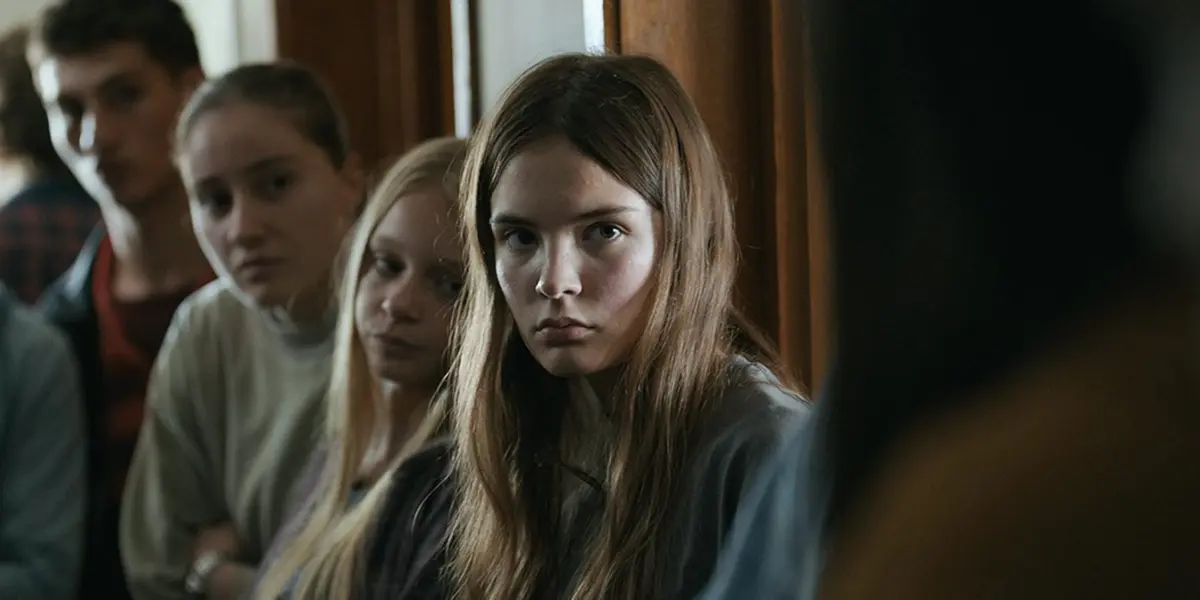
The cinematic landscape of the 1990s Balkans has long been defined by macro-political discourse, international diplomacy reports, and historical post-mortems. However, director Blerta Basholli’s latest feature film, Dua, shifts the analytical focus inward, examining the human cost of conflict through the vulnerable eyes of a thirteen-year-old girl. Set in Pristina during the turbulent final decade of the twentieth century, the 100-minute drama chronicles the life of Dua, played by newcomer Pinea Matoshi, as she navigates adolescent maturation amid escalating ethnic tensions and sociopolitical collapse. Following Basholli’s critically acclaimed, triple Sundance Award-winning feature Hive, Dua represents a significant maturation in the director’s visual storytelling, cementing her status as a vital voice in contemporary international cinema.
Main Facts and Narrative Framework
Dua operates as a deeply personal anti-war narrative that deliberately eschews traditional depictions of battlefield combat and grand military strategy. Instead, Basholli examines the microscopic fractures that war introduces into everyday civilian existence. The plot opens with a deceptive sense of normalcy: thirteen-year-old Dua and her circle of friends gather around a bedroom mirror, applying makeup and whispering about schoolyard crushes ahead of an upcoming evening social.
This innocence is abruptly shattered when armed police raid the school dance, forcing students to flee frantically into the darkened streets. Through contextual cues—such as breaking television news broadcasts and the influx of displaced students into makeshift classrooms housed within overcrowded apartments—the film outlines the escalating Kosovo War. Dua soon forms a tight bond with Maki, a fearless Albanian refugee portrayed by Vlera Bilalli, who utilizes judo training to navigate the hostile environment. Supported by stellar performances from Yllka Gashi and Kushtrim Hoxha as Dua’s beleaguered parents, the narrative underscores how political oppression steadily encroaches upon domestic stability, personal identity, and the simple right to grow up safely.
Historical Background and Chronological Context
To fully appreciate the narrative weight of Dua, one must understand the socio-political pressure cooker that was Kosovo during the late 1990s. Following the dissolution of the Socialist Federal Republic of Yugoslavia and the revocation of Kosovo’s autonomous status by Slobodan Milošević’s government in 1989, the region experienced nearly a decade of systemic discrimination, institutional segregation, and escalating violence against the ethnic Albanian majority.
While the international community’s focus largely crystallized during the peak of the Kosovo War in 1998 and 1999—culminating in the 78-day NATO bombing campaign—the years leading up to the open conflict were characterized by pervasive civil resistance, clandestine parallel state institutions, and localized police crackdowns. Basholli’s film captures this exact pre-war pressure cooker environment of the mid-to-late 1990s. By anchoring the narrative in Pristina, the film reflects the daily reality of a population living under a de facto state of martial law, where routine activities such as selling gasoline to make a living become high-stakes encounters with authorities.
Cinematic Craftsmanship and Technical Execution
From a technical standpoint, Dua succeeds through meticulous collaboration across all departments of filmmaking. Shot entirely on location in the Kosovan capital, the production design and cinematography by Lucie Baudinaud imbue every frame with the tangible weight of historical trauma. Baudinaud’s camera maintains an intensely intimate proximity to the actors, frequently keeping the audience restricted to Dua’s personal headspace. In moments of extreme psychological stress, the sound design subtly amplifies the protagonist’s breathing, drawing the viewer deeper into her internal panic while obscuring graphic violence in the background to emphasize psychological realism over explicit shock value.
The film relies heavily on the strength of its ensemble cast. Pinea Matoshi anchors the production with an understated, naturalistic presence in her acting debut, conveying volumes through internalized tension rather than overt exposition. Vlera Bilalli offers a sharp counterbalance through her assertive physicality, illustrating the ways young women adapted to systemic threats through self-defense and resilience. Meanwhile, Audrey Ismaël’s sparse, strategic musical score punctuates the narrative sparingly, allowing natural ambient soundscapes to dictate the emotional rhythm of the film.
Critical Reception and Analytical Implications
While Dua has garnered widespread praise for its atmospheric immersion, visceral emotional resonance, and exceptional performances, critical evaluations have also pointed to minor structural shortcomings. Some reviewers note that the film occasionally leans into coming-of-age tropes—particularly the device of a naive protagonist overhearing critical information by accident—and risks flirting with familiar stylistic conventions of Eastern European arthouse minimalism.
Nevertheless, the broader implications of Basholli’s work extend far beyond standard cinematic critique. By prioritizing individual human narratives over didactic historical exposition, Dua contributes to a growing body of regional art that preserves cultural memory and offers localized perspectives on displacement and survival. As international film markets increasingly demand diverse, authentic narratives from underrepresented regions, Basholli’s latest offering stands out as an uncompromising, expertly crafted testament to resilience under fire. Through its acute focus on the psychological dimensions of growing up in a conflict zone, Dua ensures that the personal histories behind geopolitical statistics are neither forgotten nor overlooked.