The cinematic landscape of the 1980s represented a distinct apex for the fantasy genre, characterized by practical effects, unpolished world-building, and an abundance of muscle-bound heroes wielding broadswords. While the genre experienced a steep decline during the 1990s before resurfacing with massive studio backing in the 2000s, the films of the earlier decade remain unique cultural artifacts. Among these, the 1985 release Red Sonja stands as a focal point for discussions regarding the evolution, missteps, and eventual stagnation of the sword-and-sorcery subgenre produced by legendary Italian producer Dino De Laurentiis. As part of a broader critical examination of canonical fantasy cinema released between 1980 and 1989, the film offers a wealth of material for analyzing the intersection of commercial ambition, creative miscalculation, and the shifting dynamics of representation in action cinema.
Production Background and Chronological Context
To understand the trajectory of Red Sonja, one must examine its place within De Laurentiis’s loose Robert E. Howard cinematic trilogy. The sequence began with 1982’s Conan the Barbarian, a surprisingly nuanced and commercially viable exploration of mythic masculinity directed by John Milius and starring Arnold Schwarzenegger. This was followed by 1984’s Conan the Destroyer, a lighter, more fantastical sequel directed by Richard Fleischer that introduced audiences to campy elements and fantastical creatures. Red Sonja was designed to complete this trilogy, arriving in theaters on August 30, 1985, under the direction of Richard Fleischer once again.
However, behind-the-scenes complications plagued the production from its inception. Due to intricate legal rights and copyright divisions surrounding Robert E. Howard’s literary properties, the production team was legally barred from using the name "Conan" for Schwarzenegger’s character. Consequently, Schwarzenegger was repurposed to play a mercenary named Kalidor—a figure functionally identical to Conan in almost every narrative aspect. This legal hurdle set a fragmented tone for a production that was already attempting to launch a major new female-led action franchise on a reported budget of $17.9 million.
Narrative Overview and Structural Elements
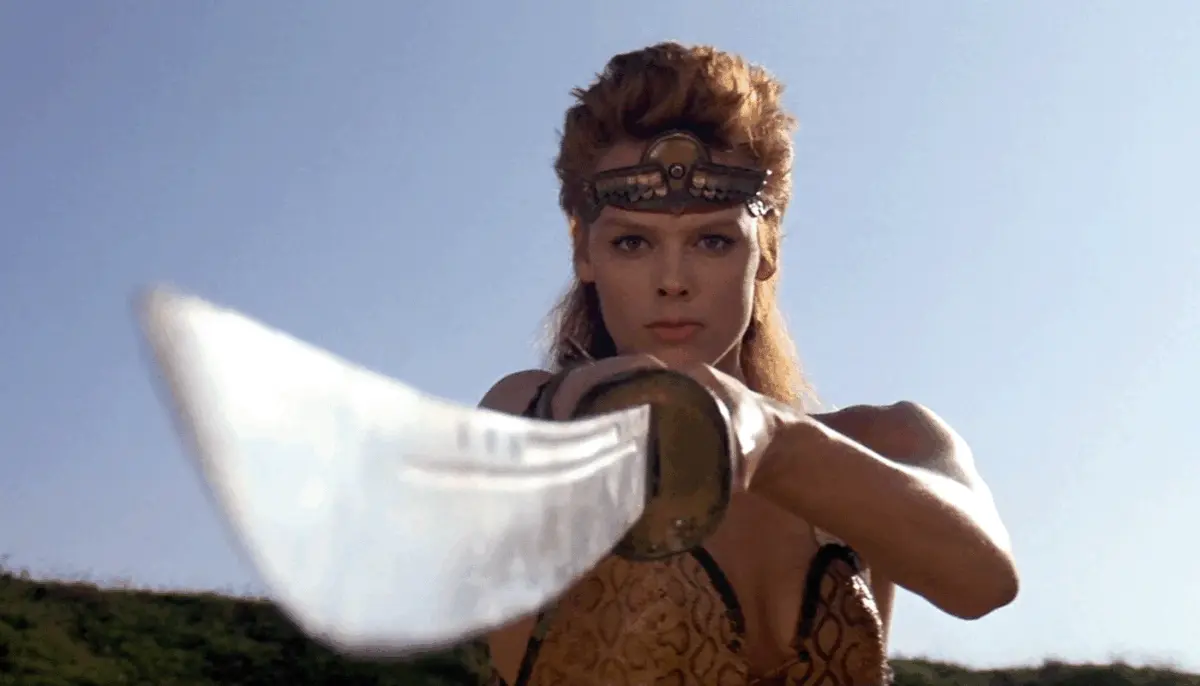
The plot of Red Sonja borrows heavily from the established tropes of 1980s fantasy cinema. The protagonist, Sonja—portrayed by Brigitte Nielsen in her feature film debut—sees her remote village destroyed by marauding soldiers. In the opening sequences, Sonja is subjected to a brutal sexual assault by the raiders, an event that serves as the primary catalyst for her vengeance. When she cries out for retribution, a mystical spirit intervenes, granting her the extraordinary combat prowess necessary to become a legendary warrior.
Years later, the raiders are identified as the forces of Queen Gedren, played by Sandahl Bergman. Gedren seeks to control "the Talisman," an ancient green orb believed to have forged the universe. The orb requires exposure to light to function, and the sacred priestesses protecting it—including Sonja’s sister, Varna—attempt to seal it in eternal darkness. Gedren’s forces massacre the temple inhabitants, steal the orb, and mortally wound Varna. Kalidor encounters the dying Varna and brings her to Sonja, who is undergoing rigorous training under a swordsman known as the Grand Master. With her dying breath, Varna implores Sonja to recover the Talisman.
Sonja and Kalidor embark on a perilous quest, eventually joined by the young, deposed prince Tarn—played by Ernie Reyes Jr.—and Tarn’s loyal bodyguard, Falkon, portrayed by character actor Paul L. Smith. The quartet infiltrates Queen Gedren’s fortress, defeats the antagonist, and hurls the Talisman into a volcanic abyss to neutralize its power. In alignment with Sonja’s prior vow to refuse any man who cannot best her in physical combat, she and Kalidor engage in a brief duel and subsequent reconciliation, concluding the narrative.
Commercial Performance and Critical Reception
Upon its theatrical release, Red Sonja was a critical and financial failure. The film grossed a meager $6.9 million domestically against its $17.9 million production budget, resulting in significant financial losses for Metro-Goldwyn-Mayer and De Laurentiis Entertainment Group. Contemporary reviews were overwhelmingly hostile, criticizing the film’s pacing, dialogue, and derivative storytelling.
In subsequent years, key participants did not shy away from expressing their disdain for the project. Arnold Schwarzenegger famously joked in interviews that Red Sonja was the worst film he had ever made, a remark that underscored the project’s reputation as a creative dead end. Furthermore, the film’s poor box office performance effectively derailed plans for a third official Conan film, halting De Laurentiis’s sword-and-sorcery cinematic universe in its tracks.
Critical Analysis of Narrative and Thematic Failures
Modern retrospective analysis reveals that Red Sonja struggled under the weight of several severe structural and thematic miscalculations. The most immediate and damaging flaw occurs within the film’s opening minutes. A ghostly voiceover explains that Sonja was targeted for sexual assault because she rejected Queen Gedren’s romantic and sexual advances. By directly conflating the primary antagonist’s queer sexuality with innate villainy early in the narrative—only for this plot point to become entirely irrelevant for the remainder of the runtime—the film establishes a regressive moral tone from which it never recovers.
Beyond this initial misstep, the film undercuts its own protagonist in ways that contradict the core tenets of empowerment. Although Sonja shares a tragic origin story with Conan, her path to strength is handled differently. While Conan’s capabilities are forged through years of brutal physical enslavement and gladiatorial combat, Sonja’s abilities are bestowed upon her wholesale by an unexplained spirit. This narrative choice implies that a female lead is inherently incapable of achieving formidable strength through merit or training alone.
Additionally, the narrative frequently relies on Kalidor arriving at convenient moments to rescue Sonja from mortal peril. This dynamic reduces the agency of the title character, contrasting sharply with Sandahl Bergman’s portrayal of Valeria in Conan the Barbarian, a warrior who maintained absolute autonomy and tactical competence throughout her screen time.
Performances and Standout Elements
The performances across the cast are notably uneven. Sandahl Bergman, who delivered a commanding and physically adept performance as Valeria in the first Conan film, struggles with the material as Queen Gedren, rendering the primary villain remarkably flat and uninspired. Similarly, Brigitte Nielsen’s debut performance relies heavily on physical presence rather than emotional range, though she occasionally displays a functional comedic dynamic alongside Ernie Reyes Jr.
Conversely, the supporting performances of Ernie Reyes Jr. and Paul L. Smith provide some of the film’s few redeeming qualities. Reyes brings a self-aware, comedic energy to the role of the spoiled boy-prince Tarn, executing a credible character arc as the young monarch learns responsibility. Paul L. Smith delivers a warm, charismatic performance as Falkon. Notably, Smith’s portrayal of a larger character avoids relying on cheap, size-based comedic tropes, presenting Falkon as a loyal, wry, and highly competent warrior on par with his peers.
Production Design, Visuals, and the Raiders Connection
From a production standpoint, Red Sonja reflects the budgetary constraints of its era, featuring sets and costumes that appear noticeably less polished than its predecessors. The aesthetic choices lean heavily into eccentric territory, exemplified by Sonja’s iconic red mullet hairstyle and the BDSM-inspired wardrobe worn by Queen Gedren’s military forces. Practical creature effects, including a mechanical eel and a miniature spider puppet, highlight the tactile, hands-on approach to filmmaking typical of mid-1980s fantasy productions.
Sharp-eyed cinema historians have also noted a distinct creative crossover between Red Sonja and Steven Spielberg’s 1981 classic Raiders of the Lost Ark. The production utilized several actors from Raiders, including Ronald Lacey as Gedren’s vizier Ikol, Pat Roach as the toll-keeper Brytag, Tutte Lemkow as a court wizard, and Terry Richards as a well-dressed bandit. This informal reunion adds a layer of unexpected genre connectivity to an otherwise isolated production.
Legacy and Broader Implications
The long-term legacy of Red Sonja remains complex. Like its predecessors, the film generated tie-in comic book media, and its intellectual property rights eventually led to the development of a 2025 remake starring Matilda Lutz, which met with similarly tepid critical responses. For the principal cast members, the film served as a launching pad for recognizable careers, though neither Nielsen nor Reyes achieved prolific mainstream dominance in dramatic cinema.
Ultimately, Red Sonja stands as a cautionary tale within franchise filmmaking. It illustrates the dangers of rushing derivative properties to the screen without adequate narrative cohesion or thematic sensitivity. While it retains a niche following among enthusiasts of 1980s camp and retro fantasy, it remains a misfire that demonstrated the limits of the sword-and-sorcery boom, closing the book on an era of unfiltered, unpolished cinematic myth-making until the genre’s high-budget revival decades later.