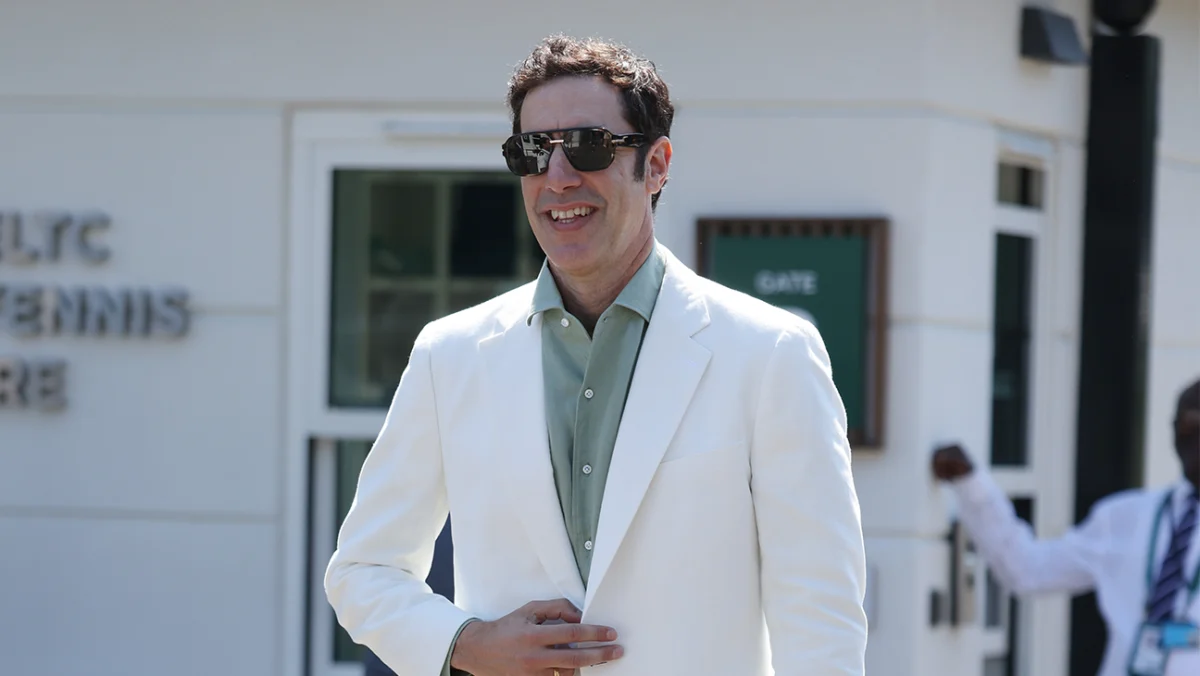
The highly anticipated return of Sacha Baron Cohen’s indelible character, Ali G, has sent ripples through both the entertainment industry and unexpected corners of the sporting world, with the fictional Staines-born rapper making a surprise appearance at the 2026 Wimbledon men’s singles finals. This unexpected public re-emergence, captured in a video posted to a newly established Instagram account on Sunday, comes on the heels of reports that a new, secretly produced film starring the character has recently completed production, igniting fervent speculation and excitement among fans and cultural commentators alike.
The audacious stunt saw Ali G, known for his distinctive yellow tracksuit and idiosyncratic patois, injecting his brand of satirical humor into the hallowed grounds of the All England Lawn Tennis and Croquet Club. In the viral video, the character, portrayed by the acclaimed British comedian Sacha Baron Cohen, addressed viewers directly, stating, "Iz here at the men’s singles in Wimbledon, which actually, despite its name, ain’t a party for Gaylords. It’s like the World Cup of something called tennis, which is like a crap version of ping pong. Them say that tennis is better played on grass, which is why I intend to sell as much of it while iz here. So if you want some herbal remedies, me got anything you want." The quip, delivered with Ali G’s characteristic deadpan delivery and thinly veiled innuendo about illicit substances, immediately garnered widespread attention across social media platforms.
Further amplifying the buzz, the accompanying caption to the Instagram post read, "I iz BACK! And if u iz at dis borin wimbledore final lookin 2 get grand slammed, I iz here wif de hookup." The post quickly became a trending topic, with millions of views, shares, and comments reflecting a mix of nostalgia, amusement, and genuine surprise at the character’s unannounced reappearance. The choice of Wimbledon, an event synonymous with tradition, decorum, and high society, provided a stark and comedically potent contrast to Ali G’s irreverent persona, a juxtaposition that has always been central to Cohen’s satirical genius.
A Return Decades in the Making: The New Film and the Hiatus
This high-profile public stunt serves as a potent, if unconventional, marketing prelude to the character’s long-awaited return to the big screen. Reports confirm that a new feature film starring Ali G has quietly wrapped production, with details surrounding its plot, director, and release date remaining under tight wraps. This surprise sequel marks more than two decades since Ali G last graced cinemas in 2002’s Ali G Indahouse, a film that grossed over $27 million worldwide on a modest budget and solidified the character’s global recognition. The significant gap between projects has only intensified the anticipation, with many wondering how Ali G’s brand of satire will translate to the social and political landscape of 2026.
The decision to bring Ali G back after such a prolonged absence speaks volumes about the enduring appeal and cultural relevance of Sacha Baron Cohen’s creation. Following Ali G Indahouse, Cohen largely focused on other highly successful and equally provocative alter egos, most notably Borat Sagdiyev (from 2006’s Borat: Cultural Learnings of America for Make Benefit Glorious Nation of Kazakhstan and 2020’s Borat Subsequent Moviefilm) and Bruno Gehard (from 2009’s Brüno), alongside more dramatic roles in films like The Trial of the Chicago 7 and Les Misérables. Each of these characters, much like Ali G, employs a distinct comedic persona to expose societal prejudices, hypocrisy, and absurdities, often through unscripted interactions with unsuspecting members of the public or high-profile figures.
The Genesis of an Icon: Ali G’s Rise to Stardom
Ali G, whose full name is Alistair Leslie Graham, first burst onto the scene in 1998 as a segment on the British satirical television program The 11 O’Clock Show. Portrayed as a "voice of da yoof" from Staines-upon-Thames, a suburb of London, Ali G quickly captivated audiences with his distinctive hip-hop slang, often grammatically incorrect and replete with made-up words, his bright yellow tracksuits, and his signature "Booyakasha" catchphrase. His early segments involved interviewing real-life figures, including politicians, academics, and celebrities, who were often unaware they were speaking to a satirical character. These interviews, characterized by Ali G’s feigned ignorance and bizarre questions, expertly highlighted the interviewees’ own biases, discomfort, or attempts to appear "cool" and relatable to youth culture.
The character’s popularity soared, leading to his own highly successful television series, Da Ali G Show, which ran for three seasons from 2000 to 2004. The show, which later transitioned to HBO in the United States, allowed Cohen to expand Ali G’s reach, conducting interviews with an even wider array of prominent personalities, including figures like Donald Trump, Buzz Aldrin, and David and Victoria Beckham. These interactions became legendary, demonstrating Cohen’s unparalleled ability to maintain character and provoke genuine reactions, often leading to moments of profound comedic and social commentary. The show garnered critical acclaim, including multiple BAFTA Awards and an Emmy nomination, solidifying Ali G’s status as a cultural phenomenon and establishing Sacha Baron Cohen as a master of guerrilla comedy.
Sacha Baron Cohen’s Satirical Method and Cultural Impact
Sacha Baron Cohen’s approach to comedy is rooted in the tradition of satire, utilizing exaggerated personas to critique society. Ali G, in particular, often served as a mirror, reflecting the absurdities of cultural appropriation, class distinctions, and political posturing. His seemingly naive questions would often lead interviewees to inadvertently reveal their true opinions or prejudices, making the audience question not just the character, but the subjects themselves. This method requires immense courage, quick wit, and an acute understanding of human psychology, qualities Cohen has consistently demonstrated throughout his career.
The enduring appeal of Ali G lies in his ability to be both ridiculous and insightful. He challenges authority figures not through direct confrontation, but through a disarming combination of perceived ignorance and streetwise bravado. This approach often allowed him to bypass the usual defenses of public figures, leading to revealing and often hilarious encounters. In the late 1990s and early 2000s, Ali G became a cultural touchstone, influencing slang, fashion, and comedic styles, and cementing his place in the pantheon of iconic British comedy characters. His unique blend of humor, which pushes boundaries and often makes audiences uncomfortable, has always been a hallmark of Cohen’s work.
Wimbledon as the Stage: A Deliberate Juxtaposition
The choice of the Wimbledon finals for Ali G’s surprise re-emergence is particularly astute. The tournament, steeped in over a century of history and tradition, represents the pinnacle of British gentility and sporting excellence. It is a venue where decorum is paramount, and any deviation from established norms is typically met with stern disapproval. Ali G’s presence, with his outlandish attire and attempts to peddle "herbal remedies," directly subverts this environment, creating an immediate and striking comedic contrast.
Wimbledon typically attracts an affluent and sophisticated audience, with viewership reaching hundreds of millions globally. In 2025, the men’s singles final alone drew an average of 4.5 million viewers in the UK and significant international numbers, making it a prime, high-visibility stage for a viral marketing stunt. The incongruity of Ali G attempting to sell marijuana in such an esteemed setting not only generates laughter but also serves as a pointed commentary on class, culture, and societal expectations. It also harks back to the character’s roots of infiltrating established institutions and exposing their often-unspoken rules and snobberies. The reaction from attendees, ranging from confused glances to delighted smiles, would have been a fascinating barometer of the character’s continued resonance.
Modern Relevance and Challenges in 2026
The return of Ali G in 2026 poses interesting questions about the evolution of satire in an increasingly sensitive and hyper-aware social media landscape. When Ali G first debuted, the internet was in its infancy, and social media as we know it did not exist. His humor, while always provocative, was consumed in a different media environment. Today, every public utterance is scrutinized, and comedic intent can easily be misinterpreted or condemned.
However, this new context might also be precisely why Sacha Baron Cohen has chosen now for Ali G’s comeback. In an era often characterized by performative authenticity and identity politics, Ali G’s exaggerated, almost childlike persona, could serve as a powerful tool to expose new forms of hypocrisy and societal absurdities. His ability to disarm and provoke remains his core strength. Commentators suggest that Ali G could explore contemporary themes such as influencer culture, cancel culture, digital privacy, or the shifting definitions of masculinity, all while maintaining his signature comedic style. The challenge will be to adapt the character’s unique brand of "ignorant" satire to avoid merely rehashing old jokes and instead find fresh, relevant targets.
The Strategic Rollout: Viral Marketing in the Digital Age
The choice of Instagram for Ali G’s initial video speaks volumes about the strategic marketing approach for his return. In an era dominated by short-form video content and instant virality, a direct-to-social media rollout allows for immediate global reach and engagement. The creation of a new, dedicated Instagram account also signals a concerted effort to build a digital presence for the character, leveraging the platforms where contemporary audiences, particularly younger demographics, consume media.
This approach contrasts sharply with traditional film promotion cycles, which typically involve press releases, trailers, and talk show appearances. By creating an event-driven, organic-feeling moment at Wimbledon, Cohen and his team have generated significant media coverage and public discussion without a formal announcement, effectively turning the character’s return into a viral news story in itself. This guerilla marketing tactic is a hallmark of Cohen’s work, mirroring the improvisational and unpredictable nature of his characters.
Anticipation for the New Film and Beyond
While details of the new Ali G film remain scarce, the sheer fact of its existence, coupled with the character’s public re-emergence, has generated immense excitement. Fans are eager to see how Ali G will navigate the modern world, what new figures he will interact with, and what societal norms he will challenge. The film will likely combine Cohen’s signature improvisational interviews with a narrative structure, much like Ali G Indahouse and the Borat films.
The return of Ali G is not merely a nostalgic trip; it represents a continuation of Sacha Baron Cohen’s ongoing satirical project. With the world constantly grappling with new social and political complexities, the need for sharp, incisive humor remains as potent as ever. Ali G’s comeback promises to deliver precisely that, offering a unique lens through which to examine our collective human foibles. The Wimbledon stunt was a bold declaration: Booyakasha, Ali G is truly back, and he’s ready to once again provoke, entertain, and perhaps even enlighten audiences worldwide.