New York City’s iconic Lincoln Square was transformed into a theatrical marvel on Tuesday night, hosting the highly anticipated New York premiere of Christopher Nolan’s epic adaptation, The Odyssey. The event, a pivotal stop on the film’s global promotional tour, brought together an constellation of Hollywood stars, a significant military presence, and an awe-inspiring, 40-foot replica of the legendary Trojan Horse, effectively shutting down a major urban artery for a spectacle befitting the ancient Greek epic it celebrates. The arrival marked not just a film premiere but a cultural event, underscoring the ambition and scale of Nolan’s latest cinematic endeavor, poised to redefine the classic tale for a new generation.
A Grand Entrance: The Trojan Horse Dominates Lincoln Square
The centerpiece of the night was undoubtedly the massive Trojan Horse, an exact replica of the practical prop used in the film. Standing at an imposing 40 feet, its colossal presence commanded attention, drawing gasps from onlookers and serving as a dramatic backdrop for the arriving celebrities. Flanked by actors dressed as ancient Greek soldiers, the horse wasn’t merely a static display; it was a living, breathing symbol of the film’s commitment to immersive realism and historical authenticity, elements that Christopher Nolan is renowned for. Its construction, a testament to modern engineering and meticulous craftsmanship, took months, involving a dedicated team of designers, carpenters, and sculptors who worked to bring the ancient war machine to life with unprecedented detail. The material composition, likely a robust combination of steel framework, timber, and expertly aged fiberglass or resin cladding, was designed to withstand the rigors of filming and subsequent promotional tours, demonstrating both structural integrity and visual fidelity.
This physical manifestation of the Trojan Horse underscores its critical role within the narrative. As audiences familiar with Homer’s Odyssey know, the horse is central to the culmination of the Trojan War, serving as the ingenious ruse that allows Odysseus (portrayed by Matt Damon) and his elite contingent of Achaean warriors to infiltrate the seemingly impenetrable walls of Troy. Their clandestine entry within its hollow belly ultimately leads to the city’s downfall, setting the stage for Odysseus’s arduous and fabled decade-long journey home. The decision by Nolan and his team to construct this monumental prop practically, rather than relying solely on computer-generated imagery, speaks volumes about the director’s artistic philosophy and his unwavering dedication to tangible filmmaking experiences. This commitment extends beyond mere aesthetics, aiming to provide both actors and audiences with a visceral sense of reality that CGI, however advanced, often struggles to replicate.
Nolan’s Vision: Practicality Over Pixels
Christopher Nolan’s reputation as a director who favors practical effects and real-world constructions over digital wizardry is well-established, evidenced in blockbusters like Inception‘s rotating corridor or Dunkirk‘s expansive naval sequences. The Odyssey continues this tradition, with the Trojan Horse being a prime example of this methodology. The director’s hands-on approach even saw him, famously, climb inside the gargantuan structure himself during filming. This anecdote, shared by John Leguizamo, who plays Odysseus’s trusted friend Eumaeus, on the red carpet, highlights Nolan’s leadership and commitment.
"I was looking for Chris Nolan to meet him," Leguizamo recounted to The Hollywood Reporter, "and they told me he was inside the horse with 20 actors and the DP [Hoyte van Hoytema] and the IMAX camera. I couldn’t believe that. I was like, wow, this man is a leader. This man is not going to ask anything of you that he doesn’t attempt himself." This statement offers a profound insight into Nolan’s collaborative yet demanding set environment, where the director often places himself in the same challenging circumstances as his cast and crew. Such leadership fosters a deep sense of camaraderie and respect, undoubtedly contributing to the film’s authenticity and the intensity of its performances. The presence of Hoyte van Hoytema, Nolan’s frequent collaborator and acclaimed cinematographer, inside the horse with an IMAX camera further emphasizes the meticulous planning and execution required to capture the scene’s claustrophobic and pivotal moments with maximum fidelity and immersive quality, characteristic of Nolan’s large-format cinematography.
The Organic Chaos of Creation: Inside the Horse
Matt Damon, the film’s protagonist, has also offered fascinating glimpses into the challenging production of the Trojan Horse sequence. During the press run, he revealed to GamesRadar+ that Nolan, remarkably, had not fully mapped out the filming strategy for the scene until the very day of shooting. This unconventional approach, while potentially anxiety-inducing for some, is indicative of Nolan’s trust in his team and his embrace of organic problem-solving in the pursuit of genuine cinematic moments.
Damon described Nolan’s instruction to the group as, "we’re just going to cram in there and figure it out." This improvisational spirit allowed the natural dynamics of the tight space to dictate the filming. "That feeling of claustrophobia, that was all just developing organically," Damon recalled. "Hoyte was looking through the lens, and Chris was right next to him. They just built that in real time. It was so cool to see. If we had planned it out, I don’t think it would have had that same energy." This method, while seemingly chaotic, often yields the most authentic and powerful results, capturing raw human reactions and the true essence of a scene. The confined space, the lack of a predetermined blocking, and the collective effort to "figure it out" undoubtedly contributed to the palpable tension and realism that audiences can expect from this critical sequence in the film. It’s a testament to Nolan’s unique directorial style, where the environment itself becomes a character, shaping the performances and narrative in unforeseen ways.

A Star-Studded Assembly: The Red Carpet Experience
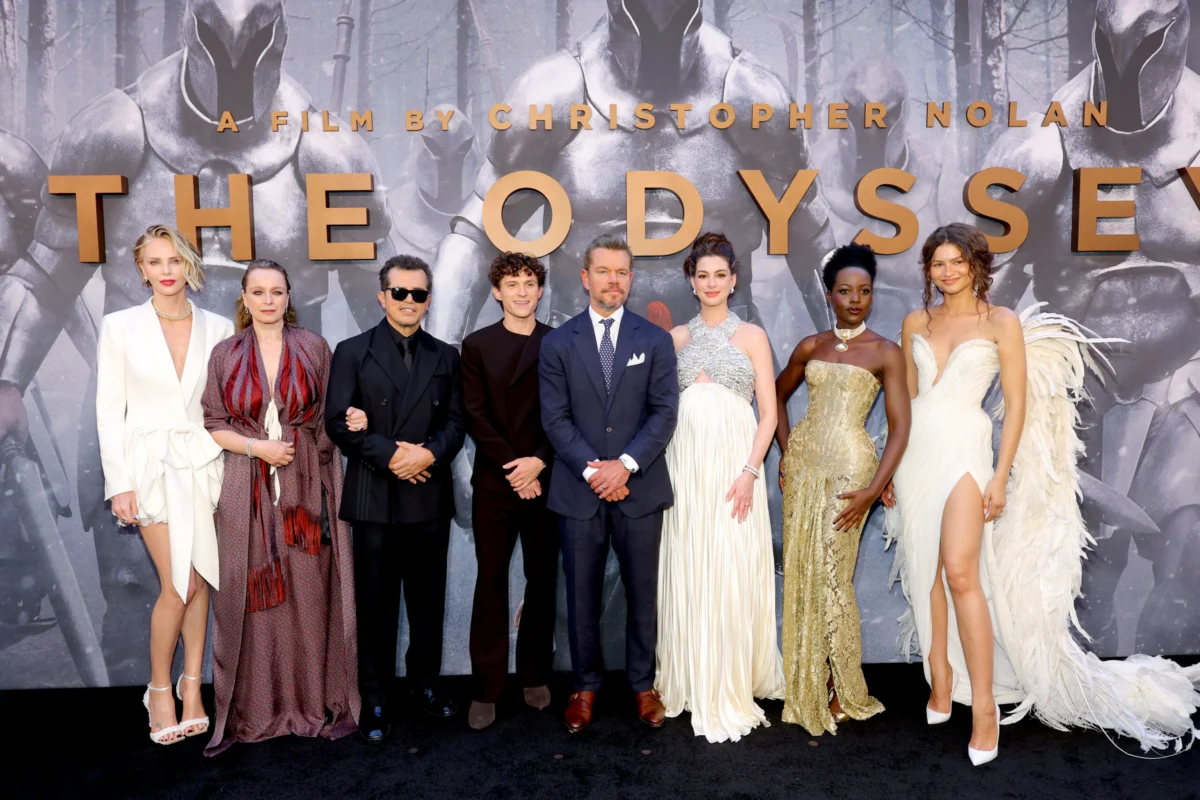
The New York premiere’s red carpet was a dazzling display of star power, underscoring the film’s massive ensemble cast. Alongside Matt Damon, who anchors the film as Odysseus, luminaries such as Tom Holland, Anne Hathaway, Zendaya, Charlize Theron, Lupita Nyong’o, Elliot Page, Jon Bernthal, and Samantha Morton graced the event. Each actor, a celebrated talent in their own right, contributed to the film’s allure and the magnetic energy of the premiere. Their presence collectively signaled the gravity of the project and the draw of working with a visionary like Christopher Nolan.
The logistical undertaking of hosting such a high-profile event in the heart of Manhattan was immense. Lincoln Square, a bustling nexus of culture and commerce, required extensive coordination with city officials, the NYPD, and traffic management agencies. Road closures commenced hours before the event, rerouting vehicular and pedestrian traffic to ensure both security and a smooth flow for the arriving celebrities and media. Security perimeters were established, with uniformed officers and private security personnel managing crowd control, ensuring the safety of the public and the attendees. The entire operation was a meticulously planned ballet of urban logistics, demonstrating the significant investment by Universal Pictures in the film’s grand unveiling. For the hundreds of fans and onlookers who gathered, braving the elements, the opportunity to witness such a gathering of cinematic talent and the awe-inspiring Trojan Horse was a once-in-a-lifetime experience, generating significant buzz across social media platforms.
The Enduring Legacy of Homer: Why Now?
The Odyssey is not merely a film; it is a modern interpretation of one of the foundational texts of Western literature. Homer’s epic poem, penned millennia ago, recounts Odysseus’s perilous journey home to Ithaca after the fall of Troy, a voyage fraught with mythical creatures, divine interventions, and profound personal trials. Its themes of resilience, loyalty, temptation, and the human desire for home resonate universally and timelessly.
Previous adaptations, ranging from classic Hollywood epics to television miniseries, have attempted to capture its grandeur, but Nolan’s take promises a unique blend of intellectual depth and visceral action, filtered through his signature non-linear narrative structures and practical effects. In an era often saturated with superhero franchises and genre films, a return to classical mythology, particularly with a director of Nolan’s caliber, represents a bold artistic statement. It reflects a cultural appetite for stories that delve into profound human experiences and universal struggles, presented with a scope and ambition that only a few filmmakers can command. The film’s release timeline, following a period of global uncertainty and introspection, might also be seen as serendipitous, offering a narrative of perseverance and eventual homecoming that could strike a chord with contemporary audiences. Nolan’s meticulous research into historical warfare and ancient Greek culture, coupled with his narrative prowess, suggests that this Odyssey will not just be an action spectacle but a thoughtful re-examination of an enduring human story.
Marketing Momentum and The Road Ahead
The New York premiere is a crucial crescendo in The Odyssey‘s extensive marketing campaign, which has strategically built anticipation over recent months. Following earlier stops in major international cities, the NYC event solidifies the film’s global footprint and its status as a tentpole release for Universal Pictures. The decision to display the actual 40-foot Trojan Horse at each premiere city has been a stroke of marketing genius, transforming a mere prop into a tangible symbol of the film’s scale and Nolan’s commitment to practical filmmaking.
Beyond the premieres, the original Trojan Horse from the film is now on display outside the AMC Theater at Universal Studios Hollywood’s CityWalk. This strategic placement ensures that the monumental prop continues its life as a promotional tool, drawing tourists and film enthusiasts, further extending the film’s reach and enhancing the studio’s brand. Such immersive marketing tactics blur the lines between film promotion and experiential entertainment, creating lasting memories for fans and amplifying the overall cultural impact of the release.
As The Odyssey prepares to hit theaters on Friday, industry analysts are closely watching its box office projections. Given Nolan’s track record of critical and commercial success, coupled with the film’s star-studded cast and the epic scope of its narrative, expectations are exceedingly high. Early buzz from critics and preview screenings suggests a film that delivers both intellectual stimulation and breathtaking cinematic spectacle, a combination that has historically resonated with a broad audience base. The practical effects, the immersive IMAX cinematography, and the compelling performances are all anticipated to contribute to a powerful and memorable theatrical experience, solidifying The Odyssey‘s place as a major cinematic event of the year and potentially reinvigorating interest in classical mythology on the big screen.
Michaela Zee contributed to this report.