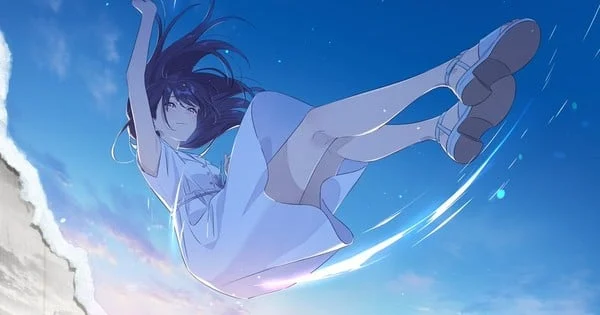
The cinematic landscape is often punctuated by narratives that grapple with profound themes, exploring the human condition through unique and often fantastical lenses. Among these, To You in the Beyond emerges as a film that, while aiming for emotional resonance and conceptual intrigue, ultimately struggles to fully realize the ambitious premise it sets forth. This coming-of-age romance, set against the backdrop of a picturesque seaside town, centers on the unconventional relationship between Kazuki, a talented pianist haunted by past trauma, and Nanao, a mysterious young woman who has inexplicably traveled from the 1970s. While the film’s core concept offers fertile ground for exploring themes of isolation, self-discovery, and the nature of connection across temporal divides, its execution leaves audiences with a lingering sense of missed opportunities.
The Premise: A Temporal Anomaly Meets Teenage Angst
At its heart, To You in the Beyond attempts to weave a delicate tapestry of adolescent vulnerability and unexpected romance. Scriptwriter Akiko Abe, known for her work on the popular shojo manga Ao Haru Ride, brings her experience with exploring teenage social anxiety to this narrative. Similar to her previous work, the film features protagonists who, in their own ways, engage in self-isolation as a defense mechanism. For Kazuki, a gifted pianist, this manifests as a denial of his talent following a traumatic incident in the city. His internal struggle mirrors Futaba’s journey in Ao Haru Ride, where she suppressed her femininity to navigate the complexities of school social dynamics. However, Kazuki’s retreat is driven by a desire to outrun his past, a choice that carries the weight of potentially alienating his friends and altering his understanding of himself. This profound sense of internal conflict makes his eventual opening up to Nanao, a figure entirely detached from his temporal reality, a significant plot development.
Nanao, despite being physically present in Kazuki’s time, embodies a profound sense of displacement. Her hometown, a place of her upbringing, is in ruins, and the people she once knew are gone. This existential void makes her initially appear timid and overwhelmed. However, as Kazuki engages in conversations with her, a more vibrant and spirited personality begins to surface. Actress Anna Nagase, who voices Nanao, has spoken of her long-standing admiration for the character, having reportedly aspired to portray her since her middle school days. Nagase’s performance, transitioning from a quiet reserve to an infectious, rambunctious energy, particularly shines during a pivotal dinner scene. This transformation underscores Nanao’s resilience and her capacity to find wonder and excitement in a new environment, even after losing everything she once held dear.
Drawing Parallels and Highlighting Divergences: The "Your Name." Effect
The film’s premise immediately invites comparisons to Makoto Shinkai’s critically acclaimed your name., a film that masterfully blended a fantastical premise of body-swapping and time displacement with a compelling romantic narrative. your name. demonstrated the potent appeal of exploring unconventional connections, particularly those that transcend ordinary boundaries, including temporal ones. The idea of meeting someone new to your life, and then discovering they are separated by time, offers a natural escalation to exploring the complexities of long-distance relationships, albeit on an unprecedented scale.
However, where your name. utilized its fantastical element as a driving force, fundamentally shaping the second half of its narrative, To You in the Beyond appears to relegate its central conceit of time travel to a more ornamental role. The film’s narrative structure suggests a missed opportunity to fully integrate this extraordinary element into the fabric of its storytelling. This divergence from the principle of narrative necessity, often encapsulated by the concept of Chekhov’s gun – where every element introduced should serve a purpose – becomes a point of contention for the film’s critical reception.
The Underutilization of a Compelling Premise
The film’s narrative trajectory becomes particularly frustrating with the mid-film revelation that individuals have been visiting this specific timeline for decades. This implies that the town itself, and the community within it, have been shaped by the contributions of people who have drifted in from both the past and the future. This revelation opens up a vast and compelling avenue for exploration: the societal and cultural impact of consistent temporal displacement. Imagine the economic ramifications of a peasant from the Sengoku era establishing a thriving farmers’ market, or a fortune teller with foreknowledge influencing local events for half a century. The potential for exploring alternate histories and the subtle, yet profound, ways these temporal visitors might have reshaped society is immense.
The film, however, largely sidesteps delving into these fascinating implications. Instead, the time travel element appears to serve primarily as a flavoring agent for the romance, contributing little to the overarching plot beyond Nanao’s temporal origin, her distinct tastes in food and music, and her occasional familial resemblance to Kazuki’s grandmother. The narrative shifts its focus to themes of cancel culture and the existential despair of an individual who feels alienated from the world. While these are valid and important themes, their prominence overshadows the unique premise that the film initially presented as its core appeal. The decision to introduce such a rich and complex temporal premise only to leave it largely unexplored feels like a missed opportunity to create a truly groundbreaking narrative. The film raises questions about the impact of future visitors, such as the potential for advanced technology like flying cars, without providing any substantive answers or even exploring the implications of such anachronisms.
Supporting Characters and a Divergent Climax
Despite the narrative’s shortcomings in fully exploiting its central premise, To You in the Beyond does showcase a promising ensemble of supporting characters. The film effectively captures the essence of small-town camaraderie, with Kazuki’s dorm mates providing a blend of lighthearted teasing and steadfast support, embodying the ideal qualities of true friends. One particular classmate plays a significant role in Kazuki’s past, underscoring his unwavering loyalty. Nanao’s adoptive uncle, Takatsu, offers a compelling portrayal of a seemingly irresponsible individual who harbors a hidden depth as a caring artist, a secret known only to the local school teacher.
However, the film falters in its climax with the introduction of a villain whose motivations and actions are depicted with a cartoonish level of malice. This abrupt shift in tone and the simplistic portrayal of evil detract from the more nuanced and character-driven drama that the film had been building. The narrative did not inherently require a villain, and the inclusion of such a simplistic antagonist feels at odds with the film’s otherwise introspective and emotionally driven themes. This artificial conflict undermines the emotional impact of the climax, leaving the audience questioning its necessity.
Production Values: A Subdued Aesthetic
On a technical level, To You in the Beyond presents a production that, while competent, stands in contrast to the more vibrant and dynamic style often associated with director Junichi Wada’s previous television series. The hand-drawn backgrounds effectively capture the serene beauty of the seaside setting. However, the shot composition and color palette, while pleasant, lack the striking visual energy seen in Wada’s works such as Sakugan or High Card.
Where the film truly excels is in its character animation. The consistent quality and fluidity of the character movements are indicative of the resources and time afforded to a feature film production. A notable achievement is the depiction of Kazuki’s piano performances, which are rendered entirely through hand-drawn animation, eschewing the use of CG for his hands. This level of detail and dedication to traditional animation techniques is commendable, especially considering the technical challenges such a feat often presents, as evidenced by other animated films that have struggled with similar aspects.
Musical Score: A Missed Opportunity for Resonance
The musical score, composed by Kōji Nakamura, a musician with experience as the guitarist for the band SUPERCAR, fails to leave a lasting impression. The score attempts a cinematic quality, evoking the styles of renowned directors like Hayao Miyazaki and Makoto Shinkai, but ultimately feels like a placeholder, lacking the distinctiveness and emotional depth that would elevate the film. The ending song by Tota offers a pleasant conclusion, but a more impactful final piano performance from Kazuki would have provided a more fitting and emotionally resonant farewell.
Future Prospects and Unseen Narratives
During its premiere at Anime Expo, Director Junichi Wada indicated plans for further editing before the film’s theatrical release. While a tighter edit might enhance the pacing, it is unlikely to fundamentally alter the film’s narrative direction or address the core issue of its underutilized premise. The film’s potential success may hinge on its existing fanbase and the inherent appeal of its source material, similar to how the director and lead actress found their audiences.
For many viewers, the lingering question will be about the untold stories and the alternative perspectives that exist beyond the confines of the presented narrative. The film hints at a richer, more complex world that exists just beyond the frame, prompting speculation about potential sequels or spin-offs that could delve into the experiences of other characters, perhaps even exploring the future from which Nanao might have originated. The true potential of To You in the Beyond may lie not in what it showed, but in the compelling narratives it left unseen.