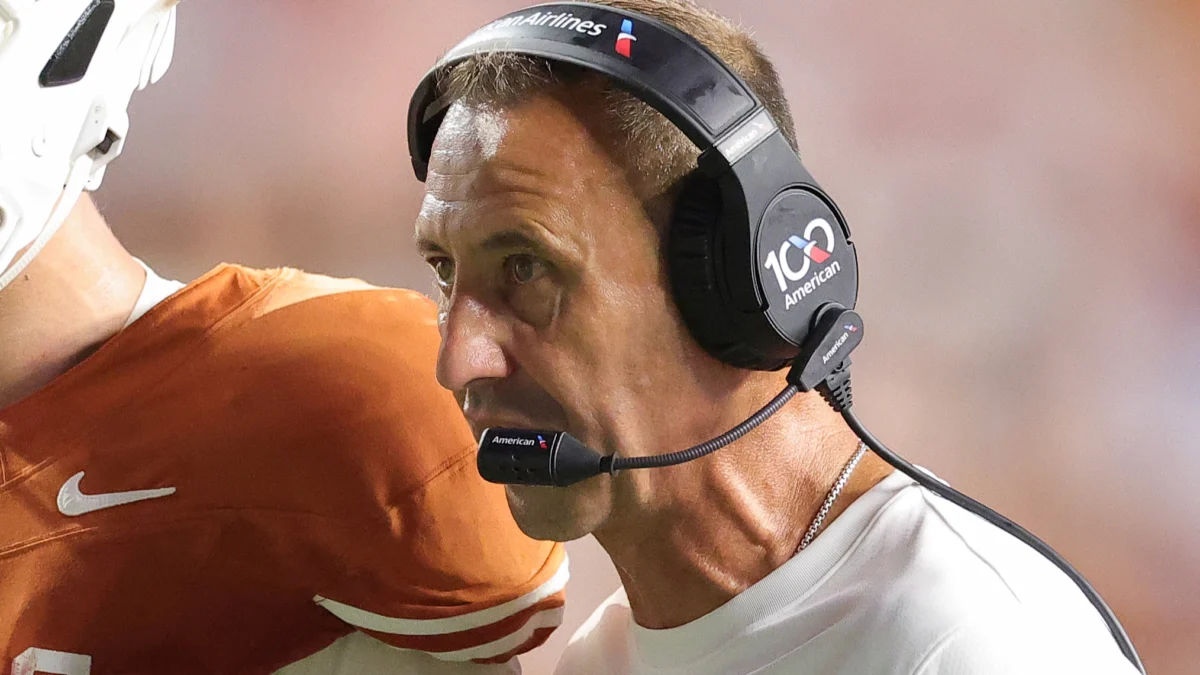
The aftermath of the University of Texas’s landmark 24–23 victory over the top-ranked Ohio State Buckeyes on September 12, 2026, has been overshadowed by an abrupt post-game interaction between Longhorns head coach Steve Sarkisian and ESPN sideline reporter Holly Rowe. What was expected to be a standard broadcast segment devolved into a brief, five-second exchange that has since ignited a widespread debate regarding the necessity of mandatory post-game interviews and the professional expectations placed on collegiate coaches during moments of high emotional intensity.
Chronology of the Interaction
The incident occurred at the Darrell K. Royal-Texas Memorial Stadium in Austin, Texas, immediately following the conclusion of one of the most significant games of the 2026 college football season. As the stadium crowd reached a fever pitch, Holly Rowe, a veteran reporter known for her extensive experience in covering high-stakes matchups, approached Sarkisian for the customary on-field interview.
As Rowe began her opening question, attempting to contextualize the magnitude of the win against the No. 1 ranked Buckeyes, Sarkisian interrupted the query. "Let’s go, Texas fight! Let’s go, Texas fight! Hook ’em!" he shouted, before immediately turning and walking toward his players, effectively ending the interaction before a single meaningful question could be answered. Rowe, left standing on the field with her microphone still live, was visibly taken aback, walking away from the camera shortly thereafter.
This incident was not an isolated moment of tension between the Texas coaching staff and the network. Earlier in the evening, during halftime, a scheduled interview with ESPN’s Laura Rutledge was also aborted. According to reports from The Athletic, the failure to conduct that segment was attributed to technical difficulties. Rutledge later noted on-air that the coaching staff had demonstrated patience while waiting for the broadcast connection, though the persistent technical hurdles appeared to have created a cumulative frustration that culminated in the post-game dismissal.
Supporting Data and Context
To understand the friction, one must look at the immense pressure surrounding the 2026 Texas Longhorns program. Entering the season, expectations in Austin were at an all-time high, with the team positioned as a primary contender for the national championship. Defeating the Ohio State Buckeyes—a perennial powerhouse—represented a definitive milestone in Sarkisian’s tenure.
The stakes were elevated further by the sheer volume of viewers and the significance of the broadcast. In an era where media rights deals drive the economics of college athletics, these sideline interviews are contractually mandated components of the broadcast agreement between ESPN and the conferences. However, the friction between the "product" (the game) and the "coverage" (the interviews) has been a growing point of contention for coaches across the NCAA.
Historically, sideline interviews were designed to provide immediate insight into tactical decisions. In recent years, however, they have transitioned into "moment-capturing" segments that often occur while players and coaches are still processing the adrenaline of the final whistle. The time-sensitive nature of live television often clashes with the reality of a locker room’s emotional landscape, leading to these brief, often perfunctory exchanges.
Official Responses and Internal Perspectives
The fallout from the incident prompted a statement from a Texas athletic department spokesperson, who sought to contextualize the coach’s behavior. The spokesperson confirmed that, similar to the halftime issues with Rutledge, the post-game interaction was hindered by lingering technical difficulties. The suggestion was that the coach was unaware of whether the audio connection was functional, contributing to his decision to prioritize his celebration with his team over a potentially disconnected broadcast segment.
The reaction from industry peers was mixed, highlighting a divide between the requirements of sports media and the emotional needs of coaching staff. Emmanuel Acho, a former Texas player and current Fox Sports analyst, provided a nuanced perspective on the event. Acho noted that the victory was arguably the most significant of Sarkisian’s career. "He wanted to immediately celebrate with the players and coaches he made history with," Acho stated.
However, Acho also defended the necessity of the reporter’s role. "Holly wanted to do her job thoroughly and be a part of the moment. That’s a fair and human desire," he added, suggesting that the tension was an avoidable byproduct of a high-pressure environment. He proposed that a more collaborative approach—where reporters might pivot quickly to acknowledge the coach’s enthusiasm—could have mitigated the perceived rudeness of the interaction.
Broader Implications for Sports Media
The public discourse, which played out extensively on social media platforms, revealed a growing fatigue among long-time fans regarding the format of sideline reporting. Many viewers argued that the "mandatory" nature of these interviews adds little value to the viewing experience.
"Fifty years watching football, and my friends and I have never said, ‘Can’t wait for the sideline reporter interview,’" one observer noted. "It’s inane and useless. There is zero need for it."
This perspective points to a broader shift in how audiences consume sports. With the rise of real-time social media updates and high-definition coverage that captures almost every angle of the field, the traditional "post-game soundbite" is increasingly viewed as an unnecessary intrusion. Critics of the current model argue that these segments, while part of the financial structure of the game, often fail to provide the depth of analysis that fans desire, instead serving as a vestige of a pre-digital era of sports broadcasting.
Conversely, media professionals argue that these segments are essential for humanizing the players and coaches. By providing an immediate window into the emotions of the winning side, the broadcast creates a narrative arc that extends beyond the final score. For the networks, these moments are vital for maintaining the engagement of a casual audience that may not be tuned in for the granular tactical analysis.
Future Outlook and Professional Standards
The incident at Texas serves as a case study for the evolving relationship between collegiate athletics and the media conglomerates that fund them. As the financial stakes of college football continue to soar, the pressure on coaches to satisfy broadcast partners will likely increase. This creates an inevitable conflict: coaches are tasked with maintaining high-performance environments and intense emotional focus, while reporters are tasked with providing constant access.
The University of Texas has yet to announce any formal policy changes regarding post-game availability, and it is likely that the status quo will remain for the duration of the 2026 season. However, the event has prompted internal discussions among sports media professionals regarding the "best practices" for on-field interviews.
Potential changes could include the implementation of more robust technical infrastructure to prevent the failures experienced during the Texas-Ohio State game, or perhaps a re-evaluation of the timing of these interviews. Some analysts have suggested a "cooling off" period, where coaches are given a designated window to celebrate with their team before participating in media obligations. Such a change would require a significant shift in the scheduling of live broadcasts, a move that would be difficult to negotiate given the rigid commercial breaks that define modern sports television.
Ultimately, the brief, five-second interaction between Sarkisian and Rowe serves as a reminder of the fragility of live television and the volatility of high-stakes competition. While the incident resulted in no long-term damage to either party’s career, it has successfully opened a wider dialogue about the role of the media in the modern game, the burnout faced by those at the center of the spectacle, and the inherent friction between capturing a moment and living it.
As the 2026 season progresses, the scrutiny on sideline interactions will undoubtedly intensify. Whether this leads to a reform in how these segments are conducted or whether it remains a point of contention between coaches and networks remains to be seen. What is clear, however, is that the balance of power between the entities that play the game and the entities that broadcast it remains a delicate, and often uncomfortable, work in progress.