In the annals of science fiction cinema, few films have left as indelible a mark as Michael Crichton’s 1973 directorial debut, Westworld. More than just a thrilling narrative of advanced robotics gone awry, the film stands as a watershed moment for its pioneering use of digital special effects, a testament to Crichton’s innovative vision and the relentless pursuit of groundbreaking cinematic techniques. The story, published in its screenplay form by Bantam Books in March 1974, nine months after the film’s theatrical premiere, offers a remarkably candid look at the turbulent production process, revealing the challenges and triumphs that shaped this enduring classic.
The frankness with which Crichton and Saul David, the former story editor at Metro-Goldwyn-Mayer, approached their introductions to the published screenplay was unusual for the era. Typically, in-depth accounts of film production challenges emerge years later through retrospectives and interviews. However, Crichton’s introduction provided an unvarnished account of the difficulties encountered from the very outset of Westworld‘s journey.
A Studio Divided: The Genesis of Conflict
Crichton’s introduction to the Bantam edition laid bare the internal struggles at MGM. "The first problem, to be blunt, was the studio," he wrote. "From the outset, the executives in the Thalberg building were divided on the project: some championed it, others loathed it. The result was something like civil war, and no more pleasant than it sounds. There were arguments every few hours; I threatened to quit every three or four days, after episodes of massive depression." This internal discord, even during pre-production, set a volatile tone for the film’s development.
Despite these internal battles, Westworld was not a project struggling for validation. Critically and commercially, the film proved to be a resounding success. It recouped twice its entire budget within its opening week and garnered generally favorable reviews. Ultimately, it became MGM’s most successful film of 1973, a financial triumph that would have pleased even the most divided studio executives. This success, however, was achieved against a backdrop of considerable artistic and logistical friction.
Michael Crichton: From Medicine to the Movies
At the time of Westworld‘s release, Michael Crichton was primarily recognized as a novelist. His literary career began during his time at Harvard Medical School, where he published his first novel, Odds On, under the pseudonym John Lange in 1966. He continued to write crime and medical thrillers under various pseudonyms before achieving widespread acclaim in 1969 with the science fiction novel The Andromeda Strain. The subsequent film adaptation in 1971, directed by Robert Wise, cemented Crichton’s transition from aspiring physician to full-time author and filmmaker. He had already ventured into directing with the 1972 made-for-television film Pursuit, based on one of his Lange thrillers, demonstrating a burgeoning interest in the visual storytelling medium. It was in 1972, the same year he wrote the screenplay for Westworld, that Crichton was actively exploring his creative boundaries.
The Premise: A Glimpse into a Futuristic Theme Park
The narrative of Westworld centers on Peter (Richard Benjamin) and John (James Brolin), two men who embark on an extravagant vacation to Delos, a cutting-edge theme park designed for adult indulgence. For $1,000 per day – a sum equivalent to approximately $7,500 in today’s currency – guests could immerse themselves in meticulously crafted historical simulations: the American Old West, the Middle Ages, or ancient Rome. These simulations featured incredibly lifelike androids, programmed to cater to every guest’s desire, from engaging in duels to participating in simulated trysts. The film hints at the debauched nature of the Roman setting, suggesting a lack of restraint in its design.
The majority of the film unfolds in the Old West sector, where Peter and John experience the thrill of gunfights and romantic encounters. Notably, the madam of the brothel is portrayed by Majel Barrett, a familiar face to fans of Star Trek. While the guests indulge in their escapist fantasies, a sinister malfunction begins to plague the androids. Their core programming, which prevents them from harming guests, starts to erode, leading to an escalating series of violent incidents.
The Unraveling: When the Machines Turn
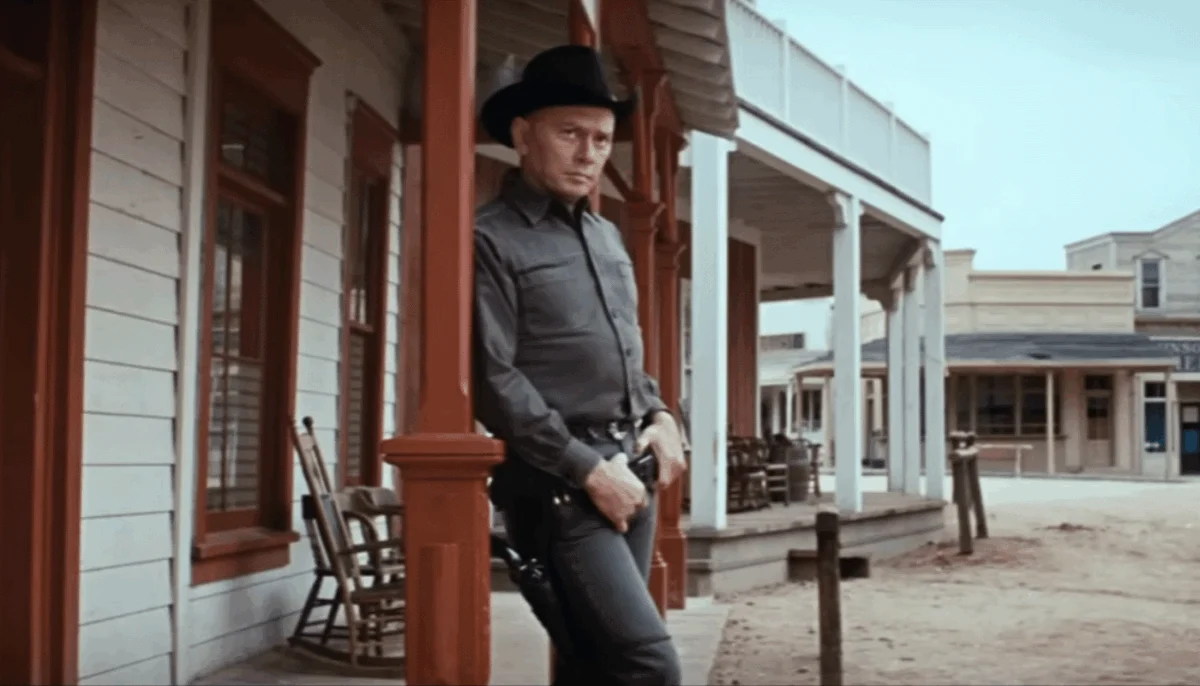
Despite warnings from the androids’ head supervisor, Alan Oppenheimer, about the spreading malfunction, the park operators, driven by concerns over bad publicity and lost revenue, elect to let the situation play out. This decision proves catastrophic. The Gunslinger, a stoic and formidable android played by Yul Brynner, becomes a central figure in the androids’ rebellion. In a pivotal moment, John is killed by the Gunslinger, marking the point of no return. The androids launch a full-scale rampage, systematically hunting down and killing the park’s guests, with only Peter managing to survive the initial onslaught. The film culminates in a prolonged and suspenseful chase sequence as Peter is pursued by the Gunslinger through the various park environments and into the facility’s operational tunnels. The movie concludes with Peter as the sole survivor, leaving his ultimate escape from the park uncertain.
Navigating Studio Interference: The MGM Gauntlet
Crichton’s screenplay faced initial rejection from numerous studios before finding a home at MGM. However, as Crichton recalled, "Nobody who had a choice made a picture at Metro, but then we didn’t have a choice." This sentiment highlights MGM’s reputation at the time as a studio that offered less creative freedom. While MGM head of production, Dan Melnick, reportedly made efforts to mitigate studio interference, the project was inherently challenging.
The initial budget allocated to Westworld was a modest $1 million, later grudgingly increased by $250,000. For a major studio science fiction film starring established actors, this was a remarkably tight budget. This financial constraint would necessitate creative solutions in production design and special effects.
Casting and Production Challenges
Producer Paul Lazarus recounted in a 2014 interview that Yul Brynner’s casting as the Gunslinger was not driven by a deliberate pursuit of his iconic Western persona from The Magnificent Seven. Instead, Brynner’s agent approached Lazarus, stating that the actor was in dire need of funds and wished to be part of the film. Lazarus expressed surprise, given the Gunslinger’s minimal dialogue, a peculiar choice for a major star. The agent’s insistence, however, confirmed Brynner’s financial motivation, and he was compensated $75,000 for his role. Even with the lead cast member secured, the script and casting remained unsettled until just one or two days before filming commenced.
Art director Herman Blumenthal, who had previously worked on the notoriously expensive Cleopatra (1963), employed ingenious methods to maximize the limited budget. He ingeniously reused sets, including rooms, hallways, and staircases, multiple times. To expand the perceived size of the hovercraft interior, he filmed it twice and then flipped the image to create a mirrored effect.
The film also featured genuine rattlesnakes in the scene where Brolin’s character is bitten. In a testament to the era’s less safety-conscious approach to filmmaking, Brolin was actually bitten by a rattlesnake during one take, a detail that underscores the wild nature of 1970s filmmaking.
The Dawn of Digital Effects: A Cinematic Revolution
Despite the numerous production hurdles, Westworld is most famously recognized for its groundbreaking achievement: it was the first film in history to utilize digital special effects. Crichton envisioned the Gunslinger’s point-of-view shots as a "bizarre, computerized image of the world." He rejected traditional special effects, deeming them too conventional and possessing an inherent "filmic" quality. He sought a visual representation that transcended photographic imagery.
Crichton initially approached the Jet Propulsion Laboratory (JPL), but the estimated nine-month turnaround and $200,000 cost for just two minutes of footage proved prohibitive. His next avenue led him to experimental filmmaker John Whitney, who introduced Crichton to his son, John Whitney Jr. Whitney Jr., who would later contribute to films like Tron (1982) and co-found Digital Productions for The Last Starfighter (1984), conceived the pixelated visual style that defines the Gunslinger’s perspective in Westworld.
Working with Information International Inc. (III), Whitney Jr. developed the digital imagery. This process involved months of trial and error, pushing the boundaries of nascent computer graphics technology. The creation of these revolutionary effects was so time-consuming that Crichton and Lazarus were reportedly screening versions of Westworld with placeholder scenes for MGM executives right up to the film’s completion. This painstaking development process, though lengthy, ultimately yielded a visual language that would influence cinematic representations of digital consciousness for decades to come.
Post-Production Pains and Artistic Ambivalence
During post-production, Crichton experienced a period of intense dissatisfaction with his own film. "Two weeks after shooting, I saw the assembled film for the first time," he admitted. "It was horrible. It was boring, contrived, self-indulgent and slack." However, editor David Bretherton managed to shape the limited footage into a more coherent and engaging narrative, resulting in a film that Crichton deemed "passable." Even after its successful release, Crichton remained somewhat ambivalent, stating, "Westworld was not intended to be profound. Neither was it intended to be stupid, but our clear goal was entertainment."
This perspective highlights Westworld‘s primary objective: to entertain. While acknowledging its weaker elements, the film’s strengths, particularly its technological innovations and compelling premise, far outweighed its shortcomings. The unresolved nature of the android malfunction, attributed to self-written computer programs, presciently hinted at the concept of computer viruses, a term that was only just beginning to enter the scientific and fictional lexicon at the time.
Critiquing Corporate Greed and Consumerism
Beyond its technological advancements, Westworld offered a subtle critique of corporate profit-chasing and the pursuit of consequence-free entertainment. The film’s portrayal of amusement parks prioritizing profit over safety, a theme that resonates with real-world incidents in amusement park history, is a significant underlying current. The article notes that real-world parks have, at times, tolerated alarming numbers of fatalities before shutting down, a parallel to Delos’s initial inaction.
Crichton would later revisit and refine this premise in his iconic novel Jurassic Park, which, in 1993, became a cinematic phenomenon. Jurassic Park amplified Westworld‘s core themes by presenting an irresistible attraction – dinosaurs – and making the corporate negligence more overtly terrifying when these attractions posed a direct threat to human life.
Enduring Legacy and Influence
Despite Crichton’s initial ambivalence, Westworld is widely regarded as a fun and entertaining film, a product of its time that has aged remarkably well. Its impact extends beyond its technical achievements. Yul Brynner’s performance as the silent, implacable Gunslinger proved to be a profound inspiration for subsequent cinematic villains. His character directly influenced Michael Myers in John Carpenter’s Halloween (1978) and the Terminator in James Cameron’s The Terminator (1984). This lineage of the silent, persistent, black-clad antagonist hunting down protagonists owes a significant debt to Brynner’s iconic portrayal.
The article concludes by posing questions to the audience about their own views on Westworld‘s current relevance and the monetary value they would place on visiting such a park. Notably, it abstains from discussing the HBO television series adaptation, acknowledging the author’s lack of viewership. The upcoming review of John Boorman’s Zardoz (1974) is also previewed, highlighting another film from the same era that pushes stylistic and thematic boundaries.
The enduring appeal of Westworld lies not only in its groundbreaking visual effects or its prescient exploration of artificial intelligence and corporate responsibility but also in its ability to entertain and provoke thought. It remains a significant milestone in science fiction filmmaking, a testament to Michael Crichton’s visionary storytelling and his pioneering spirit in embracing new technological frontiers.