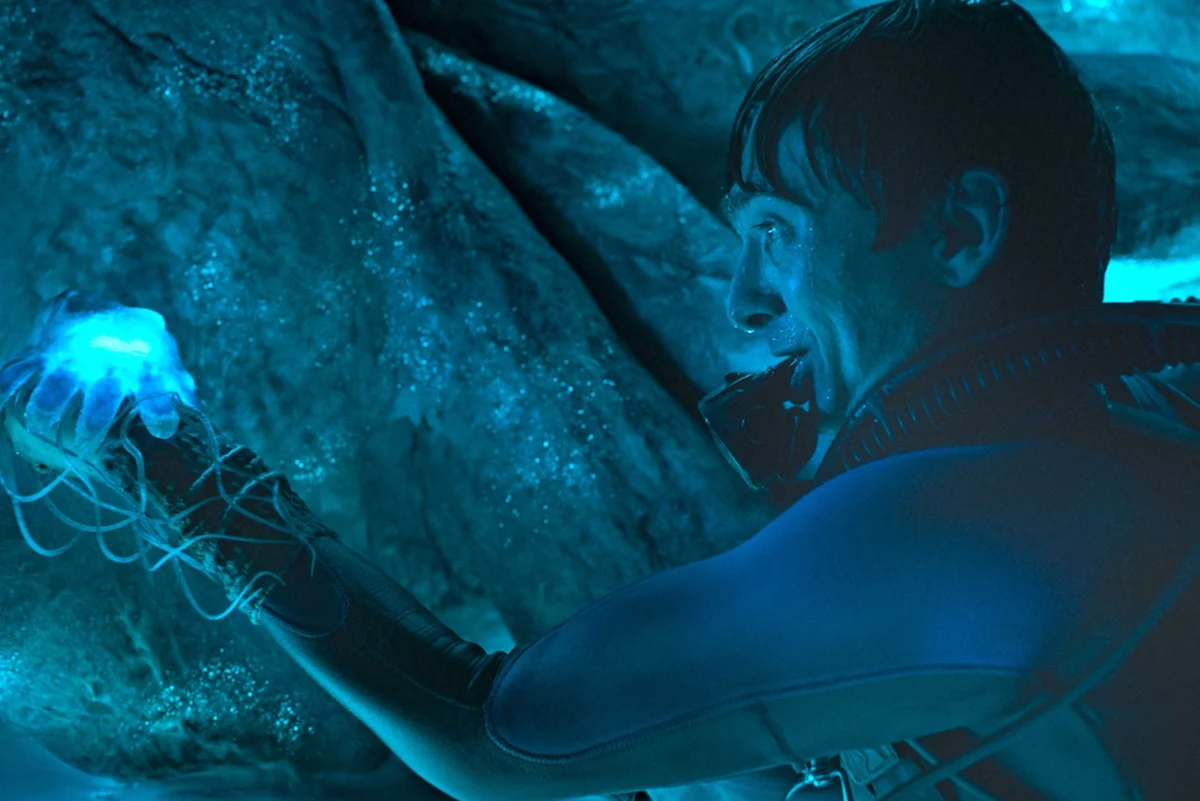
The latest promotional footage for the upcoming survival drama Whalefall delivers a stark, uncompromising look at its central premise: a desperate struggle for survival from within the anatomy of a sperm whale. Directed by Brian Duffield and co-written alongside author Daniel Kraus—who penned the bestselling novel of the same name—the film stars Austin Abrams as Jay, a young diver who becomes accidentally ingested by a marine mammal during a catastrophic deep-sea encounter.
Scheduled for a nationwide theatrical release on October 16, 2026, the project combines intense psychological elements with physiological horror. While previous marketing materials emphasized the emotional undercurrents of the narrative—specifically familial grief and a complex father-son dynamic involving a character portrayed by Josh Brolin—the newest trailer pivots sharply toward the visceral mechanics of the protagonist’s confinement. With only a dwindling hour of oxygen remaining, the narrative explores the razor-thin margin between life and death deep beneath the ocean’s surface.
Narrative Premise and Plot Mechanics
The story originates from Daniel Kraus’s acclaimed 2023 novel, Whalefall, which garnered significant attention for its unprecedented setting and rigorous adherence to marine biology and diving physics. In the cinematic adaptation, Abrams portrays Jay, an amateur diver exploring the ocean depths when he is caught in the crossfire of a violent struggle between a sperm whale and a giant squid. In an unexpected turn of events, the whale engulfs the diver alongside its prey, plunging him into a dark, alien, and deeply hazardous environment.
Unlike traditional survival narratives that take place in remote wilderness or post-apocalyptic landscapes, Whalefall confines its protagonist to a single, organic, and hostile container. The newly released trailer highlights the harrowing conditions inside the animal’s digestive tract, showcasing distinct biological hazards such as glowing deep-sea organisms, an incapacitated yet dangerous giant squid, and a failed, frantic attempt by Jay to escape through the whale’s blowhole.
Crucially, the narrative maintains a high degree of technical realism regarding diving equipment. Throughout the ordeal, Jay must keep his regulator firmly gripped in his mouth to utilize his remaining compressed air, introducing a distinct physical and cinematic hurdle for both the actor and the filmmakers. This constraint elevates the tension, transforming every breath into a calculated resource.
Behind the Scenes: Adaptation and Production
The journey of Whalefall from page to screen reflects a deliberate collaboration between the literary creator and the filmmaking team. Daniel Kraus, known for his ability to blend high-concept genre fiction with deep emotional resonance, co-authored the screenplay with director Brian Duffield. Duffield, recognized for his work on taut, genre-defying projects such as No One Will Save You and Spontaneous, brings a distinct visual style well-suited to claustrophobic storytelling.
Industry analysts have noted the unique production challenges presented by the source material. A significant portion of the narrative takes place entirely within the dark, shifting confines of a whale’s interior. This structural choice raises questions regarding the film’s pacing and real-time execution. In the novel, the passage of time mirrors the physical depletion of Jay’s oxygen supply, suggesting that the cinematic adaptation may employ a similar real-time framing device for its central sequences.
Furthermore, the project balances its intense physical thrills with a poignant emotional core. Flashbacks and psychological reflections shed light on Jay’s strained relationship with his late father, an experienced diver whose legacy hangs heavy over the expedition. Josh Brolin’s brief appearances in the promotional material underscore this generational conflict, ensuring that the film operates simultaneously as an external survival ordeal and an internal journey of reconciliation.
Chronology and Marketing Campaign
The rollout of Whalefall has followed a calculated trajectory typical of major studio thrillers designed to build sustained audience anticipation.
- Literary Origin (August 2023): Daniel Kraus publishes Whalefall, which quickly receives critical acclaim for its meticulous research and inventive premise, drawing comparisons to classic survival literature.
- Development and Casting (2024–2025): News breaks regarding the film adaptation, with Brian Duffield attached to direct and Austin Abrams cast in the lead role of Jay, later joined by Josh Brolin.
- Initial Teaser Releases (Early 2026): The studio releases initial trailers focusing on the emotional dimensions of the father-son relationship and the broader atmospheric tone of the deep-sea setting.
- Theatrical Trailer Debut (Mid-2026): The latest promotional clip shifts focus directly to the visceral, inside-the-whale survival elements, highlighting the use of practical tools such as the squid beak ("Beaky") and emphasizing the ticking-clock nature of the oxygen supply.
- Theatrical Premiere (October 16, 2026): The film is slated to open exclusively in theaters, positioning it as a major autumn release for audiences seeking high-concept genre entertainment.
Industry Implications and Audience Expectations
The release of Whalefall arrives at a time when audiences increasingly gravitate toward high-concept, contained thrillers that prioritize intense pacing and unique settings. By restricting the primary location of the film to the interior of a marine mammal, the production team has engineered a distinct visual and atmospheric challenge that sets the project apart from standard disaster or survival cinema.
Box office and critical analysts observe that movies relying heavily on single-location tension—such as 127 Hours, Buried, or Open Water—depend heavily on strong lead performances and rigorous spatial direction. Abrams’s physical commitment to the role, combined with Duffield’s precise pacing, places the film in a favorable position to capture the attention of thriller enthusiasts and literary fans alike.
Moreover, the scientific and biological accuracy championed in Kraus’s original text has cultivated a dedicated readership eager to see how visual effects and practical set design translate the complex internal anatomy of a sperm whale to the big screen. As the countdown to October 16, 2026, continues, Whalefall stands as one of the most distinctive cinematic experiments of the year, promising a theatrical experience defined by pressure, breath, and survival against impossible odds.