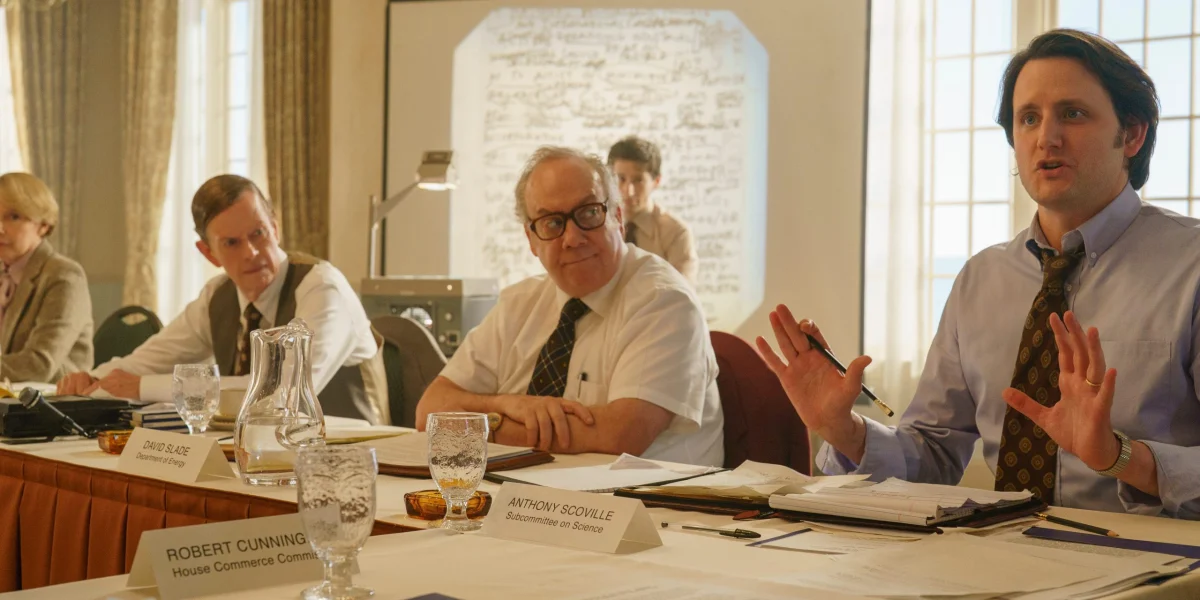
The intersection of science, politics, and environmental policy has rarely been as starkly illuminated as it was during a humid weekend in 1980 at a beachside resort in St. Petersburg, Florida. Gathered under a straightforward congressional mandate, twenty distinguished experts—comprising climate scientists, environmental activists, attorneys, and federal policymakers—convened to draft a definitive statement on the looming, yet largely unacknowledged, threat of rising carbon dioxide emissions.
Directed and written by Tom McCarthy, the resulting cinematic and historical examination, A Statement, brings this pivotal closed-door meeting back into the public consciousness. Utilizing actual conference transcripts as the bedrock of its screenplay, the film captures an inflection point in modern history. It illustrates how the architecture of political compromise and scientific caution hindered early interventions against a crisis that now defines the twenty-first century.
The Genesis of a Global Warning: Background Context and Historical Timeline
To understand the weight of the 1980 gathering, one must examine the protracted timeline of climate awareness. The foundational scientific connection between fossil fuel consumption and atmospheric warming was first established in 1896 by Swedish chemist Svante Arrhenius. Arrhenius calculated that the doubling of carbon dioxide in the atmosphere could significantly elevate global temperatures through the greenhouse effect. However, for decades, this hypothesis remained an academic curiosity, largely divorced from public policy discussions.
By the late 1970s, accumulating empirical data began to shift scientific consensus. Recognizing the potential socio-economic ramifications of shifting weather patterns and destabilized ecosystems, the United States government authorized studies to evaluate the environmental dangers of carbon dioxide accumulation. This legislative push led directly to the formation of the National Commission on Air Quality and the commissioning of the 1980 St. Petersburg conference.
The mandate given to the twenty assembled participants was deceptively simple: formulate a concise, actionable statement advising Congress on how to control and mitigate the impending problem. Yet, the chasm between identifying an existential threat and designing a politically palatable bureaucratic response proved nearly insurmountable from the outset.
Chronology of a Stalemate: Four Days in St. Petersburg
Over the course of four intensive days, the St. Petersburg resort served as a crucible for competing ideologies and professional methodologies. Moderated by Tom Jorling—portrayed on screen by Paul Rudd—the conference was designed to foster collaborative problem-solving among factions that rarely intersected.
The opening sessions immediately laid bare the communication barrier between empirical researchers and administrative policymakers. Dr. David Rose presented a series of sobering projections detailing the multi-decade environmental consequences of escalating carbon dioxide emissions. For non-scientists in the room, such as Annemarie Crocetti of the National Commission on Air Quality, the deeply technical deep dive highlighted the difficulty of translating complex atmospheric models into language that could motivate lawmakers.
As the days progressed, the debate shifted from data collection to political viability. The fundamental tension of the conference crystallized around a distinction emphasized early by Jorling: the difference between unanimity and consensus.
In addressing young atmospheric science expert Robert Cunningham, Jorling explained that unanimity required every participant to fully agree, whereas consensus merely required that no participant actively disagreed. Even this lower threshold proved elusive. The scientific community, inherently adverse to absolutes and accustomed to operating within probabilities and margins of error, clashed directly with the political necessity of certainty. Lawmakers and regulators argued that actionable legislation required definitive declarations to successfully sell environmental regulations to skeptical constituents and opposing legislators.
Supporting Data and the Mechanics of Breakdown
The discussions captured in the St. Petersburg transcripts reflect a systemic paralysis that continues to plague environmental policymaking. The participants operated under professional standards characterized by an overabundance of caution. While virtually everyone in the room acknowledged the reality of anthropogenic climate change, the fear of overstating the risk—or conversely, failing to capture the full scope of the disaster—paralyzed the drafting process.
Key quantitative metrics discussed during the era involved projected carbon loading rates and anticipated shifts in global mean temperatures over fifty-to-one-century horizons. Although the computing power of 1980 was a fraction of today’s capacity, the directional accuracy of the models presented by researchers like Rose has been largely validated by subsequent decades of observation.
Despite this accuracy, the institutional machinery required to translate data into law faltered. The transcripts reveal poignant moments of frustration, such as those embodied by environmental activist Rafe Pomerance, who repeatedly pushed for urgent language only to be met by procedural roadblocks and administrative hesitance.
Official Responses and Stakeholder Perspectives
While the 1980 conference did not result in immediate, sweeping legislative action, its proceedings offer a profound case study in institutional behavior during the nascent stages of a global crisis.
Observers and policy analysts examining the historical record note that the St. Petersburg meeting exposed the vulnerability of democratic frameworks when confronted with long-term, incremental threats. Politicians demanded immediate, unassailable proof before expending political capital, while scientists guarded their institutional credibility by refusing to step outside the bounds of peer-reviewed consensus.
Furthermore, the inclusion of non-scientist bureaucrats and activists highlighted the socio-economic divisions inherent in environmental policy. The participants were acutely aware that any regulatory framework developed from their statement would ultimately impact working-class industries, energy producers, and regional economies. This awareness introduced a layer of self-censorship and diplomacy that diluted the urgency of their final recommendations.
Broader Impact and Implications for Modern Governance
The legacy of the 1980 St. Petersburg conference, as analyzed through contemporary historical lenses, extends far beyond the historical text of its unpublished or overlooked reports. It serves as an enduring template for the difficulties of collective action in the face of planetary-scale challenges.
The systemic inability of the 1980 delegation to forge a bold, uncompromised statement foreshadowed decades of delayed climate policy. By illustrating how well-intentioned experts can become entangled in procedural semantics and political calculations, the event provides critical insight into the mechanics of governmental inertia.
Ultimately, the examination of these historical transcripts—whether through academic study or artistic adaptation—forces a reckoning with the concept of institutional delay. The recurring tendency to defer difficult decisions, prioritize short-term political stability over long-term survival, and demand absolute certainty in an uncertain world remains the central vulnerability of modern democracies. The 1980 conference stands not merely as a relic of early environmental policy, but as a mirror reflecting the ongoing struggle to align scientific reality with political will before time runs out.