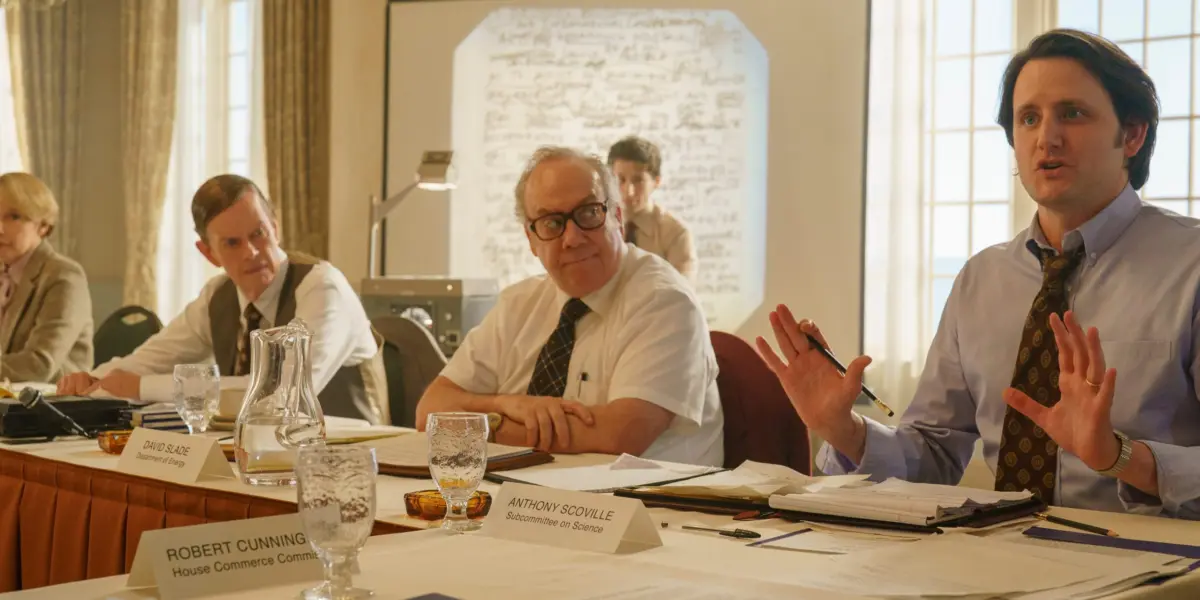
The intersection of science, policy, and political inertia has rarely been captured with such granular precision as in Tom McCarthy’s cinematic exploration, A Statement. Set against the sun-bleached backdrop of a Florida beachside resort in 1980, the film chronicles a pivotal, albeit largely forgotten, moment in modern environmental history: a weekend conference convened by the United States government to address the burgeoning threat of carbon dioxide emissions. Featuring an ensemble cast led by Paul Rudd, Evan Peters, Paul Giamatti, and John Turturro, the narrative reconstructs the four-day gathering where twenty experts—comprising scientists, activists, lawyers, and policymakers—were tasked with a deceptively simple congressional mandate: draft a definitive statement outlining how the nation should confront global climate change.
Rather than relying on conventional dramatic license for its core exchanges, A Statement anchors its screenplay directly in historical record. Every line of dialogue spoken during the formal deliberations is lifted verbatim from the actual conference transcripts. By weaving these historical artifacts into a dramatic framework, McCarthy delivers a compelling examination of how the foundational architecture of contemporary climate policy was constructed, compromised, and ultimately constrained by the realities of political bureaucracy.
Background Context and Historical Origins
While public consciousness regarding global warming often traces its roots to late-twentieth-century environmental movements, the scientific foundation of the crisis was established decades prior. In 1896, Swedish chemist Svante Arrhenius first postulated the connection between the industrial combustion of fossil fuels and the elevation of Earth’s surface temperature via the greenhouse effect. However, nearly a century passed before the United States federal government formally attempted to synthesize these warnings into actionable legislative guidance.
By 1980, mounting empirical data regarding atmospheric carbon accumulation prompted Congress to authorize targeted inquiries into environmental stability. The resulting studies underscored an urgent need for regulatory foresight. In response, the federal administration convened a multidisciplinary cohort to formulate a cohesive strategy. This select group represented a cross-section of American expertise, including atmospheric scientists measuring shifting weather patterns, legal scholars navigating regulatory frameworks, and passionate activists seeking immediate ecological intervention.
Moderated by Tom Jorling, portrayed in the film by Paul Rudd, the delegation was housed for four intensive days in a St. Petersburg, Florida hotel. Their assignment was clear: produce a consensus document that could guide lawmakers toward meaningful environmental stewardship. Yet, as the historical record demonstrates, translating complex scientific projections into palatable legislative language proved an extraordinary challenge.
Chronology of the St. Petersburg Deliberations
The 1980 conference unfolded over four days of rigorous debate, punctuated by technical presentations, ideological clashes, and strategic negotiations.
Day One established the baseline parameters of the crisis. Following introductory remarks, Dr. David Rose—portrayed by John Turturro—presented a series of detailed projections outlining the trajectory of global carbon dioxide emissions and their corresponding environmental impacts over subsequent decades. This technical deep-dive served as a litmus test for the interdisciplinary assembly, highlighting the inherent communication barrier separating empirical researchers from public policy administrators.
Days Two and Three were characterized by escalating friction between the demand for scientific accuracy and the necessity of political pragmatism. Atmospheric science experts, reluctant to endorse absolutes within a rapidly evolving field of study, clashed with policy advocates who insisted that definitive statements were required to motivate legislative bodies. Environmental activists, represented in the film by Evan Peters’s character Rafe Pomerance, grew increasingly frustrated by institutional caution and procedural delays.
Day Four culminated in a structural impasse. Despite unanimous agreement among participants that anthropogenic emissions posed a clear and present danger to global ecosystems, the assembly struggled to reconcile divergent professional standards. The inability to finalize a cohesive draft statement left participants grappling with the realization that institutional caution had crippled their collective mandate.
Supporting Data and Technical Realities
The intellectual friction at the heart of the 1980 conference stemmed from a fundamental dichotomy between scientific methodology and political utility. Scientific inquiry thrives on nuance, probabilistic forecasting, and continuous revision in the light of new data. Conversely, the legislative process demands certainty, clear mandates, and absolute metrics to justify regulatory intervention to constituents and economic stakeholders.
During the St. Petersburg deliberations, experts grappled with several critical variables:
- Emissions Projections: Calculations regarding the exponential growth of carbon dioxide output resulting from industrial expansion and fossil fuel consumption.
- Climatic Feedback Loops: Early models predicting accelerated warming trends, polar ice depletion, and destabilized weather systems.
- Consensus Versus Unanimity: As debated by conference moderator Tom Jorling and atmospheric researcher Robert Cunningham, the distinction between unanimity (total agreement) and consensus (an absence of active disagreement) proved vital to operational progress, yet ultimately unattainable under rigid procedural standards.
These technical realities underscored a pervasive systemic vulnerability: the mechanisms designed to draft public policy were ill-equipped to process long-term, cumulative environmental threats without immediate, visible economic catalysts.
Official Responses and Reactions from Stakeholders
While the participants of the 1980 conference operated behind closed doors, the retrospective analysis of their deliberations reveals distinct viewpoints among the participating factions:
- The Scientific Community: Researchers maintained that premature policy recommendations based on incomplete models could undermine scientific credibility, advocating instead for continued observation and cautious provisional assessments.
- Policymakers and Bureaucrats: Government representatives emphasized the practical limitations of federal jurisdiction, noting that any proposed statement required sufficient political backing to survive legislative scrutiny.
- Activists and Legal Advocates: Reform-minded participants argued that procedural minutiae and institutional hesitation amounted to active complicity in environmental degradation, urging immediate, unambiguous calls to action.
The convergence of these competing priorities created an environment where compromise frequently devolved into paralysis, effectively neutralizing the panel’s overarching objective.
Broader Impact, Implications, and Cinematic Analysis
Tom McCarthy’s adaptation transcends the boundaries of standard historical drama by reframing bureaucratic failure as a systemic tragedy rather than an individual shortcoming. By contrasting the intimate, human moments of the attendees against the monumental scale of the ecological crisis, A Statement illustrates the psychological toll of institutional inertia.
The film’s structural reliance on verbatim transcripts engenders an immersive, vérité-style experience, positioning the viewer as an unacknowledged observer in a high-stakes legislative seminar. Through dynamic performances—notably Turturro’s transition from rigid academic detachment to suppressed emotional urgency, and Amy Ryan’s poignant delivery of the conference’s central ethical dilemma—the narrative humanizes the abstractions of climate policy.
The implications of the 1980 St. Petersburg conference resonate powerfully within contemporary political discourse. The failure to establish decisive policy consensus four decades ago established a precedent of delayed action that continues to complicate global climate mitigation efforts. By examining the historical friction points of early environmental governance, A Statement serves as both an archival autopsy of a missed opportunity and a cautionary reminder of the structural hurdles confronting modern democratic institutions as they attempt to address planetary-scale crises.