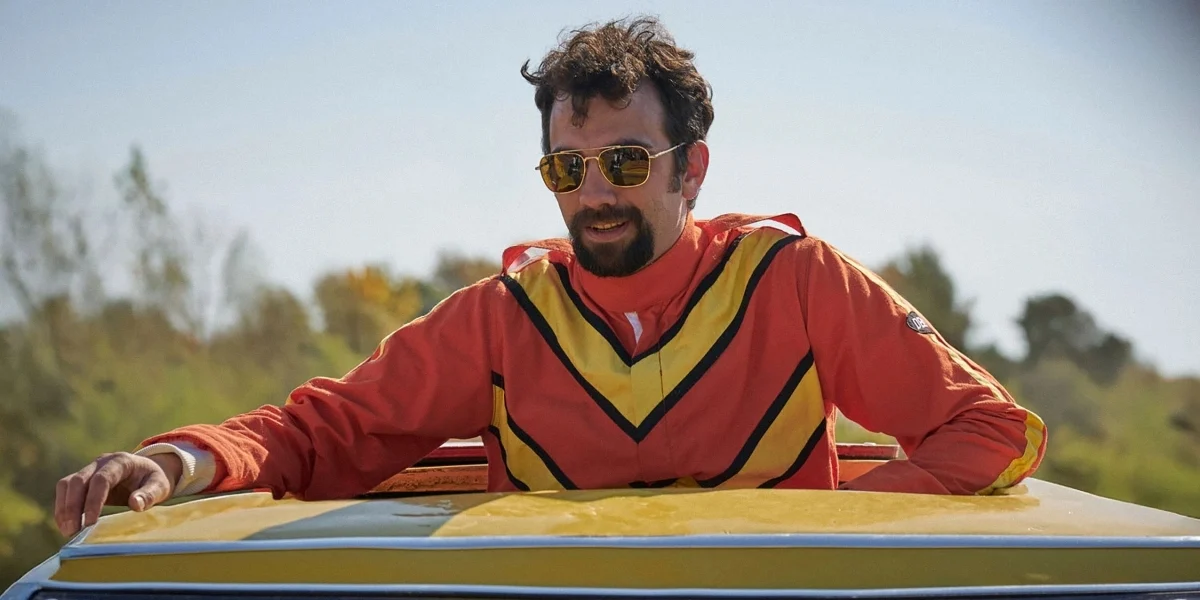
The release of Michael Dowse’s hybrid feature film The Stunt Driver brings renewed attention to one of the most eccentric chapters in 1970s North American daredevil history, chronicling the ill-fated and deeply ambitious quest of Canadian stuntman Ken Carter to launch a rocket-powered Lincoln Continental across the St. Lawrence River from Canada to the United States. Spanning 99 minutes, the film reunites director Dowse with lead actor Jay Baruchel following their successful collaboration on the 2011 comedy Goon. However, rather than playing strictly for laughs, The Stunt Driver adopts an innovative meta-narrative structure that blends newly shot dramatic sequences with archival footage from Robert Fortier’s acclaimed 1981 National Film Board of Canada (NFB) documentary, The Devil at Your Heels. Alongside Baruchel, the film features a robust ensemble cast including Ed Helms as rocket engineer Dick Keller, Ben Foster as Evel Knievel, Laurence Leboeuf, Dan Bakkedahl, Joe Cobden as documentarian Robert Fortier, and Marc Beaupré. Through this unique cinematic lens, the film explores the fragile boundary between bravery and delusion, framing Carter’s obsessive pursuit not merely as a roadside spectacle, but as a complex psychological and cultural artifact of 1970s Canada.
The Main Facts of the Stunt and the Production
At its core, The Stunt Driver dramatizes the true-life exploits of Kenneth Gordon Polsjek—better known by his professional moniker, Ken Carter—whose grand ambition was to build a steam-powered rocket car and clear a one-mile span of the St. Lawrence River, touching down on American soil. The logistical hurdles were monumental, involving millions of dollars in financing, untested propulsion technology, severe regulatory pushback, and extreme physical danger.
Dowse’s film captures this high-stakes environment by utilizing a nested, Matryoshka-doll structure. Widescreen 35mm dramatic footage is juxtaposed against grainy, square-aspect 16mm archival material. The production acts simultaneously as a narrative feature and a commentary on the making of the original 1981 documentary, embedding filmmaker Robert Fortier directly into the plotline via Joe Cobden’s performance. This stylistic choice allows Dowse to maintain documentary realism regarding the actual physical attempts—both triumphant and catastrophic—while offering a deeply nuanced psychological portrait of the man behind the wheel.
Baruchel’s performance divides the narrative tension between the calculated, promotional impresario side of Polsjek and the self-destructive, adrenaline-fueled persona of Ken Carter. This duality humanizes the legendary figure, shedding light on the quiet moments of hesitation, strategic delays, and underlying anxieties that frequently plagued the build-up to launch dates, challenging the simplistic media narrative of the era that often reduced Carter to a reckless madman.
Chronology of a Quixotic Obsession
The historical backdrop of Ken Carter’s crusade stretches across the late 1970s, an era defined by a booming cultural appetite for daredevil stunts popularized by figures like Evel Knievel. The chronology of Carter’s endeavor was marked by repeated delays, financial crises, and technical failures that pushed the stuntman to his psychological and financial limits.
Initially conceptualized years prior, the St. Lawrence River jump required the construction of a colossal launch ramp on the Canadian shoreline, designed to propel a modified, rocket-propelled sedan a vertical and horizontal distance previously thought impossible for a wheeled vehicle. Throughout the late 1970s, test runs were conducted at various airstrips, yielding mixed results that frequently destroyed expensive equipment and severely strained relations with financial backers and engineers.
The tension culminated during the protracted production of Robert Fortier’s 1981 NFB documentary, which captured the agonizing reality of a project constantly teetering on the edge of insolvency and collapse. By weaving these historical touchpoints into a contemporary dramatic framework, Dowse’s 2026 film maps out the slow-motion erosion of a man consumed by his own mythos. The timeline presented in The Stunt Driver honors the exhaustive, years-long ordeal documented by the NFB crew, highlighting the stark contrast between the fleeting seconds of the actual jumps and the grinding, multi-year torment required to make them happen.
Supporting Data and Historical Context
The economics and engineering behind Carter’s stunt were staggering for the era. Working alongside key technical personnel—faithfully recreated in the film by Ed Helms as rocket engineer Dick Keller—Carter attempted to harness aerospace technology for terrestrial stunt work. The vehicle, a heavy luxury sedan heavily modified with steam and rocket propulsion systems, was designed to reach velocities exceeding 300 miles per hour before leaving the ramp.
Archival records from the National Film Board of Canada indicate that the original documentary faced its own production hurdles, taking years to complete as Fortier and his crew shadowed Carter through endless financial bailouts, equipment blowouts, and psychological valleys. In The Stunt Driver, this historical data is leveraged to provide structural authenticity. The film’s inclusion of figures like Ben Foster’s skeptical Evel Knievel and Marc Beaupré’s French-Canadian cowboy persona grounds the narrative in the hyper-masculine, highly competitive subculture of 1970s daredevils, where branding, bravado, and a willingness to court death were the primary currencies.
Furthermore, the supporting cast adds critical dimension to the domestic fallout of such obsessions. Laurence Leboeuf’s portrayal of Gloria provides emotional counter-weight, preventing the narrative from sliding entirely into a celebration of unchecked male ego by anchoring the collateral damage experienced by those closest to the stuntman.
Broader Impact, Implications, and Cultural Subtext
Beyond the mechanics of the ramp and the roar of the rocket engine, Michael Dowse’s film utilizes Carter’s journey as a canvas for broader socio-political commentary. Set against the backdrop of a shifting Canada marked by political tensions, regional divides, and the looming existential questions surrounding national identity—particularly the Franco-Anglais dynamics within Quebec and the broader federation—Carter’s literal attempt to bridge the geographic and political divide between Canada and the United States takes on metaphorical weight.
In Dowse’s interpretation, the stunt was viewed by its creator not merely as a personal test of courage, but as a patriotic necessity designed to place Canadian audacity on the global map. The irony of the border-crossing stunt resonates sharply against contemporary geopolitical backdrops, where modern political posturings often mimic the theatricality of 1970s daredeviltry, albeit with far higher stakes.
The film suggests that Carter’s madness was, in its own peculiar way, a rational response to a mundane world that offered few avenues for true individual transcendence. By framing the narrative with a hypnotic framing device—encouraging both characters and viewers to confront their fears—The Stunt Driver transcends the traditional biographical sports or stunt film format. It evolves into a meditation on memory, media construction, and the human compulsion to defy limits, ensuring that the legacy of the "Mad Canadian" achieves the enduring immortality he so relentlessly chased across the ice and water of the St. Lawrence River.