The production, spearheaded by the renowned animation studio MADHOUSE, represents a departure from the high-octane shonen action that defined Natsume’s earlier tenure on One-Punch Man and the genre-bending multiversal narratives explored in his original series Sonny Boy. By shifting toward an arthouse aesthetic, ghost – end of night challenges the conventional boundaries of anime, opting for an abstract, existential inquiry into the nature of reality and human connection.
The Evolution of Shingo Natsume’s Directorial Vision
Shingo Natsume has long been regarded as one of the most versatile figures in contemporary animation. His career trajectory, which began under the tutelage of Shinichiro Watanabe on Space Dandy, established a foundation in visual experimentation and non-linear narrative structures. This background proved vital for his later projects, where he consistently pushed the technical capabilities of digital animation.
In Sonny Boy, Natsume explored the concept of the multiverse through a lens of adolescent malaise and institutional critique. With ghost – end of night, he appears to be refining this thematic preoccupation. The film posits a hypothetical scenario—often described in early critical discourse as "Haruhi Suzumiya in an Emo Phase"—that references the foundational light novel series The Melancholy of Haruhi Suzumiya. While Haruhi focused on a protagonist whose boredom threatened the structural integrity of the universe, Natsume’s latest work replaces that anxiety with a more clinical, detached existential dread.
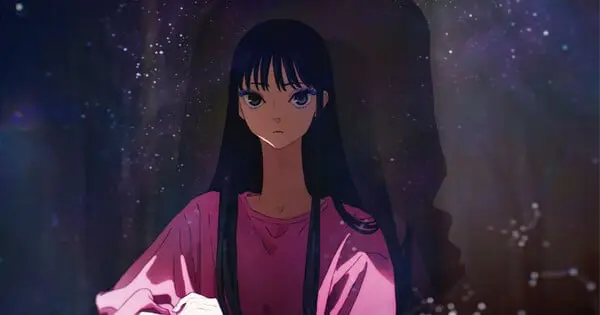
The narrative follows Nike, a high school student endowed with administrative authority over a system that dictates mortality. In a society characterized by the elimination of labor and the pursuit of endless distraction, Nike finds herself tasked with "cleansing" the universe of what she perceives as "filth"—metaphorical kaleidoscopic flowers that sprout from the emptiness of their existence.
Narrative Structure and Thematic Framework
The film’s structure is notably non-traditional, favoring atmospheric immersion over linear progression. It introduces Masu, a secondary character who acts as an ideological foil to Nike. Through Masu’s history—revealed via fragmented flashbacks—the film examines the tangible versus the ephemeral. Masu’s reliance on physical mementos, such as tattoos documenting his travels, stands in contrast to the ethereal, detached world that Nike inhabits.
Critics and industry observers have noted the film’s resistance to conventional storytelling. The pacing is intentionally erratic, with scenes that eschew traditional continuity to favor a sensory experience. This choice has polarized initial screenings; where some see a daring subversion of anime tropes, others perceive a lack of narrative cohesion. However, the film’s conclusion provides a thematic bridge to popular fan theories surrounding nihilism and the afterlife, effectively tying together its more disparate elements.
Technical Execution: Animation and Visual Language
From a technical standpoint, ghost – end of night utilizes a dual-layered visual approach. The "galaxy-brain" sequences—moments where Nike interacts with the fabric of the universe—utilize cutting-edge digital animation techniques to create psychedelic, immersive landscapes. These sequences are designed to simulate the internal psyche of a character struggling with an overwhelming, god-like perspective.
Conversely, the "real-world" segments utilize a colder, more clinical aesthetic. Working with character designs by Natsume Ono, known for her minimalist and often somber style, the production emphasizes isolation. The color palette is intentionally muted and hazy, creating a sense of distance between the characters and their environment. This deliberate "mask-like" appearance of the characters serves to reinforce the film’s central thesis: that in a world of infinite possibility and administrative control, individuals become estranged from their own humanity.
The Role of Auditory Composition
Music serves as the emotional anchor for ghost – end of night. The collaboration with the alt-rock band hitsujibungaku marks a significant departure from typical anime soundtracks. Following their recent successes with contributions to The Heike Story, Jujutsu Kaisen, and Oshi no Ko, the band was commissioned to provide a suite of six original insert songs.
When paired with the droning, atmospheric synth score composed by collaborator Ohzora Kimishima, the music functions as a narrative device, articulating emotions that the script leaves unsaid. The synergy between the visual abstraction and the musical composition has drawn comparisons to the conceptual depth of Pink Floyd’s The Wall, elevating the project from a mere film to a feature-length multimedia experience. This commitment to sound design continues the tradition Natsume established in Sonny Boy, where he prioritized musical synergy as a core component of the viewing experience.
Industry Context and Historical Significance
The release of ghost – end of night arrives at a time when the anime industry is seeing a surge in experimental feature films. The decision by MADHOUSE to greenlight such an unconventional project suggests a broader trend among major studios to support auteur-driven works that prioritize artistic integrity over mass-market appeal.
In the current landscape, such projects are often compared to the late-career works of directors like Hayao Miyazaki, who have the creative leverage to bypass commercial constraints. By allowing Natsume to pursue an unconventional script and a non-linear edit, MADHOUSE has positioned the film as a "challenging work" that invites multiple viewings.
Broader Implications and Future Reception
The implications of ghost – end of night for the wider anime medium are significant. If the film achieves success, it may encourage further investment in projects that prioritize "concept album" styles of storytelling. However, the film’s deliberate lack of clarity poses a risk to its mainstream accessibility.
Industry analysts suggest that the film’s true impact will be measured in the months following its theatrical release, as audiences engage in the long-form analysis of its symbolism and narrative ambiguity. The film does not provide a definitive resolution to the questions it raises regarding existence, labor, and the nature of "reality." Instead, it leaves the viewer to synthesize the conflicting imagery of the "filth" of the universe and the mundane, coffee-stained reality of Masu’s world.
Ultimately, ghost – end of night stands as a testament to Shingo Natsume’s evolution. While it may not function as a cohesive narrative in the traditional sense, it succeeds as an experiential piece. It captures the specific, isolating sensation of navigating an increasingly digital and automated world, mirroring the internal breakdown of its characters through its stark, cold visuals and resonant, angst-driven soundtrack. Whether this film will be remembered as a misunderstood masterpiece or a failed experiment remains to be seen, but its arrival confirms that Natsume remains one of the most unpredictable and vital voices in modern animation.