The ambitious new feature film, There’ll Likely Be Michael Jackson Vigils Throughout the Night, represents a profound attempt by artist, archivist, and programmer Marcus Batto to reconstruct a singular moment in recent history: June 25, 2009, the day Michael Jackson passed away. Eschewing traditional narrative structures, Batto delves into the vast, often chaotic, archive of online found footage to present a kaleidoscopic view of a world grappling with the sudden loss of a global icon. This cinematic endeavor not only memorializes the King of Pop but also serves as a vital historical document, capturing the nascent era of widespread user-generated content and reflecting on the fragility of our digital past.
The Day the Music Died: A Global Digital Moment
June 25, 2009, stands as a pivotal date in modern cultural history, marked by the unexpected death of Michael Jackson, the "King of Pop." The news broke with startling speed, sending shockwaves across the globe and triggering an unprecedented outpouring of grief, disbelief, and intense media scrutiny. Jackson, then 50 years old, was preparing for a highly anticipated comeback concert series, "This Is It," at London’s O2 Arena. His death, later attributed to an overdose of propofol administered by his personal physician, Dr. Conrad Murray, became a global event that transcended national borders and cultural divides.
What made this day particularly unique was its timing in the evolution of the internet and social media. In 2009, platforms like YouTube were still in their relative infancy, a burgeoning space for user-generated content before the era of hyper-curated online personas and sophisticated algorithmic feeds. Front-facing cameras on devices were becoming more common, and the concept of "vlogging" – video blogging – was a nascent genre, attracting individuals keen to share their immediate thoughts and reactions directly with an often small, intimate audience.
This confluence of a globally significant event and an emerging digital landscape created a spontaneous, unmediated record of collective experience. As Batto notes, "You always hear people saying, ‘Where were you when Michael Jackson died?’ In my lifetime, there hasn’t really been another death that was so effective, culturally." For a significant portion of the global population, the answer to that question was "on the computer." Reports from the time indicated massive surges in internet traffic, with websites like Twitter and Wikipedia experiencing outages due to the sheer volume of users seeking and sharing information. Google initially suspected a DDoS attack due to the overwhelming number of searches for "Michael Jackson." This digital earthquake provided Batto with an unparalleled, albeit fragmented, archive of human response, making June 25, 2009, a perfect subject for his unique brand of digital ethnography. It was a moment when the internet, for all its emerging cacophony, still managed to coalesce into something resembling a single, if multifaceted, chorus.
Marcus Batto: Artist, Archivist, and Digital Ethnographer
Marcus Batto, at 31 years old, has carved out a distinct niche at the intersection of art, technology, and historical preservation. Describing himself as an artist, archivist, programmer, and "something of a YouTube ethnographer," Batto’s work is deeply rooted in the first decade of YouTube’s history, a period he experienced firsthand as a twelve-year-old when iconic viral videos like "Charlie Bit My Finger" first surfaced. His fascination lies in the raw, unpolished, and often ephemeral nature of early online content, which he views as invaluable historical artifacts.
Batto’s artistic journey began with a desire to be a filmmaker, but he soon found himself drawn to editing and the creation of "found-footage things," blurring the lines between traditional film, music videos, and art pieces. This exploratory approach has culminated in his ongoing Certain Moments To Remember series (2020–), a collection of works described on his website as "bearing witness to subculture, shared experience, and social phenomena."
Among the most illustrative entries in this series is RANDOM WEBCAM DANCE @ DA IMAC STORE (2023). This compilation showcases various individuals in 2011 utilizing the then-novel front-facing cameras on Mac products to film themselves dancing in Apple Stores. Set to Johnny Duncan and Jane Fricke’s 1978 lovelorn rendition of "Stranger," the film creates a compelling temporal dissonance. A V-necked teenager performing the robot in front of an iPad 2 advertisement in 2011, accompanied by a 1978 country ballad, evokes a doubled nostalgia infused with an eerie sense of technological determinism. It subtly critiques the techno-utopian vision often projected by brands like Apple, juxtaposing it with the inevitable obsolescence and "overpopulated graveyard of lost media" that characterize our digital age. Other notable works in the series include Flashmob Compilation (2023) and Maid of the Mist VII (2023), each exploring different facets of collective online-IRL experience.
Batto’s artistic philosophy extends beyond mere compilation. His short documentary, Honeycomb (2024), also composed entirely of found footage from vlogs, television broadcasts, and security cameras, delves into the 2020–22 phenomenon of catalytic converter theft in the United States. The "honeycomb" refers to the precious metal-rich core of the converter, containing platinum, rhodium, and palladium, which thieves would extract and refine for their high market value. This film powerfully mirrors Batto’s own artistic process: both the subject matter (looters extracting value from discarded car parts) and his methodology (the archivist "stripping for parts" from the vast, often overlooked, expanse of online content) share an obsession with "untapped value sitting where it’s least expected." There is a shared "air of frantic activity" in the realization that something meaningful or valuable could be found in the overlooked detritus, whether beneath a parked car or deep within YouTube’s unindexed corners.
Michael Jackson Vigils: Reconstructing a Digital Past
There’ll Likely Be Michael Jackson Vigils Throughout the Night marks Marcus Batto’s ambitious foray into feature-length filmmaking. The film plunges viewers directly into the overwhelming torrent of digital reactions to Jackson’s death, immediately establishing a sense of sensory overload. A primary visual motif, which recurs throughout the film, is a rotating prism. Each side of this prism is composed of a five-by-four grid, simultaneously displaying twenty rectangular videos from June 25, 2009. This multi-screen approach immediately confronts the audience with the sheer volume and disorienting diversity of online content, making any attempt at systematic cataloguing "quickly futile."
Batto’s editing style is deliberately abrupt, mirroring the frenetic pace of early internet browsing. He might "key in on one such video, showing the Botafumeiro swinging incense at a Spanish cathedral, then cuts to a few seconds of ultrasound footage, then another shot that seems to show a group of refugees on a lifeboat." This rapid-fire juxtaposition of seemingly disparate scenes – a sacred ritual, the miracle of life, human suffering – underscores the global, fragmented, and often chaotic nature of the collective digital experience. It’s a testament to the idea that on any given day, countless human dramas unfold simultaneously, only to be momentarily unified by a shared cultural event.
The process of creating Michael Jackson Vigils was, by Batto’s own admission, an immense undertaking, akin to the challenges faced by other found-footage documentarians like Ian Bell with WTO/99 (2025). Bell’s film chronicled four days of anti-globalization protests in Seattle through found footage. For Batto, "locating the material was one thing, and boiling it down to a coherent cut quite another." He reveals, "I have playlists that I’ve created that have maybe 800 videos. I had a work-in-progress screening last June, but I couldn’t stop finding videos even after that. It was becoming an issue." This struggle highlights the paradox of the digital age: while content is abundant, the task of sifting, curating, and preserving it becomes exponentially more difficult.
The film intentionally positions its gridded video arrays atop a digital rendering of the rotating earth, emphasizing Batto’s concern with the global scale of human experience. He chose June 25, 2009, not out of personal devotion to Michael Jackson, but because it represented a rare moment when the world’s diffuse energies were collectively harnessed in a single direction. The year 2009 also coincided with the "front-facing camera boom," a period when YouTube vlogs were still a nascent genre. For many, the immediate impulse upon hearing the news of Jackson’s death was to turn these new cameras on and record their raw impressions, often for an audience numbering in the single digits.
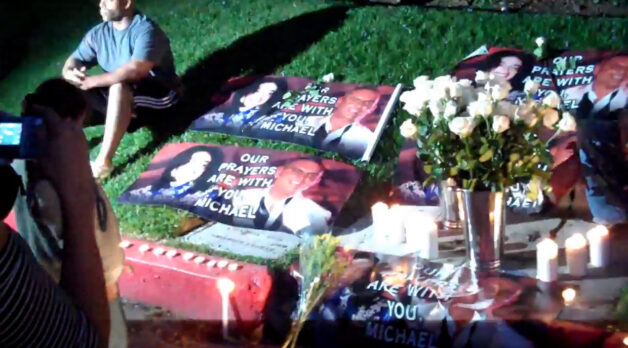
These videos, a core component of Batto’s film, offer a fascinating glimpse into a less self-conscious era of online sharing. Viewers witness a diverse range of reactions: an emo teenager performing sarcastic tears, individuals issuing threats against blogger Perez Hilton (who had controversially suggested Jackson’s death was a publicity stunt), and others reacting to the day’s other significant celebrity death, that of Farah Fawcett. One amateur film reviewer, in front of a Halloween H20: 20 Years Later poster, solemnly declares, "One of Charlie’s Angels just became an angel herself." The film even captures the poignant, if misguided, scene of mourners gathering around the Walk of Fame star of British radio DJ Michael Jackson, mistakenly believing it belonged to the King of Pop, whose star was actually obscured by a red carpet for a film premiere. This moment serves as a "fitting moment for a film that functions as a double memorial – for the King of Pop and for a moment in time where the internet’s cacophony could still sound something like a single chorus."
The Vanishing Digital Chorus: Implications for Collective Memory
A central theme woven throughout Batto’s work, and particularly resonant in Michael Jackson Vigils, is the palpable sense of "naïveté" that characterized early online interactions. Batto is drawn to spectacles of joint online-IRL experience – flash mobs, dance crazes, celebrity deaths – precisely because they reveal a different kind of digital citizenship. "With all these videos I found," he explains, "there’s this through-line of innocence. People didn’t care about how they looked on their webcam, or how they came off, in the same way they do today. They were just experimenting with this new technology." This contrasts sharply with the contemporary internet, where every post, every video, is often meticulously curated, filtered, and optimized for algorithms and perceived audience reception. The early internet, as depicted by Batto, was a space of uninhibited exploration, a public square where vulnerability was less of a calculated risk.
This "profound innocence" resonates deeply with historical parallels. Watching the cascade of early YouTube footage, one is reminded of the work of Mitchell and Kenyon, British filmmakers from the late nineteenth century who produced "Local Films for Local People." Their shorts captured the curious faces of British children encountering a movie camera for the first time, their expressions unburdened by self-awareness or the pressures of performance. The soot-marked faces of children exiting factories in 1897 and the webcam-captured mourners of 2009 share an "odd kinship," a raw authenticity that compresses the long century between these moments, making both seem a world away from 2026.
Batto’s film implicitly critiques the accelerating obsolescence of our digital history. The original article highlights the "slow obsolescence of search engines—lost first to advertisements, then to optimization, and now to artificial intelligence—our digital past gets blurrier still." As algorithms evolve and content is perpetually reshaped or removed, the ability to reconstruct historical moments through digital means becomes increasingly challenging. The sheer volume of data, coupled with its ephemeral nature, creates a vast, unstable archive. Batto’s work is a powerful counter-narrative to this trend, actively seeking to salvage and contextualize these vanishing fragments.
When asked about the possibility of creating a similar film for a more recent celebrity death, Batto offers a sobering assessment: "today’s internet doesn’t create discernible moments in the same way. It’s all so fleeting. You can’t really hold it anymore." This observation points to a fundamental shift in how collective experience is mediated online. The internet has fragmented into countless echo chambers and niche communities, making a unified "digital chorus" increasingly rare. While information spreads faster than ever, its impact is often diffuse, quickly overwritten by the next viral sensation or trending topic. This fragmentation underscores the unique value of Batto’s project, documenting a transitional period when the internet was both globalizing and still capable of generating moments of shared, unmediated experience.
Beyond the Screen: The Premiere and Its Echoes
The premiere of There’ll Likely Be Michael Jackson Vigils Throughout the Night itself served as an extension of the film’s thematic concerns, bridging the past and present with a blend of nostalgia and commentary. Attendees were treated to a giveaway of refurbished third-generation iPod Touches, preloaded with the film and a curated playlist. This tangible artifact from 2009, a device that was cutting-edge during the era the film depicts, created a tactile connection to the past, reminding viewers of the rapid pace of technological advancement and obsolescence.
Adding another layer of meta-commentary, a Michael Jackson impersonator was present at the premiere. His presence, a living embodiment of the King of Pop’s enduring cultural legacy, offered a poignant counterpoint to the digital specters on screen. Batto humorously recounts, "I asked him what he thought afterwards, and he said it was ‘okay.’" This understated reaction, perhaps a reflection of the impersonator’s professional distance or simply a candid assessment, further emphasizes the film’s objective, anthropological gaze, even amidst the theatricality of its subject matter and presentation.
Conclusion
There’ll Likely Be Michael Jackson Vigils Throughout the Night is more than just a documentary; it is a critical examination of our relationship with digital history and collective memory. Marcus Batto, through his meticulous work as an archivist and his discerning eye as an artist, has crafted a film that makes "evident the acceleration of audiovisual history." Like the catalytic converter thieves he explored in Honeycomb, Batto operates at the "end of a certain product’s life-cycle," in this case, the early, uninhibited era of user-generated content.
His work spans the increasingly wide gaps—between artist and archivist, between 2026 and 2009—to salvage and recontextualize fragments of our digital past. While there is an undeniable "mournful" quality to the film, a lament for a lost online innocence, Batto is also keenly aware of "what might still be stripped for parts." His film is a powerful reminder of the importance of digital preservation, a meditation on how we remember and how we forget in the age of constant content creation, and a compelling argument for the enduring value found in the often-overlooked corners of our shared online experience. As the digital landscape continues to evolve at an unprecedented pace, Batto’s Michael Jackson Vigils stands as a vital, if overwhelming, document of a pivotal cultural moment and a profound inquiry into the very nature of memory in the digital age.