The Toronto International Film Festival (TIFF) has long served as a premier global stage for cinema that bridges cultural divides, amplifies marginalized voices, and interrogates complex sociopolitical landscapes. It is within this prestigious arena that acclaimed Colombian-Canadian filmmaker Juan Andrés Arango has unveiled his third feature film, Where the River Begins. Clocking in at 102 minutes, the picture marks Arango’s highly anticipated return to the festival circuit, bringing with it a profound, visually arresting examination of displacement, indigenous survival, and the intricate geography of modern Colombia.
Opening with a harrowing, emotionally charged sequence—a young Emberá child sitting motionless in shallow water as her ancestral village in the Chocó rainforest is reduced to ashes—the film immediately establishes its thematic stakes. Arango pulls audiences directly into the stark dichotomy that defines contemporary Colombia: a nation perpetually oscillating between breathtaking natural serenity and devastating urban and rural violence. While the film’s narrative ambition is towering, its execution invites a nuanced critical dialogue regarding the balance between stylistic restraint and emotional resonance.
The Narrative Foundation: Displacement, Urban Survival, and an Unlikely Journey
The story centers on Yajaira, portrayed with stoic determination by non-professional actor Girleza Duave Cerezo. When audiences are reintroduced to Yajaira as a young adult, she is living in the sprawling, often hostile metropolis of Bogotá. Like thousands of members of the Emberá—an indigenous ethnic group native to the rainforests of western Colombia—she has been violently uprooted from her traditional lands.
In Bogotá, Yajaira struggles to carve out a viable existence for herself and her young daughter, Maria (Ana Michell Nama Dumaza). To survive the city’s harsh economic realities, Yajaira resorts to selling handmade traditional jewelry on the streets. However, the urban environment offers little sanctuary. Rising gang violence, systemic marginalization, and mounting instability among displaced Emberá elders amplify Yajaira’s internal unrest. She is continually haunted by fragmented dreams of the jungle, her longing for home exacerbated by the claustrophobic concrete canyons of the capital.
The narrative’s inciting incident arrives when tragedy strikes too close to home, obliterating any remaining sense of security Yajaira and Maria possess. Forced into a corner, Yajaira makes the momentous decision to abandon the city. She packs her meager belongings, embarking on a perilous trek back to the ancient forests of the Chocó region, specifically targeting the Andágueda River basin.
Crucially, Yajaira does not travel alone. She is unexpectedly joined by Jhon, a charismatic yet deeply troubled young gang member played by Juan David Junca Linares. Jhon harbors hidden motives for fleeing the city, creating an immediate layer of dramatic tension. As the trio navigates the hazardous terrain leading back to the jungle, the film frames their alliance as a study in "found family." Both Yajaira and Jhon are young adults grappling with profound psychological trauma inflicted by Colombia’s protracted internal conflict. Their mutual reliance—initially marred by hesitation, particularly concerning Jhon’s capacity to assist in caring for young Maria—serves as the primary engine for the film’s narrative propulsion.
Behind the Lens: Cast, Crew, and Aesthetic Choices
Arango’s artistic vision for Where the River Begins relies heavily on a commitment to naturalism and geographic authenticity. In alignment with his previous cinematic endeavors, the director eschewed professional casting agencies in favor of sourcing his ensemble entirely from the local communities depicted onscreen.
While this directorial choice endows the film with an undeniable layer of texture, lived-in realism, and cultural fidelity, it simultaneously introduces its most significant artistic hurdle. The performances, though commendable for their sincerity, frequently hover at a baseline of satisfaction rather than scaling the emotional peaks required by the script.
Girleza Duave Cerezo delivers a solid central performance as Yajaira, commanding the screen during a pivotal sequence in which she directly confronts the elders of her displaced community. Yet, aside from these rare flashes of vocal and emotional assertion, much of her performance remains subdued, occasionally leaving the character’s internal life opaque. Similarly, Juan David Junca Linares struggles to fully unlock the emotional depths of Jhon, a shortcoming that becomes particularly apparent during the film’s crucial emotional climax.
Where the performances occasionally falter, however, Arango’s technical crew more than compensates through masterclass-level artistry. Cinematographer Nicolas Canniccioni emerges as the film’s standout contributor, capturing Colombia’s dual identities with staggering precision. Canniccioni utilizes labyrinthine long takes to follow Yajaira through the congested, institutional hallways of makeshift urban shelters where the displaced Emberá community temporarily resides.
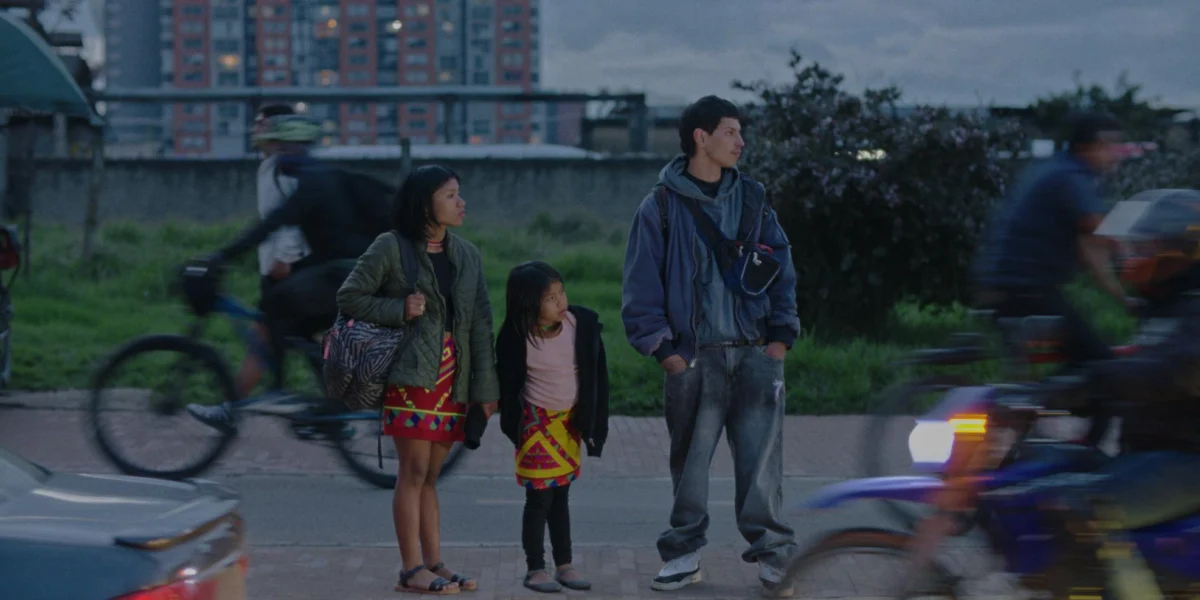
These dynamic tracking shots are deliberately contrasted with exceptionally long, static frames. In these moments, characters are shown silently commuting via public transportation, lingering on street corners to hawk their wares, or simply absorbing the oppressive atmosphere of their surroundings. Canniccioni’s lens expertly contrasts the claustrophobia of urban asphalt with the lush, hypnotic greenery of the Chocó jungle, immersing the audience completely in the sensory experience of the characters’ pilgrimage.
Further streamlining this visual poetry is editor Xi Feng, whose tight pacing attempts to anchor an otherwise languid screenplay. Despite Feng’s best efforts to shape the narrative arc, the film’s inherently slow tempo remains a formidable presence, aligning with Arango’s meditative tone but testing the patience of viewers seeking traditional dramatic momentum.
Contextualizing the Emberá Crisis in Colombia
To fully understand the sociopolitical resonance of Where the River Begins, one must examine the real-world humanitarian crisis facing indigenous populations in Colombia, particularly the Emberá people. Decades of armed conflict involving guerrilla groups, paramilitary organizations, drug cartels, and state military forces have disproportionately targeted indigenous territories rich in natural resources, such as the Chocó and Antioquia departments.
According to data compiled by organizations like the United Nations High Commissioner for Refugees (UNHCR) and the Internal Displacement Monitoring Centre (IDMC), Colombia has historically harbored one of the largest internally displaced populations (IDPs) in the world. Indigenous communities, who maintain a spiritual and physical interdependence with their ancestral lands, face severe threats including forced displacement, confinement, illegal mining, and the targeted assassination of community leaders.
When indigenous groups like the Emberá are forced to flee to urban centers such as Bogotá, Medellín, or Cali, they frequently encounter systemic neglect, cultural erosion, and extreme poverty. Many are forced to live in overcrowded, unsanitary temporary settlements or subsist on urban streets through informal economies, such as vending crafts or begging. The psychological toll of this displacement—characterized by the loss of cultural identity, traditional governance structures, and subsistence farming—forms the authentic bedrock of Arango’s screenplay.
Critical Analysis and Audience Reception
Upon its screening at the Toronto International Film Festival, Where the River Begins generated a complex spectrum of critical commentary. Film analysts and festival-goers alike have praised Arango for his empathetic handling of a deeply sensitive subject matter. The director’s refusal to sensationalize the violence, opting instead to focus on the quiet dignity of survival and spiritual reclamation, has been widely commended as an ethical approach to indigenous storytelling.
However, artistic choices regarding pacing and performance have sparked debate among critics. While the film’s atmospheric, mood-piece qualities offer a hypnotic, almost poetic journey, its restraint occasionally undercuts its dramatic potential. Several critics have noted that by prioritizing visual lyricism and documentary-style naturalism over conventional narrative catharsis, the film risks alienating viewers who seek deeper psychological insight into its protagonists.
Despite these structural critiques, Where the River Begins stands as Arango’s most visually accomplished and structurally mature work to date. It challenges audiences to look beyond headline statistics of conflict and displacement, inviting them into the interior lives of individuals striving to reclaim their heritage against insurmountable odds.
Broader Implications and Cultural Impact
As Where the River Begins continues its journey across the international festival circuit, its broader implications extend far beyond the parameters of traditional cinema. By employing non-professional actors from the displaced Emberá community, Arango has provided a platform for marginalized individuals to bear witness to their own histories on a global stage.
The film arrives at a critical juncture in Colombian history, as the nation attempts to implement transitional justice, land restitution programs, and peace-building initiatives following the 2016 historic peace accords with the FARC. Yet, as ongoing conflicts in regions like Chocó demonstrate, indigenous populations remain exceptionally vulnerable to the shifting dynamics of armed actors competing for territorial control.
Where the River Begins ultimately functions not merely as a narrative feature, but as a visual archive of endurance. Through its meticulous framing of lush rainforests and oppressive city streets, the film captures the persistent yearning for home that defines the modern diaspora. While its subdued nature and deliberate pacing may demand patience from viewers, the film succeeds in cementing Juan Andrés Arango’s reputation as a vital, empathetic chronicler of contemporary Latin American realities—leaving audiences to ponder the true cost of displacement and the arduous path required to find where the river begins.