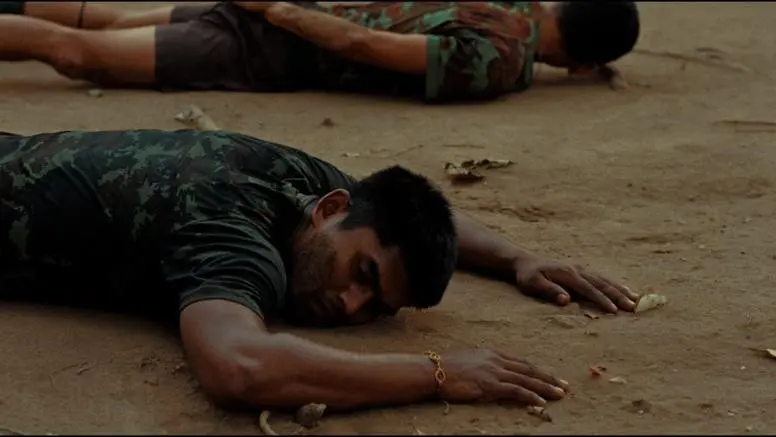
Cookie, Sugar, and Mondine might sound like the names of friends you would meet at a typical summer camp, but the reality for these young men is far removed from the idyll of youth retreats. They are instead embedded in the dense, unforgiving jungles of Myanmar, where they endure 45 days of grueling, makeshift military training. As members of the People’s Defense Force (PDF), these former students, teachers, and tour guides represent a generation thrust into an existential struggle against the military junta that seized power in a 2021 coup. Their daily existence is defined by a jarring juxtaposition: the intense physical and mental strain of preparing for the front lines, punctuated by moments of normalcy, such as calling home or singing along to pop songs.
The documentary White Tiger Column, which makes its world premiere in the International Competition of the International Documentary Film Festival Amsterdam (IDFA), offers an unprecedented, raw look at this radical transformation from civilian to soldier. As the festival runs through November 22, the film serves as a somber reminder that the fight for democracy in Myanmar is far from over, with no clear end in sight for those living in the shadow of conflict.
The Origins of a Grassroots Insurgency
The seeds of the current conflict were sown on February 1, 2021, when the Tatmadaw, Myanmar’s military, deposed the democratically elected government led by Aung San Suu Kyi. The coup triggered widespread civil disobedience and, eventually, a full-scale armed uprising. The PDF emerged as the armed wing of the National Unity Government (NUG), an organization formed by ousted lawmakers and ethnic minority leaders to challenge the junta’s legitimacy.
For the filmmakers—Robert Mentov, Dwight Jantzi, and Bryan Dickie—the project was a response to a global information vacuum. Following their 2025 hybrid short film Paradise Heights, which explored the experiences of Toronto’s Burmese diaspora, the trio felt compelled to document the conflict firsthand.
"After the coup in 2021, I was having lunch with people from the diaspora and was asked to go to the region to document the story," Bryan Dickie explains. "Everybody, myself included, felt it wasn’t getting the exposure it needed."
The production process was extensive, beginning with a research trip in early 2024 designed to build trust with local resistance commanders and navigate the complex geopolitical landscape of the region. By January 2024, the team was fully embedded with the White Tiger Column, a specific regiment within the broader PDF structure.
Geopolitical Isolation and the Complexity of the Conflict
A central challenge in understanding the Myanmar conflict is its relative invisibility on the global stage. Dwight Jantzi highlights the geographic and political isolation that hampers international awareness. "Geopolitically, Myanmar doesn’t have a lot of relevance to Europe and the West; it’s sandwiched between India and China, and there are other global powers in the area that demand a lot more attention," Jantzi notes.
The internal dynamics of Myanmar are equally labyrinthine. The country is home to over 135 distinct ethnic groups, many of whom have maintained their own ethnic armed organizations (EAOs) for decades. These groups have historically been at odds with the central government, yet the post-2021 climate has created a rare, albeit fragile, alignment.
"We really feel that it’s a pure revolution, because, despite all the ethnicities around the country, this is the moment where they’re all joining under one banner to fight against the military," says Jantzi. This unification of diverse groups under the NUG and PDF represents a significant shift in Myanmar’s political history, though it remains a tenuous coalition built under the pressure of a common adversary.
The Human Cost: A Generation in Training
The documentary serves as an intimate portrait of the psychological toll of insurgency. For the volunteers of the White Tiger Column, the transition to military life is not merely a tactical pivot but a total abandonment of their previous lives. The 45-day training cycle is designed to turn civilians—who have lived through the digital age—into combatants capable of operating in guerrilla warfare conditions.
Robert Mentov, who collaborated on the film, notes that the timing of the project was essential. "Bryan and I had been talking for, probably, seven years about doing a trip out to Burma. After the coup, we knew that this was the time we had to do it."
The film captures the vulnerability of these young men as they grapple with the reality of potentially fatal encounters with the junta’s forces. By highlighting their civilian backgrounds—the teachers and the guides—the directors emphasize that this is a conflict being fought by a generation that was arguably the most connected to the outside world in the country’s history, now forced into the isolation of the jungle to reclaim their future.
Statistical Context and the Escalation of Violence
Since the 2021 coup, the humanitarian crisis in Myanmar has reached catastrophic levels. According to reports from the United Nations and various human rights organizations, more than 2.6 million people have been internally displaced, and thousands of civilians have been killed in crackdowns by the military. The junta’s use of airstrikes against civilian populations and the systematic burning of villages have been documented as potential war crimes.
The PDF and its allies have managed to seize significant territory, particularly in rural and border regions, but they face a vastly superior force in terms of conventional weaponry. The military junta retains control over the nation’s infrastructure and urban centers, relying on its air force and heavy artillery to maintain a tenuous grip on power. This asymmetry is exactly what makes the training in camps like the one depicted in White Tiger Column so vital; without formal military training, the resistance would be unable to sustain its momentum against the better-equipped Tatmadaw.
Global Implications and the Role of Media
The international community has taken a fragmented approach to the Myanmar crisis. While Western nations have imposed sanctions on the military leadership and their business interests, the junta continues to receive support, both tacit and explicit, from regional neighbors who prioritize stability over democratic governance.
The release of White Tiger Column at IDFA is a strategic effort to refocus global attention on the region. By moving the narrative away from abstract geopolitical statistics and into the specific, human experience of the volunteers, the film seeks to bridge the gap in empathy that Jantzi identified.
"I think that plays a large role in how little understanding and coverage there is of the issues there," Jantzi says regarding the lack of Western interest. "Not to mention it’s very politically nuanced."
The film serves as a primary source for the conditions under which the resistance operates, providing a window into a side of the war that is rarely captured by news agencies, which are often barred from entering these regions by the junta. As the film begins its festival run and looks toward broader distribution, the hope of the filmmakers is that the audience will gain a more visceral understanding of why these individuals are willing to sacrifice their youth for a democratic ideal that is currently out of reach.
Conclusion: The Unending Struggle
As White Tiger Column premieres, the situation in Myanmar remains fluid. The resistance continues to evolve, adapting its tactics to an entrenched enemy. For the young volunteers—Cookie, Sugar, and Mondine—the journey from the training camp to the front line is a definitive point of no return.
The documentary does not promise a happy ending or a clean victory. Instead, it offers a stark, honest account of a revolution in progress. By documenting the training, the camaraderie, and the existential dread of these volunteers, Mentov, Jantzi, and Dickie have created a record of a pivotal moment in the history of Southeast Asia. Whether this film will stir the international community to take a more active role remains to be seen, but for the volunteers in the jungle, the film is a testament to their existence and their resolve in a fight that most of the world has forgotten.
The world premiere at IDFA is only the beginning for the film, which will likely serve as a crucial touchstone for future researchers, journalists, and observers attempting to piece together the complexities of the post-2021 uprising in Myanmar. For now, the volunteers continue their 45-day cycle, moving from the classroom of the jungle to the realities of the front line, fighting to define the future of a nation that remains in a state of violent, necessary transformation.