In a significant cultural and industry trend, a distinct pathway has emerged for comedic auteurs transitioning into the horror genre, a shift that has redefined audience expectations and critical perceptions. Following the acclaimed footsteps of figures like Jordan Peele and Zach Cregger, Katie Dippold, a veteran writer from the world of sketch comedy and sitcoms, has launched Widow’s Bay on Apple TV+, a series poised to become a landmark in the horror-comedy subgenre. The show, which expertly navigates genuine scares with astute comedic timing, is not only captivating audiences but also sparking crucial conversations about genre classification within the television awards landscape, particularly concerning the prestigious Emmy Awards.
From Sketch to Scream: The Rise of Comedy Auteurs in Horror
The synergy between comedy and horror, though seemingly disparate, is deeply rooted in their shared reliance on eliciting strong, visceral reactions from an audience: a laugh or a gasp. This fundamental connection has fostered a burgeoning trend where creators, initially acclaimed for their comedic prowess, are finding immense success in crafting narratives that delve into the terrifying.
One of the most prominent pioneers of this movement is Jordan Peele. After a highly successful career in sketch comedy with Key & Peele (2012-2015), Peele made a seismic shift into feature filmmaking. His directorial debut, Get Out (2017), was not merely a horror film but a biting social satire that garnered widespread critical acclaim, culminating in an Academy Award for Best Original Screenplay in 2018. He continued to solidify his unique brand of thought-provoking, socially conscious horror with Us (2019) and Nope (2022), each film pushing thematic boundaries while maintaining a suspenseful, often terrifying, core. Peele’s films have consistently achieved both critical adoration and significant commercial success, demonstrating a clear appetite for intelligent, genre-bending storytelling.
Similarly, Zach Cregger, a founding member of the irreverent comedy troupe The Whitest Kids U’ Know (active from the early 2000s), transitioned into horror with striking impact. His 2022 film Barbarian became a sleeper hit, celebrated for its unpredictable plot twists, unsettling atmosphere, and dark humor. Cregger’s follow-up, Weapons, released this year, further cemented his reputation, with actress Amy Madigan earning a Best Supporting Actress award for her devious performance. These successes underscore a creative lineage where the foundational skills of comedic timing, character development, and narrative setup translate powerfully into crafting suspense and fear.
Katie Dippold, with a rich background in comedic writing for shows like Mad TV and the beloved Parks and Recreation, stands firmly within this emerging tradition. Dippold articulates this connection eloquently, stating, "I really do think there’s something to people who started in sketch comedy understanding how to build something, setting up the anticipation and the payoff." She adds, "What I find fun is that you don’t know if that build is going to lead to something that’s going to make you laugh or scare you." This philosophy is precisely what defines Widow’s Bay, offering a viewing experience that constantly keeps the audience on edge, oscillating between genuine terror and uproarious laughter.
Widow’s Bay: A New England Nightmare Wrapped in Wit
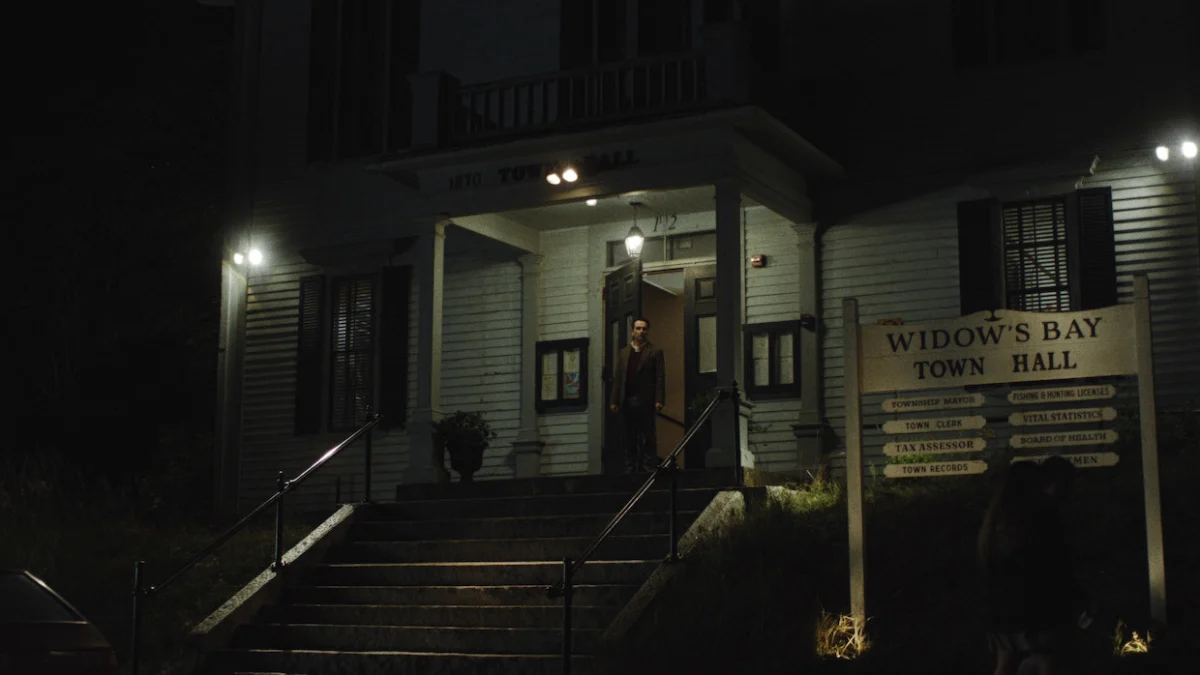
Widow’s Bay, Apple TV+’s latest genre-bending offering, plunges viewers into the picturesque yet perpetually cursed eponymous New England island. At its heart is Tom Loftis, the island’s perpetually optimistic mayor, portrayed with captivating charm by the Emmy-winning Matthew Rhys. Loftis harbors ambitious dreams of transforming Widow’s Bay into a bustling vacation destination, a vision that often clashes comically with the island’s grim supernatural realities. His character embodies a delightful blend of earnest civic duty and almost willful ignorance of the increasingly outlandish horrors manifesting around him, reminiscent of Mayor Vaughn from Jaws if he possessed an endearing, almost naive, determination.
The narrative pits Tom’s unwavering optimism against the fervent, often comical, doomsaying of Wyck, the town’s resident crankpot, played by the versatile Stephen Root. Wyck is a staunch believer in the island’s ancient curse, serving as a vital foil to Tom’s progressive aspirations and often providing prescient, if hysterically delivered, warnings. The supernatural threats themselves are a darkly imaginative array: an ominous, sentient fog that blankets the island, a malevolent killer clown, an amorously aggressive sea hag who dispatches her victims by smothering them with her formidable posterior (leading to a memorable physical gag involving a reclining armchair), a genuinely unsettling haunted inn, and a malevolent spellbook that nearly turns a seemingly innocent cocktail party into a mass drowning.
While the series undeniably features genuinely unsettling supernatural elements designed to evoke chills, Widow’s Bay is fundamentally structured as a comedy. Its humor largely stems from the characters’ remarkably grounded and often exasperated reactions to the escalating absurdity of their cursed existence. Viewers witness Tom’s futile attempts to debunk the haunted inn by spending a night there himself (a venture that predictably goes awry, even convincing the innkeeper to flee). The sea hag’s bizarre method of murder, and the ensuing physical comedy when Tom tries to escape her clutches, perfectly encapsulates the show’s unique tone. Like the finest sitcoms, the joy of Widow’s Bay lies in observing its cast navigate progressively unhinged scenarios with a relatable mix of disbelief, fear, and comedic resignation.
Crafting the Chills and Chuckles: Dippold’s Creative Journey
The genesis of Widow’s Bay is a testament to creator Katie Dippold’s enduring vision, a concept she has nurtured for nearly two decades. "I’ve been thinking about this for 18 years," Dippold reveals, tracing the show’s origins back to a Parks and Recreation spec script she penned long ago. This lengthy incubation period allowed the initial broad comedic concept to evolve, through her experiences co-writing the 2016 female-led Ghostbusters and penning Disney’s 2023 Haunted Mansion, into the nuanced blend of humor and horror seen today.
Dippold credits the collaborative nature of television production as instrumental in shaping the show’s intricate balance. Unlike the often singular vision of feature film directing, where a writer’s input might be limited post-script delivery, the television model allows for a dynamic exchange of ideas. "Not being able to have much say once the script is in and [now] being in a position where I have all the say naturally made me someone who wants that collaboration," Dippold explains. She praises her team, noting, "These actors are brilliant, the production design team is tremendous, and the directors who came in had other ideas that I would not have thought of. It’s thrilling to me, and I can’t imagine doing it in a way where it’s all my vision and nothing will ever change."
A pivotal collaboration was with executive producer and acclaimed director Hiro Murai, known for his distinctive visual style on series like The Bear, Atlanta, and Station Eleven. Murai helmed five of the season’s ten episodes, significantly contributing to the show’s brooding visual tone. This aesthetic was further inspired by Dippold’s teenage memories of a lawless 1980s haunted house in Long Branch, New Jersey. "It was the ’80s, and it was lawless. They could chase you around and grab you," she recalls. "That mix of being scared, but you’re having the time of your life, is a feeling I’ve wanted to capture ever since." This foundational experience clearly informs the series’ unique ability to deliver both genuine frights and exhilarating fun.

The Art of Performance: Grounding the Supernatural with Dramatic Talent
A crucial element in Widow’s Bay‘s success in melding its disparate tones is its meticulously assembled cast. Dippold made a deliberate choice to populate her fictional island with actors primarily known for their dramatic work in lead roles, reserving the more overtly comedic performers for supporting parts. This strategy, she explains, was essential for grounding the fantastical elements and ensuring the audience takes the horror seriously. "When I imagined an actor that you know from comedy starring in it, it just took me out of it," Dippold notes. "Like, I don’t believe it’s a real place, and I don’t know that I would watch the show. As a horror fan, I want to know that they’re taking it seriously."
Matthew Rhys, an Emmy winner for his intense dramatic role in The Americans, was a brilliant suggestion from casting director Allison Jones. Dippold lauds Rhys’s performance as Tom Loftis: "He always just plays the truth of the scene. He never goes for the joke. He’s so naturally funny, and he understands what’s funny about [the scene]." This approach allows the comedy to emerge organically from the character’s genuine reactions to absurd circumstances, rather than from overt comedic delivery.
The main cast further reinforces this dramatic grounding: Kate O’Flynn as Tom’s understated assistant Patricia, Kevin Carroll as the composed town sheriff Bechir Clemmons, and Dale Dickey as the no-nonsense employee Rosemary. These actors, primarily recognized for their roles in television dramas, lend credibility and depth to the series’ heightened reality.
Conversely, the supporting cast strategically features a roster of acclaimed comic performers, including Emmy winner Jeff Hiller, Tim Baltz, Toby Huss, Neil Casey, Connor Ratliff, and Chris Fleming. Their contributions inject targeted bursts of comedic energy, often in smaller, scene-stealing roles, without undermining the narrative’s underlying seriousness. Stephen Root, uniquely, bridges both worlds, known for his comedic turns in NewsRadio and Office Space, his Emmy-nominated dramatic performance in Barry, and his recent Emmy-contending voice work in the animated series Strip Law. His versatility allows him to embody the "town crankpot" Wyck with both dramatic conviction and comedic flair. This calculated casting strategy ensures that Widow’s Bay maintains its delicate balance, proving that a serious approach to performance can unlock profound comedic and terrifying potential.
The Tootsie Principle: Truth in Performance, Humor in Absurdity
Dippold’s philosophy regarding performance finds a surprising, yet deeply resonant, parallel in the classic comedy Tootsie. She shares an anecdote from a Q&A with director Sydney Pollack, who expressed astonishment at how funny Tootsie turned out, given the dramatic intensity of the set. Dippold reveals, "Often when I talk about influences on the show, I talk about Stephen King and John Carpenter, Atlanta and Parks and Rec, but I am secretly also thinking about Tootsie — but I never say it, because I know it’s going to confuse the hell out of everyone."
The key insight, as both Dippold and the interviewer agree, lies in Dustin Hoffman’s dedicated, dramatic performance as Michael Dorsey/Dorothy Michaels. Hoffman played the role with absolute sincerity, focusing on the character’s internal struggle and commitment to the facade, rather than attempting to be overtly funny. It is this unwavering commitment to the "truth of the scene" that elevates Tootsie from a mere farce to a timeless comedy.
This "Tootsie Principle" is precisely what Dippold strives for in Widow’s Bay. "I mean, he’s in a drama," Dippold laughs, referring to Hoffman’s approach. "If he was playing it any differently, it would feel terrible. And I think the actors on this show are doing something very similar. They don’t look at it like they’re in a comedy or a horror show; they’re just playing the scenes and they’re not thinking about the genres. And I think that helps a great deal." By instructing her actors to portray their characters’ realities with conviction, regardless of the supernatural chaos unfolding, Dippold allows the inherent absurdity of the situations to generate authentic humor, while simultaneously ensuring the horror elements retain their impact. This approach fosters a unique viewing experience where the audience’s emotional journey is deeply tied to the characters’ genuine responses, making both the scares and the laughs more profound.
Emmy Contention: Challenging Genre Norms in Television Awards
As Widow’s Bay enters the awards season, it faces a fascinating challenge: it will be submitted to the Emmy Awards as a comedy series. While it undoubtedly delivers some of the year’s most genuinely hilarious moments, its gruesome supernatural elements position it as arguably the most terrifying entry in the comedy slate. This strategic categorization highlights a persistent tension within the television awards landscape, where genre shows often struggle to gain traction in traditional comedy categories.
Historically, the Emmy Awards have demonstrated a certain conservatism when it comes to genre-bending comedies. However, recent years have shown a gradual thawing, with notable exceptions such as Netflix’s Wednesday and FX’s What We Do in the Shadows. These shows, while vastly different in tone and style, have managed to carve out a space in the comedy categories despite their fantastical or supernatural premises. It’s also worth noting that in film awards, particularly the Golden Globes, horror films with comedic undertones or dark humor, like Get Out and The Substance, have often been successfully submitted and recognized in the comedy categories.
The Emmy Awards’ drama categories, in contrast, have shown remarkable inclusivity towards genre fare. After four consecutive wins for Game of Thrones, the Drama Series category has embraced a diverse array of nominees, including science fiction epics like The Mandalorian and Stranger Things, superhero sagas like The Boys, post-apocalyptic narratives like The Last of Us, and historical horror like Lovecraft Country. In these dramatic series, the genre elements are inextricably woven into the fabric of their dramatic weight.
Widow’s Bay presents a compelling test case for Emmy voters: can the comedy series category demonstrate a similar level of inclusivity and appreciation for innovative genre blending? The series’ core strength lies in its balanced duality; the jokes are as vital to its identity as the chills. Dippold’s work implicitly argues that mastering a jump scare requires as much craft and precision as landing a perfect punchline. Acknowledging Widow’s Bay in the comedy category would not only validate its unique artistic achievement but also send a powerful message to the industry: that the boundaries of television comedy are expanding to embrace sophisticated narratives that seamlessly integrate terror and humor. Such recognition could pave the way for a new era of genre-fluid storytelling to receive the mainstream critical acclaim it often deserves, influencing future creative endeavors and awards strategies across the television landscape.