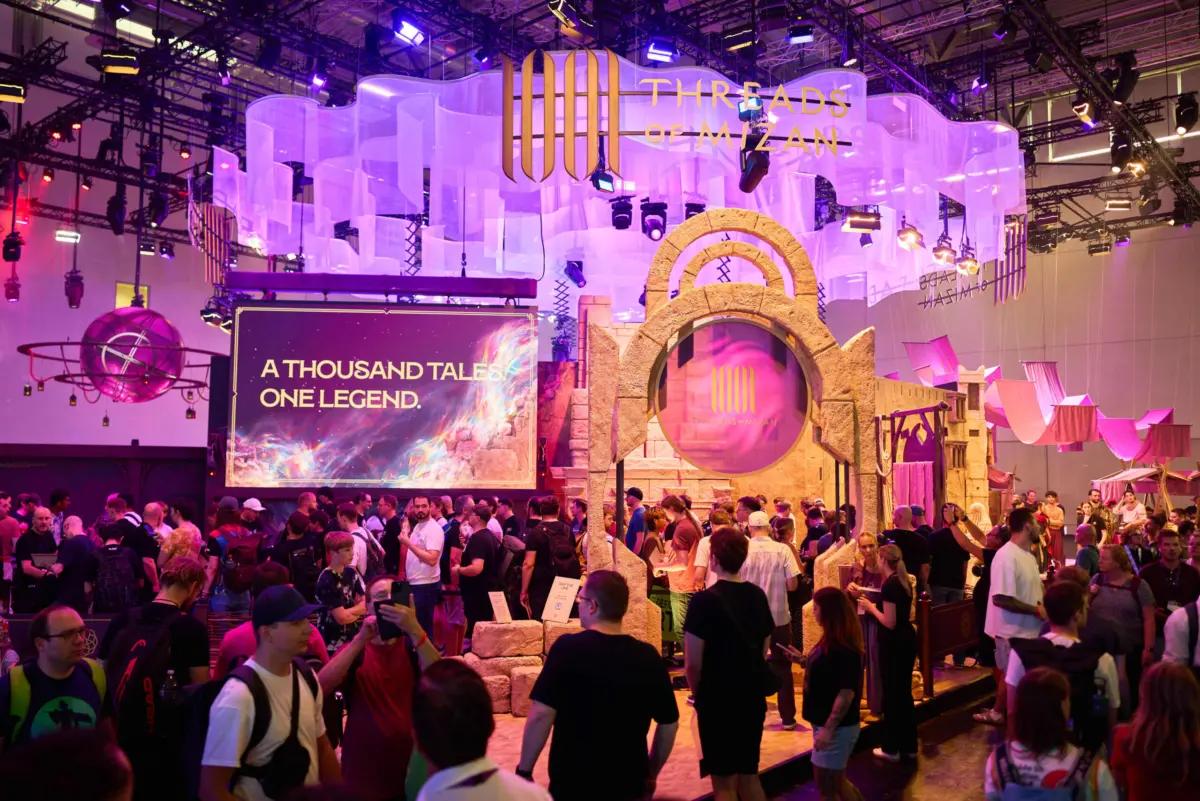
At the center of the frantic, neon-lit exhibition floors of Gamescom 2026, one title managed to cut through the noise of established franchises and multi-billion-dollar sequels: 1001 Threads of Mizan. The game, a debut project from the newly formed MBC Game Studio, transformed from an unknown quantity into the show’s most discussed surprise. By leveraging the deep, often untapped reservoirs of Middle Eastern folklore and pairing them with high-fidelity, three-player co-op action, the studio has signaled a seismic shift in how regional media giants are approaching the global interactive entertainment market.
The game’s arrival at the Cologne-based convention was marked by three-hour wait times for a 20-minute playable demo and a trailer that accumulated 70 million views within its first week of public availability. For a studio previously operating in relative obscurity, these metrics represent a rare "lightning in a bottle" moment, effectively fast-tracking the game onto critical best-of lists and industry watchlists for the upcoming fiscal year.
A Chronology of Development and Strategic Vision
The genesis of MBC Game Studio did not occur in a vacuum. While the studio began scaling its internal development teams in 2023, the conceptual groundwork was laid years earlier. MBC Group, the Middle East’s leading media conglomerate, recognized that traditional barriers—namely the linguistic and cultural constraints inherent in television and film—could be bypassed by the universal language of gaming.
Daniel Engelhardt, CEO of MBC Game Studio, brings a veteran’s perspective to this transition. With a career spanning influential roles at Lionsgate—where he helped architect the studio’s gaming business alongside Peter Levin—and contributions to major titles like Fortnite x John Wick and Five Nights at Freddy’s VR: Help Wanted, Engelhardt was brought on to bridge the gap between traditional media production and interactive storytelling.
"We were talking about what it would mean to build a games business for MBC," Engelhardt notes. "What was really exciting was that MBC was willing to look at games as an opportunity to build new IP, not as a licensing activity." This distinction is critical. Rather than merely licensing existing brands to third-party developers, MBC Group has committed to an in-house development model that treats the studio as an "IP engine" capable of feeding the broader media ecosystem.

Anchoring Innovation in Cultural Heritage
The choice of 1001 Arabian Nights as the foundation for the studio’s flagship project was a calculated strategic move. The collection of folktales, compiled during the Islamic Golden Age, offers a narrative framework that is globally recognized yet historically underserved in modern AAA gaming. By moving beyond the surface-level interpretations—the familiar tropes of Aladdin or Sinbad—and consulting directly with historians and academics, the team at MBC Game Studio aimed to craft a world that feels authentic rather than derivative.
"These are not consultants; they’re built into our team to really make sure that we were starting to deeply understand the spirit of this material," Engelhardt explains. This rigorous approach to world-building is intended to provide players with a sensory experience that feels both familiar, due to its place in global literature, and entirely fresh in its execution. The goal is to provide a "tasting" of a rich, oral storytelling tradition, expanded into a modern, interactive medium.
Supporting Data and Market Impact
The data surrounding 1001 Threads of Mizan suggests that the "mythology-first" approach is resonating with a modern audience. In an era of gaming dominated by established sequels, the appetite for new, narrative-rich intellectual property remains high. The 70 million trailer views are not merely vanity metrics; they indicate a significant level of engagement from a demographic that is increasingly looking for diverse cultural representation in high-end entertainment.
Furthermore, the integration of ancillary products at launch—specifically trading cards produced in partnership with Upper Deck and a storybook series from Titan Publishing—demonstrates a sophisticated, transmedia launch strategy. This approach mimics the successful blueprint of companies like Riot Games or Blizzard, where the game serves as the core pillar of an expansive, multi-platform brand.
Official Perspectives and Long-term Strategy
For Mike Sneesby, CEO of MBC Group, the investment in gaming is a logical evolution of the company’s mandate to export stories rooted in the Arab world to a global audience. "The incredible thing for gaming as a launchpad is that it has its own global language that transcends culture and the spoken language," Sneesby stated.
The strategy relies on the belief that gaming provides a more immersive entry point than linear media. By allowing players to inhabit the world of Mizan, interact with its creatures, and navigate its environment, the studio builds a deeper emotional connection than a film could achieve in two hours. While both Engelhardt and Sneesby remain cautious about over-committing to future projects, they confirm that the infrastructure built for 1001 Threads of Mizan is designed for longevity. The game is the "launchpad," with the potential for film and television adaptations already being contemplated as the IP matures.

Fact-Based Analysis: The Broader Implications
The emergence of a major, well-funded studio in the Middle East has broader implications for the global games industry. Historically, the center of gravity for AAA development has been restricted to North America, Europe, and East Asia. The success of 1001 Threads of Mizan suggests that this geography is shifting.
- Cultural Exportation: By utilizing local folklore as a value proposition rather than a secondary aesthetic, MBC is proving that regional stories can command global appeal if the production values meet international standards.
- The "IP Engine" Model: The move toward vertical integration—where the studio, the IP holder, and the distribution platform work in tandem—reduces the risks associated with licensing. This model is becoming increasingly popular as media companies seek to retain more control over their creative assets.
- The Co-op Market: By focusing on three-player co-op gameplay, the studio is positioning itself within a high-demand niche. Players are currently gravitating toward social, collaborative experiences, and a fantasy-adventure setting provides a robust environment for such mechanics.
Looking Toward the 2027 Launch
The next few months are being treated as a "quiet period" by the development team. With the impending release of industry juggernauts like Grand Theft Auto in November 2026, the studio is wisely pacing its promotional efforts. The roadmap for 2027 includes a steady rollout of information as the game prepares for its multi-platform release on PlayStation 5, Xbox Series X/S, Nintendo Switch 2, and PC.
"We can’t have as big of a surprise as we had at Gamescom," Engelhardt admits, reflecting on the difficulty of maintaining momentum after such a successful debut. However, the plan is to "continue to surprise players with more information and more exciting pieces to the puzzle."
As the industry waits to see if 1001 Threads of Mizan can replicate its Gamescom success at the point of sale, one thing is clear: the paradigm for regional media expansion has been rewritten. MBC Game Studio has established itself not just as a developer of a single title, but as a contender in the global IP arena, ready to leverage the vast, centuries-old storytelling traditions of the Arab world to capture the attention of a new, digital-native generation. Whether the final product can match the immense anticipation generated at the show remains the ultimate test, but the foundation laid thus far is arguably the most compelling debut in the recent history of the medium.