Adapted from Jenny Erpenbeck’s acclaimed novel Heimsuchung (published in English as Visitation), legendary auteur Volker Schlöndorff’s latest cinematic offering, also titled Visitation, premiered to significant attention at the Cannes Film Festival. This ambitious film, directed by the 87-year-old Oscar-winner known for The Tin Drum and The Lost Honour of Katharina Blum, masterfully encapsulates a hundred years of German history. It achieves this expansive narrative feat by meticulously focusing on the events unfolding within just two buildings situated on adjoining plots of lakeside land near Berlin, transforming a localized setting into a profound microcosm of national experience.
A Return to Form for an Enduring Auteur
Schlöndorff, whose career spans over six decades, has consistently explored the intricate relationship between political forces and individual lives. Visitation marks a compelling return to this thematic core, echoing the refined cinematic and literary taste that has characterized his most celebrated works. Unlike many historical dramas that can veer into didacticism, Schlöndorff’s approach, guided by Erpenbeck’s source material, remains remarkably subtle. The film portrays how monumental political shifts — from the rise and fall of the Third Reich to the emergence and eventual collapse of the Communist-controlled German Democratic Republic — directly impact personal destinies, yet it does so without ever feeling preachy, overtly emblematic, or obvious. This delicate balance is a testament to Schlöndorff’s seasoned directorial hand, demonstrating a sensitivity that has earned him a reputation as one of Germany’s most important filmmakers. The film’s critical reception at Cannes underscored this achievement, with many hailing it as "a return to form" for the veteran director.
The ensemble cast assembled for Visitation is particularly strong, featuring some of Germany’s most respected actors. Martina Gedeck, celebrated for her roles in films like The Lives of Others, and Lars Eidinger, known for his compelling performance in Dying, lead a distinguished roster that includes Susanne Wolff, Ulrich Matthes, Detlev Buck, and Angela Winkler. These actors portray a diverse array of visitors and residents who pass through the properties, embodying the cyclical nature of history and the enduring human spirit across the story’s four temporal dimensions. Their performances are instrumental in grounding the film’s ambitious historical sweep in deeply personal and relatable experiences.
From Page to Screen: Adapting Jenny Erpenbeck’s Literary Acclaim
Jenny Erpenbeck’s novel Heimsuchung, first published in 2008, is a highly regarded work in contemporary German literature. Known for her lyrical prose and deep engagement with themes of memory, displacement, and the indelible marks of history on individuals and places, Erpenbeck’s novels often explore the complexities of German identity in the wake of the 20th century’s cataclysms. Heimsuchung specifically tells the story of a plot of land near Berlin and the succession of its inhabitants over nearly a century, each leaving an imprint on the house and its surroundings. The novel is characterized by its fragmented, non-linear narrative, which eschews traditional plot structures in favor of a more meditative and poetic exploration of time and memory.
Adapting such a novel, with its profound interiority and emphasis on atmosphere over action, presented a unique challenge. Schlöndorff’s decision to maintain the novel’s focus on the two properties as central characters, rather than merely backdrops, speaks to his respect for Erpenbeck’s artistic vision. The film mirrors the novel’s structure by observing a near-Aristotelian unity of space, even if it expands beyond the classical unities of time and action. This spatial constancy allows the audience to witness the profound changes wrought by history, not just on people, but on the very fabric of the landscape and the homes themselves. The film’s narrative, while economical, feels expansive, a testament to how effectively Schlöndorff has translated the novel’s philosophical depth into a visual medium, making the houses themselves repositories of memory and silent witnesses to generations of human drama.
A Microcosm of History: Two Houses, A Hundred Years
The core of Visitation‘s narrative power lies in its microcosmic approach. The two lakeside properties near Berlin serve as a stage upon which a century of German history is played out. The film deftly weaves snippets of archive footage – showing the rise and fall of the Third Reich and then the ascent and collapse of the German Democratic Republic – into its personal narratives. This technique provides essential broader historical context without ever overshadowing the intimate dramas unfolding within the houses. It’s a subtle yet effective way to remind the audience that these personal stories are not isolated but are inextricably linked to the grander, often brutal, sweep of national history.
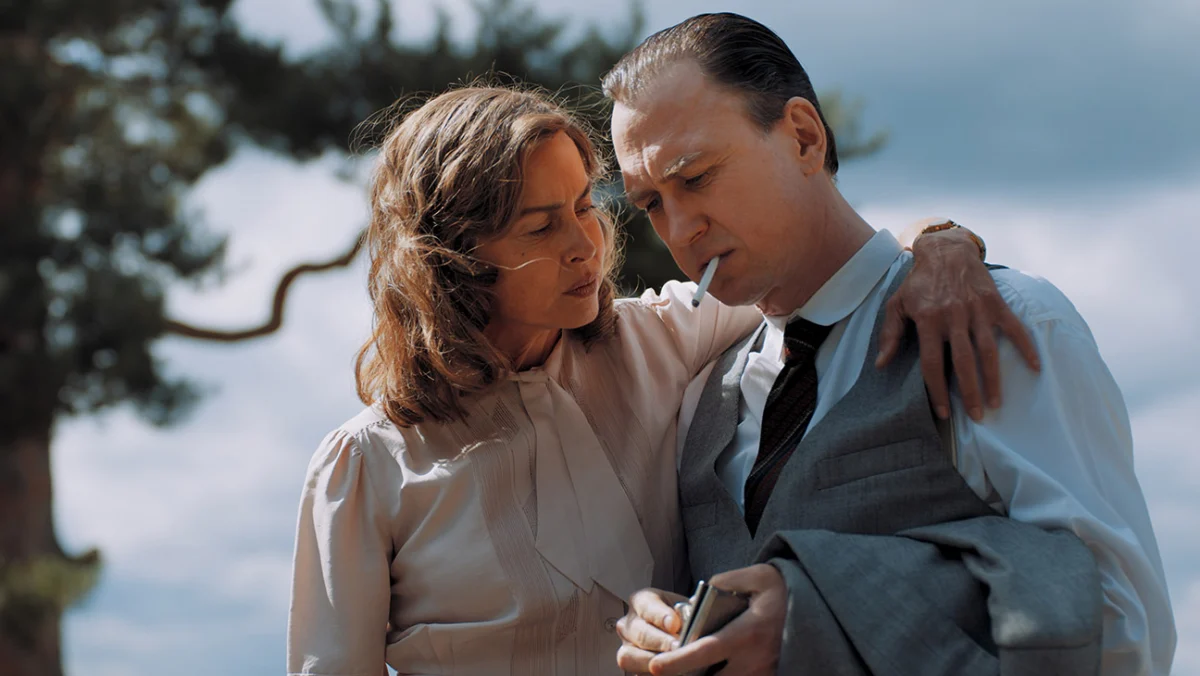
One of the properties, a strikingly elegant, spare Bauhaus-style structure, carries an additional layer of historical resonance. Much of the film was partly shot in and around Albert Einstein’s actual summer home in Caputh, designed by the real architect Konrad Wachsmann. This extra-textual connection adds a poignant dimension to the film, as in Visitation, this home is built by Lars Eidinger’s character, simply credited as "The Architect." He is depicted as a figure aligned with the nascent Nazi regime, a chilling inversion of the historical reality where Einstein, a Jewish physicist, was forced to flee Germany to escape Nazi persecution. The architect, with his subtly sinister politeness and a truly memorable, hideous bowl haircut, strategically places the deeds to the property in the name of his stylish socialite fiancée, Susanne Wolff, a legal maneuver that will have far-reaching repercussions across the decades. This detail highlights the often-insidious ways in which power and privilege were consolidated during the rise of the Third Reich.
Just meters down the shoreline, a more modest, traditional-looking summer hut is built by a German Jewish cloth manufacturer, portrayed with dignified pathos by Ulrich Matthes. At first, this places the manufacturer, his wife (Josefin Platt), daughter Elizabeth (Stella Denis-Winkler), son-in-law Dr. Ernst Kaplan (Matthias Hungerbühler), and granddaughter Doris (played by Pelle Bo Winkler and Ava Weisbrod at different ages) on seemingly near-equal footing with their new, modern-minded neighbors. However, the architect’s barely concealed disdain foreshadows the tragic events to come. With the implementation of the "Aryanization" laws in 1933, which systematically stripped Jewish citizens of their property and rights, the architect is able to acquire his neighbors’ land cheaply, their property expropriated by the state.
The Shifting Tides of Ownership and Fate: A Chronology of Inhabitants
The film meticulously follows the brutal chronology of the Jewish family’s fate, guided by Erpenbeck’s source material, which itself draws on found letters by a real girl named Doris Kaplan. The grandparents are among the first to be sent "back east" with a strict packing list and a small suitcase, vanishing into the abyss of the Holocaust. Doris, a child of poignant innocence, continues to send them letters, each affixed with a carefully placed stamp bearing Hitler’s face, a heartbreaking detail that underscores the chilling normalcy of the unfolding horror. Eventually, Doris and her immediate family are also taken away by train, swallowed whole by the Holocaust. Schlöndorff’s treatment of this tragedy is marked by a profound lack of sentimentality. There are no dramatic reunions or improbable escapes; instead, the family’s existence persists only as echoes, ghostly reminders in later, twinned shots of characters affixing stamps to letters, years apart. This understated approach heightens the emotional impact, allowing the historical reality to speak for itself without manipulative embellishment.
The narrative continues through the war years, where the architect is shipped to the Eastern Front, leaving his wife to navigate survival and the occupation of their house by Soviet soldiers. This period, too, is handled with an unsentimental realism, depicting the harsh realities of post-war Germany and the shifting power dynamics.
The final section of the film brings the audience into the era of the German Democratic Republic (GDR). An acclaimed left-wing writer, played by Martina Gedeck, leverages her party connections to secure sole access to the Bauhaus house for herself, her journalist husband (Michael Maertens), her son (Ludwig Trepte), daughter-in-law Erika (Nina Lilith Völsch), and their young daughter Marija (portrayed by Sara Bartknecht, Romy Miesner, and Asta Willmine Winkler at different ages). This period of the GDR, while perhaps less outwardly dramatic than the Nazi era, is portrayed with a nuanced understanding of its quiet repressions and the particularities of life behind the Iron Curtain.
It is Marija who becomes the narrative’s emotional anchor in this final act. As a sweet summer child, she loves to jump into the lake with her hunky local boyfriend (Yvon Moltzen, Camille Moltzen, and Sean Douglas) and quietly questions the authority of the Eastern Bloc. Her most significant discovery, however, is the hidden cache of Doris’s letters in the crumbling cottage next door. This act of finding and remembering links the disparate timelines, making Marija a conduit for the past. Her consciousness largely dominates the last stretch of the film, culminating in the fall of the Berlin Wall. With reunification, the house, a silent witness to so much history, finally slips through her family’s grasp, preparing for an ending that is aptly downbeat and faintly flat, like the sound of masonry crumbling to dust – a metaphor for the transient nature of ownership and political systems.
The Weight of Place: Filming Locations and Their Resonance
The choice of filming locations, particularly the use of Albert Einstein’s former summer home in Caputh, is not merely incidental; it is integral to the film’s thematic depth. The actual architect of Einstein’s home, Konrad Wachsmann, was a pioneer of modern architecture, and the house itself is a significant example of Bauhaus influence. By setting a key part of Visitation in such a historically charged location, and by having a Nazi-sympathetic architect build a similar house, Schlöndorff creates a powerful extra-textual layer. It forces a contemplation of how places, even those associated with intellectual freedom and scientific advancement, can be co-opted or overshadowed by darker historical currents. This decision reinforces the film’s central idea that land and architecture are not inert but are imbued with the memories and ideologies of their inhabitants, carrying the weight of past events into the present. The precise detail of the real architect, Wachsmann, adds a layer of factual grounding to the fictionalized narrative, blurring the lines between history and storytelling in a way that enriches the viewer’s experience.
Critical Reception and Enduring Impact
Visitation arrives at a time when Germany continues to grapple with its complex past, particularly the legacies of the Third Reich and the GDR. Schlöndorff’s film offers a vital contribution to this ongoing national dialogue by presenting a narrative that is both deeply personal and broadly historical. Its lack of sentimentality in handling profound tragedy, especially the Holocaust, stands as a mature artistic choice, aligning with a more recent trend in German cinema to approach these topics with a sober, reflective gaze rather than overt emotional manipulation.
The film’s structure, which moves through distinct historical epochs while anchored to a fixed physical space, serves as a powerful metaphor for the persistence of memory and the cyclical nature of human experience. It underscores how individual lives, despite their transience, contribute to a collective historical tapestry. The nuanced portrayals of characters, from the opportunistic architect to the quietly resilient Marija, avoid easy categorization, reflecting the moral ambiguities and complexities of living through turbulent times.
For Schlöndorff, Visitation is more than just another film; it represents a profound meditation on his nation’s history, a theme he has explored throughout his illustrious career. While it may not overshadow the monumental impact of The Tin Drum, a film that reshaped German cinema’s engagement with its wartime past, Visitation is undoubtedly a work of worthy craftsmanship and seriousness. It reaffirms Schlöndorff’s position as a master storyteller capable of transforming literary depth into compelling cinematic narrative. Its premiere at Cannes signals its international relevance and its place within the ongoing conversation about historical memory and national identity in a global context.
Conclusion: A Reflective Coda to a Storied Career
At 87, Volker Schlöndorff presents Visitation not as a summation of his career but as a continuation of his artistic inquiry into the human condition shaped by historical forces. The film’s concluding moments, with the house slipping from Marija’s grasp and the quiet sound of masonry crumbling, resonate with a profound sense of impermanence and the relentless march of time. Yet, within this melancholic resignation, there is also a quiet triumph of memory, embodied by Doris’s rediscovered letters and Marija’s understanding of the past.
Visitation is a testament to Schlöndorff’s enduring vision and his commitment to nuanced storytelling. It is a film that encourages reflection, inviting audiences to ponder the layered histories embedded within seemingly ordinary places and the ways in which the past continually "visits" the present. If Schlöndorff were to choose this as his final cinematic bow, it would indeed be on a note of profound artistic integrity and historical significance, leaving an indelible impression on the landscape of German and world cinema.