Narrative Structure and the Triptych of Spanish Identity
The film’s architecture is built upon three interlocking stories, each defined by a central protagonist whose experiences reflect the sociopolitical climate of their respective era. By eschewing a strictly linear progression, Ambrossi and Calvo create a "thematic conversation" between the decades, suggesting that while the legal status of queer individuals has evolved, the fundamental human desire for authentic love and safety remains constant.
The first segment, "Carlos 1932," is rooted in the historical context of the Second Spanish Republic. This era, while brief, was a period of significant cultural flourishing and relative social liberalization before the descent into authoritarianism. The character of Carlos, portrayed by Milo Quifes, is a young man navigating the rigid class structures of Spanish society. His narrative is directly inspired by Lorca’s unfinished play La bola negra, dealing with the titular "blackballing" or social exclusion from a local club—a metaphor for the systemic rejection of those who do not conform to heteronormative standards.
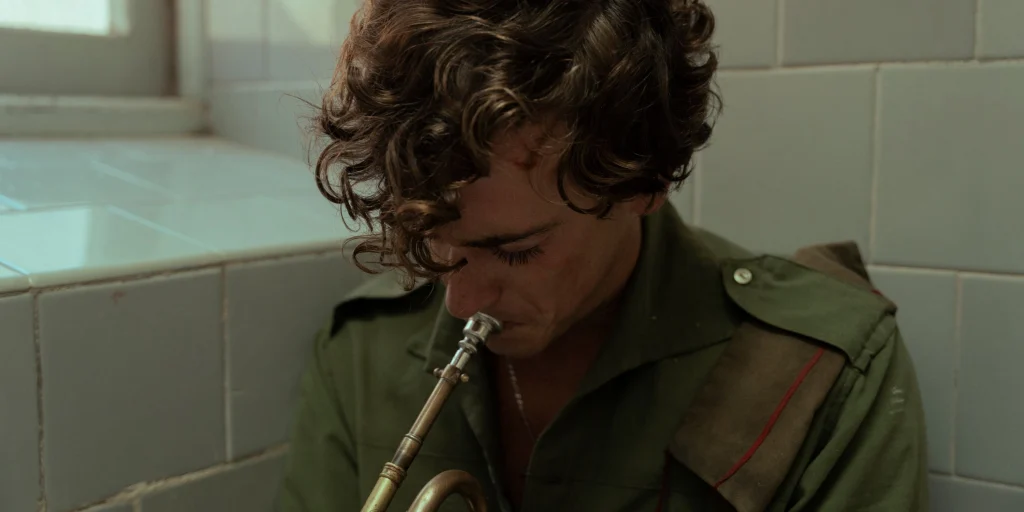
The second segment, "Sebastián 1937," shifts the tone to a harrowing wartime drama. Set in northern Spain during the height of the Spanish Civil War, it follows Sebastián (played by musician Guitarricadelafuente in his acting debut), a trumpet player conscripted into the Nationalist army. This chapter is based on Alberto Conejero’s play La piedra oscura (The Dark Stone), which focuses on the real-life figure of Rafael Rodríguez Rapún, Lorca’s lover and the keeper of his legacy. The film depicts the unexpected bond between Sebastián and a wounded enemy soldier, Rafael (Miguel Bernardeau), amidst the backdrop of fascist repression.
The final segment, "Alberto 2017," brings the narrative into the 21st century. Carlos González stars as Alberto, a contemporary playwright struggling with creative stasis and a lack of purpose. This modern thread serves as a mirror to the previous eras, highlighting the "sociopolitical seesaw" mentioned by critics—where the unprecedented freedoms of the modern global queer community are increasingly threatened by a resurgence of far-right ideologies.
Historical Context and Literary Foundations
To understand the weight of The Black Ball, one must consider the legacy of Federico García Lorca, arguably Spain’s most significant 20th-century poet and dramatist. Lorca was executed by Nationalist forces in 1936, early in the Civil War, partly due to his socialist leanings and his homosexuality. His death left several works unfinished, including the manuscript that gives this film its name.
The decision by Ambrossi, Calvo, and Conejero to use an unfinished work as a narrative cornerstone is a symbolic act of "artistic reclamation." In Spanish history, the period following the Civil War—the Francoist dictatorship (1939–1975)—was marked by the "Law of Vagrants and Malefactors," which was used to systematically imprison and "re-educate" homosexual individuals. By placing a story in 1937 and another in 2017, the filmmakers highlight the progress made since the transition to democracy while warning against historical amnesia.
Supporting data from historical archives suggests that thousands of individuals were persecuted under Franco-era morality laws. The Black Ball contextualizes this data through the character of Sebastián, who must hide his identity while serving the very regime that would eventually seek to eradicate people like him.
Technical Execution and Cinematic Grandeur
The production of The Black Ball utilizes filmmaking techniques reminiscent of mid-century Hollywood epics, specifically the works of David Lean. The directors employ expansive sets, a high volume of background extras, and sophisticated camera movements to create a sense of historical scale.
One of the film’s technical highlights is a sequence involving Carlos in 1932, filmed in a single, unbroken take. The camera follows him through a crowded cabaret, capturing intricate choreography and blocking that emphasizes his isolation within a bustling social environment. This "theatrical vision" is complemented by the cinematography, which varies its palette between the eras: the dusty, high-contrast shadows of the 1937 war zones contrast sharply with the vibrant, neon-inflected aesthetics of 2017 Madrid.
The auditory landscape of the film is equally ambitious. Composer Raül Fernandez Miró has crafted a score that utilizes heavy brass and sweeping strings, providing a "classic" feel that bridges the gaps between the timelines. Sound design plays a crucial role in the film’s transitions; musical cues from a 1930s trumpet performance often bleed into the ambient noise of a 2017 city street, reinforcing the idea that history is a continuous, reverberating force.
High-Profile Casting and Performance Analysis
The ensemble cast of The Black Ball features a mix of rising stars and established international icons, adding significant prestige to the project.
- Guitarricadelafuente (Sebastián): Known primarily as a folk-pop musician, his transition to acting has been noted for its "softness and vulnerability." His portrayal of a man caught in the machinery of war provides the film’s emotional heart.
- Miguel Bernardeau (Rafael): Bernardeau, widely known for his role in the Netflix series Elite, delivers a performance described as "statuesque." The directors use his physical presence to explore the "forbidden gaze," a uniquely queer perspective of longing and admiration in a hostile environment.
- Penélope Cruz (Nenée): In a brief but transformative role, Academy Award winner Penélope Cruz plays a cabaret performer. Her character serves as a catalyst for Sebastián, representing the "disruption of machismo" through art and drag-inflected performance.
- Glenn Close: The legendary American actress appears in the 2017 segment, performing primarily in Spanish. She portrays a literary expert who assists Alberto in his research. Her inclusion has been cited as a "camp" highlight, particularly her delivery of academic discourse on homophobia in a Spanish accent, which anchors the film’s connection to global queer history.
Sociopolitical Implications and Industry Impact
The release of The Black Ball comes at a time of heightened tension regarding LGBTQ+ rights in Europe. In Spain, the rise of the Vox party and similar right-wing movements has sparked national debates over the "Law of Democratic Memory," which seeks to address the legacy of the Franco regime.
The film acts as a cinematic intervention in these debates. By showing the visceral reality of 1937 alongside the relative comfort of 2017, it argues that progress is not a guaranteed linear path but a hard-won state that requires constant defense. Analysts suggest that the film’s success at international festivals could signal a renewed interest in "prestige queer cinema"—films that combine high production values with uncompromising political messaging.
Furthermore, the collaboration between "Los Javis" and Alberto Conejero marks a maturation of the directors’ styles. Having previously found massive success with the television series Veneno and La Mesías, this film cements their status as the preeminent voices of contemporary Spanish cinema, capable of handling massive budgets and complex historical themes.
Conclusion: Art as an Act of Preservation
Ultimately, The Black Ball is a meditation on the endurance of the human spirit through art. The final act of the film emphasizes the preservation of Lorca’s ideas against the "march of fascism." It serves as a tribute to the "queer elders" who navigated the dangers of the 20th century, ensuring that future generations could live and love with fewer restraints.
The film’s 157-minute duration, while daunting to some, is a deliberate choice to allow the weight of history to settle on the audience. It is a story that looks backward to determine a way forward, asserting that as long as art survives, the truths of those who were silenced will continue to be told. Through the combined mastery of Ambrossi, Calvo, and their world-class cast, The Black Ball stands as a definitive work of the 21st century, proving that the communication of love and truth has the power to outlast any oppressive regime.