The enduring mystique surrounding the creation and interpretation of Robert Wiene’s 1920 masterpiece, The Cabinet of Dr. Caligari, continues to captivate filmmakers, scholars, and audiences over a century after its premiere. This seminal work of German Expressionism, written by Hans Janowitz and Carl Mayer, and starring Conrad Veidt, Werner Krauss, and Friedrich Feher, is not merely a film but a cultural artifact, a canvas upon which shifting historical narratives and critical analyses have been projected. Its disorienting visual style and ambiguous narrative frame have sparked decades of debate, revealing as much about the anxieties of its time as about the nature of cinematic storytelling.
Genesis in Post-War Disillusionment
The genesis of The Cabinet of Dr. Caligari is inextricably linked to the profound disillusionment that gripped Germany in the aftermath of World War I. In the summer of 1918, mere months before the Armistice that signaled the end of the devastating conflict, Janowitz and Mayer, two young German writers who had served in the military, found themselves deeply affected by their wartime experiences. Both emerged as ardent pacifists, profoundly disillusioned with their nation’s involvement and the prevailing political climate. Penniless and seeking employment, they turned to screenwriting, a nascent yet rapidly growing industry.
The Lumière brothers’ groundbreaking public film screening in Paris in 1895 had ignited a global cinematic revolution. Within two decades, filmmaking had evolved from a novelty showcasing everyday events to a powerful medium of entertainment, a burgeoning art form, and a lucrative international industry. However, the outbreak of World War I abruptly fractured this global exchange. Nations at war ceased importing each other’s films, with Germany particularly isolated from Allied productions. Despite the hardships, the German film industry, partially nationalized by the government to sustain itself and for propaganda purposes, managed to survive the war, continuing to produce films for a hungry domestic audience.
It was reportedly silent film actress Gilda Langer who suggested Janowitz and Mayer collaborate on a screenplay. Driven by a potent mix of youthful anger and financial necessity, they sought inspiration. The recently concluded war and their bitter personal experiences became a primary wellspring, alongside more localized motifs such as a circus sideshow and a woman’s murder. This confluence of influences would birth The Cabinet of Dr. Caligari. While their initial screenplay may have been conceived as relatively straightforward, it would ultimately evolve into a visually arresting and artistically radical allegory, exploring themes of oppressive authority, pervasive fear, and the helplessness of individuals against overwhelming power.
Navigating the Myth of Caligari’s Creation
The widely accepted narrative of Caligari‘s inception, however, is not without its complexities. Hans Janowitz’s own account, penned in 1941, more than twenty years after the film’s release, has been subject to scrutiny. Film scholars note potential discrepancies, attributing them to misremembering, embellishment, or the natural evolution of his perspectives over time. This retrospective framing makes definitively pinpointing every factual detail of the film’s production challenging. With the passage of over a century, and the deaths of Janowitz, Mayer, and director Robert Wiene, certain aspects of its creation remain inherently unverifiable.
This historical ambiguity has, paradoxically, fueled significant academic interest. Film scholar Mike Budd, editor of The Cabinet of Dr. Caligari: Texts, Contexts, Histories, observed that "The myth is entertaining and memorable, and some of it is probably true, but it resembles too much all those other stories coming out of Hollywood, [German production studio] UFA, and other commercial film industries." The enduring appeal lies in the desire to disentangle fact from the layers of repetition and embellishment that have accumulated over time, a common phenomenon in the history of cinema.
Contrary to popular belief, Janowitz and Mayer did not initially set out to craft a pointed political allegory. Their screenplay focused on hypnosis and murder. It was only later, through the lens of their wartime experiences and the charged German political atmosphere, that they recognized the deeper thematic resonance. Janowitz himself articulated this in his 1941 monograph, "Caligari – The Story of a Famous Story," stating, "It was years after the completion of our screenplay that we realized our subconscious intention… the corresponding connection between our Doctor Caligari, and the great authoritative power of a government that we hated, which had subdued us into an oath, forcing conscription on those in opposition of its official war aims, compelling us to murder and be murdered…"
While some critics and scholars have questioned the timing of this realization, suggesting a convenient reinterpretation years later, Janowitz’s experience aligns with a common phenomenon for writers: revisiting early work with the benefit of time and experience to uncover latent meanings.
Production and Artistic Vision
With the screenplay in hand, Janowitz and Mayer sought a production company. Erich Pommer, a co-founder and production head of Decla-Film, acquired the script, viewing it as a potentially fast and inexpensive production that would appeal to audiences seeking a melodramatic thriller. Their initial choice for director was the emerging talent Fritz Lang, but his commitment to the two-part adventure film The Spiders (1919-1920) led them to Robert Wiene, a prolific but largely unpreserved director of the era.
The production of Caligari soon became entangled in conflicting accounts, primarily concerning its groundbreaking visual design and the script’s ultimate structure.
The Expressionist Aesthetic: A Deliberate Departure
The film’s striking visual style, characterized by its distorted perspectives, skewed architecture, and painted shadows, was a conscious departure from naturalism. While Janowitz, Pommer, and Wiene all laid claim to aspects of this vision, the actual realization was the work of three avant-garde artists: Hermann Warm, Walter Reimann, and Walter Röhrig. Their experience in set design for Expressionist theater and film made them ideal candidates to imbue the film with the desired unsettling atmosphere.
From the outset, the artistic team eschewed realism. The decision to embrace a stylized, nightmarish aesthetic was swift, and director Wiene and the producers readily agreed. While Expressionism was present in German art and theater, its application in cinema was novel. This deliberate choice ensured Caligari would stand out, creating a visual language that mirrored the film’s psychological intensity.
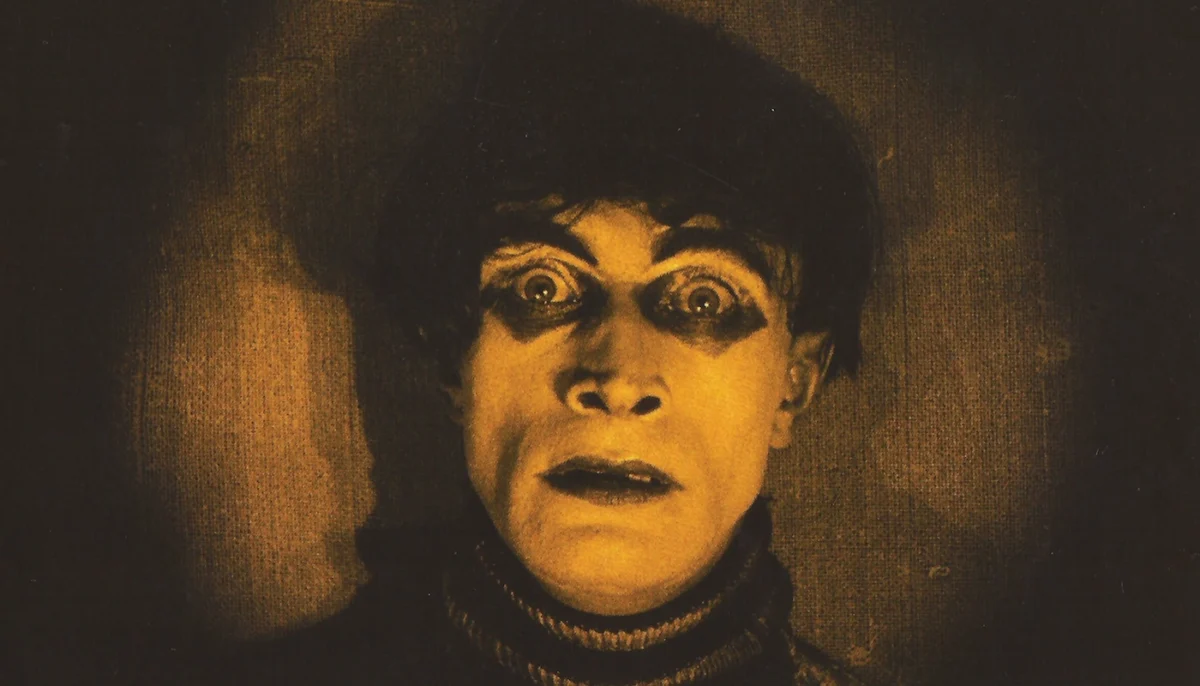
The film’s visual vocabulary is extraordinary: right angles are rare, rooms are contorted, and doorways and windows warp into improbable trapezoids. Perspectives are consistently distorted, and shadows, painted directly onto sets, are placed unnaturally. The scale of sets often mismatches the actors, creating a disorienting sense of unease. The characters, for the most part, move and appear normally, making the abnormality of their environment all the more pronounced. The result is a world that feels like a living drawing, a dreamscape rendered in two and three dimensions, a fragmented reality struggling to cohere. This visual impact is so profound that even contemporary viewers are urged to examine images from the film to grasp its uniqueness.
As professors Jerry Carlson and Gilberto Perez noted in a 2005 discussion, the film’s unconventional look was not a result of technical limitations or artistic ignorance. Stage designers, even those accustomed to German Expressionist traditions, possessed the skills to create naturalistic settings. The filmmakers of Caligari deliberately chose this path, recognizing its potential to capture attention and provoke a strong reaction, a gamble that proved remarkably successful.
The Rediscovery of Color
For much of its history, The Cabinet of Dr. Caligari was primarily viewed in black-and-white versions. However, audiences in 1920 experienced the film with hand-tinted hues. Original nitrate prints featured entire scenes washed in murky yellow, sickly green, or burnished orange, adding another layer of unreality. Unfortunately, many subsequent copies were made without this crucial tinting. The restoration of these original colors has been a gradual process, culminating in a significant effort completed in 2014. Film restorationist Barbara Flückiger documented this extensive process, detailing how six differently tinted copies from the 1920s were used to reconstruct the film’s original chromatic palette.
The unusual visual style, both then and now, aimed to disrupt the expected modes of natural realism or convincing illusion. The filmmakers’ gamble on a radically different look paid off, attracting immediate attention and inspiring countless subsequent productions.
Enduring Influence and Artistic Legacy
The impact of Caligari‘s visual style reverberates throughout film history. Contemporaries like Yakov Protazanov’s Aelita (1924) and Fritz Lang’s Metropolis (1927) clearly bore its influence. The shadowy, off-kilter aesthetics of 1930s Hollywood monster films and the noir genre of the 1940s and 1950s also owe a debt to Caligari. Later generations of filmmakers, including Tim Burton and Guillermo del Toro, have paid homage to its distinctive style. While Caligari‘s look is so unique it defies direct imitation, its influence is undeniable, with nearly every cinematic era since the 1920s offering its own interpretation and homage.
The Narrative Frame: A Locus of Debate
The second major area of contention surrounding Caligari is its narrative structure, specifically the framing device. The film’s core plot follows the mad doctor Caligari (Werner Krauss) who uses a somnambulist, Cesare (Conrad Veidt), to commit murders. A trio of young friends—Francis (Friedrich Feher), Jane (Lil Dagover), and Alan (Hans Heinrich von Twardowski)—become entangled in this violence, with Francis seeking to expose Caligari’s malevolence.
This central narrative is enclosed within a frame story. The film begins with Francis recounting his tale to an attentive listener and concludes with a twist: Francis is a patient in a mental institution, with Jane and Cesare as fellow inmates, and Caligari is the doctor treating them.
The Cabinet of Dr. Caligari is widely regarded as the first true horror film, its narrative elements—the stalking killer, the impending violence, the damsel in distress, and even a love triangle—resonating with modern horror conventions. The characters, while not deeply developed, function as archetypes, their dreamlike quality fitting the film’s surreal atmosphere. Conrad Veidt’s portrayal of Cesare is particularly lauded, capturing both fear and pity through his exaggerated expressions and uncanny movements. (Veidt, a Jewish actor who fled Nazi Germany, often found himself cast as Nazi officers in his American career, a role he understandably found difficult.)
The "it was all a dream" twist ending, while perhaps less shocking to audiences of the era accustomed to Gothic melodrama and detective fiction, has been the subject of intense academic debate for decades.
The Kracauer Interpretation and Its Critics
A pivotal interpretation of Caligari‘s narrative frame was put forth by Siegfried Kracauer in his 1947 book, From Caligari to Hitler: A Psychological History of the German Film. Kracauer, drawing on Janowitz’s 1941 account, argued that director Wiene and producer Erich Pommer added the framing sequences, including an opening and a coda, specifically to dilute the film’s potent political message. In this view, Caligari represented the oppressive German state, and Cesare embodied the manipulated populace. The added frame, by portraying Caligari as a benevolent psychiatrist and Francis as the delusional one, allegedly stripped the film of its revolutionary critique of absolute authority and transformed it into a conformist work.
Kracauer posited this shift as emblematic of Germany’s cultural trajectory towards totalitarianism, writing, "While the original story exposed the madness inherent in authority, Wiene’s Caligari glorified authority and convicted its antagonist of madness. A revolutionary film was thus turned into a conformist one…"
This interpretation, while compelling and influential, has faced challenges. Film scholars like Mike Budd have labeled it an "entertaining and memorable" myth, noting its similarity to common Hollywood narratives. The core issue lies in the uncertainty surrounding who precisely added the framing device and why, and whether its addition definitively altered the film’s thematic intent as Kracauer described.
A critical observation is that the film’s visual style remains consistent throughout, including the frame narrative. The mental hospital courtyard, for instance, retains the same distorted architecture and unnatural shadows, blurring the distinction between supposed reality and delusion. This could be a pragmatic decision to avoid building new sets, or a deliberate artistic choice to depict madness within madness, or to suggest that the "real" world itself is not entirely grounded in reality.
Furthermore, Fritz Lang’s recollection of suggesting a more conventional opening to ease audiences into the film—a claim also viewed with skepticism due to Lang’s own historical discrepancies—could indicate a commercial rather than ideological motivation for grounding the narrative.
The Ambiguity of the Surviving Script
For a long time, the origins of the narrative frame were impossible to definitively verify, as no complete script from the production era was believed to exist. Siegfried Kracauer had access to Janowitz’s personal narrative but not a definitive script. The discovery of a single surviving script, held by actor Werner Krauss, offered a potential breakthrough. However, this copy proved to be neither the frame-free version described by Janowitz nor the final shooting script. Instead, it presented a third version, beginning with Francis narrating at a bourgeois garden party and lacking the twist coda. This version does not definitively prove or disprove any particular interpretation, but it suggests that a version of the film with a non-delusional opening was considered. Notably, the script does not dictate the film’s Expressionist visual style, indicating that aspect of the design was developed separately.
The existence of this script has led some scholars to dispute Janowitz’s account and Kracauer’s interpretation, while others believe it changes little. The precise evolution of the script, the authorship and intent behind the framing device, remain subjects of vexation for film historians. The allure of finding direct links between popular art and the rise of Nazism, and the desire to pinpoint moments where artistic compromises paved the way for totalitarianism, makes this debate particularly charged.
The ambiguity surrounding the frame’s addition—whether ideological, commercial, or simply a narrative trope—underscores the complex interplay between art, commerce, and historical context.
The Enduring Question: Does it Matter?
The persistent debates over the narrative frame, Wiene’s alleged intentions, the accuracy of historical accounts, and the mythologizing of cinematic production raise a fundamental question: Does it ultimately matter?
The author argues that it does, not in the pursuit of definitive answers, but because the ongoing discourse offers profound insights into both art and politics. Film, as the dominant artistic medium of the 20th century, has always been intertwined with the tumultuous events of its time. The meaning and reception of Caligari have evolved alongside historical consciousness. The film Janowitz and Mayer envisioned is not identical to the film Wiene directed, but more importantly, the context in which audiences experienced Caligari in 1920—fresh from the horrors of World War I—was vastly different from its reception in later decades or today.
All art, intentionally or not, is political. Artists have limited control over how their work is interpreted over time. This is particularly true for film, which inherently records and reflects the world. While the debate over the narrative frame is significant, what truly resonates with audiences is the film’s nightmarish imagery, its disorienting visuals, its terrifying villain, and the crushing helplessness of Cesare. Few viewers today perceive Caligari as a tale of a benign psychiatrist helping an unwell young man. The frame narrative, in the context of the film’s enduring power, appears almost irrelevant, overshadowed by the potent themes of authority, control, madness, and fear that Janowitz and Mayer originally intended.
The Cabinet of Dr. Caligari possesses remarkable staying power, an unsettling, weird, and beautiful film that continues to provoke thought and inspire awe. While a single, definitive interpretation may remain elusive, its exploration of fundamental human anxieties ensures its continued relevance, its distorted glory a testament to its enduring uniqueness.
Further Discussion:
What are your thoughts on The Cabinet of Dr. Caligari? How do you interpret its notorious narrative frame? Which later films do you believe have been demonstrably influenced by Caligari‘s groundbreaking style?
Next Week:
Having delved into dreams, drugs, and hypnosis, we turn our attention to the sinister mind control exerted over an entire population in Alex Proyas’s Dark City (1998). Explore this film online.