In an increasingly innovative television landscape, a compelling trend has solidified within the horror genre: the migration of comedic auteurs to craft narratives steeped in dread, often infused with sharp wit. This creative cross-pollination, which harnesses the shared mechanics of suspense and release inherent to both comedy and horror, has found its latest and perhaps most distinct expression in Katie Dippold’s Apple TV+ series, Widow’s Bay. The show, helmed by a veteran of sketch comedy and beloved sitcoms, exemplifies a burgeoning movement that redefines genre boundaries and challenges traditional categorizations, particularly within the realm of prestigious awards.
The phenomenon gained significant traction with Jordan Peele, formerly half of the iconic sketch duo Key & Peele, whose directorial debut Get Out in 2017 became an instant cultural touchstone. A critical and commercial juggernaut, Get Out grossed over $255 million worldwide on a modest $4.5 million budget and earned Peele an Academy Award for Best Original Screenplay. His subsequent films, Us (2019) and Nope (2022), continued to explore complex social themes through the lens of psychological horror, cementing his status as a visionary filmmaker capable of delivering both chills and profound commentary. Similarly, Zach Cregger, a founding member of the sketch comedy troupe The Whitest Kids U’ Know, burst onto the horror scene with 2022’s Barbarian. Its unexpected twists and genuinely unsettling atmosphere garnered widespread acclaim and a respectable $45 million worldwide against a $4.5 million budget. Cregger’s follow-up, Weapons, further showcased his unique ability to blend suspense with darkly comedic undertones, notably earning Amy Madigan a Best Supporting Actress award for her role. These successes underscore a shared understanding among these creators of how to manipulate audience expectations, a skill honed through years of crafting punchlines and unexpected comedic turns.
The intrinsic connection between comedy and horror is not a novel concept. Both genres thrive on eliciting visceral reactions—a laugh, a scream, a jump—by building anticipation and delivering a payoff. Historically, films like John Landis’s An American Werewolf in London (1981), Sam Raimi’s The Evil Dead (1981), Wes Craven’s Scream (1996), and Drew Goddard and Joss Whedon’s The Cabin in the Woods (2012) have masterfully straddled this divide, demonstrating that humor can amplify horror, and vice versa, often by providing a much-needed release from tension or by subverting expectations to create an even greater shock. Even iconic horror figures, such as Freddy Krueger, were often characterized by their macabre one-liners, proving that a touch of dark humor can imbue terror with a memorable, albeit twisted, personality. Peele and Cregger, in their contemporary works, have refined this balance, crafting films that are not only narratively ambitious and stylistically reverent to horror traditions but also achieve significant critical and commercial resonance.
Katie Dippold, the creative force behind Widow’s Bay, joins this distinguished lineage, bringing her extensive background in comedy to the horror genre. Her career began in the trenches of sketch comedy as a writer for Mad TV, where she learned the foundational elements of comedic timing, character development, and narrative construction in short, impactful bursts. This experience proved invaluable as she transitioned to co-writing the critically acclaimed sitcom Parks and Recreation, a show renowned for its endearing characters and intricate comedic setups. Dippold’s understanding of how to build a comedic premise, establish character motivations, and deliver satisfying resolutions directly translates to the art of suspense. "I really do think there’s something to people who started in sketch comedy understanding how to build something, setting up the anticipation and the payoff," Dippold explains, highlighting the shared architectural principles of the two genres. "What I find fun is that you don’t know if that build is going to lead to something that’s going to make you laugh or scare you." This philosophy forms the bedrock of Widow’s Bay.
Dippold’s journey into horror-comedy was further solidified through her work on feature films. She co-wrote the script for the 2016 Ghostbusters reboot, a project that, despite its polarizing reception, represented a significant undertaking in blending supernatural action with broad comedy. This experience, followed by her penning of Disney’s 2023 Haunted Mansion film, provided her with invaluable insights into the technical and creative challenges of genre fusion on a large scale. These projects allowed her to hone her craft in weaving comedic beats into spooky narratives, preparing her for the expansive world-building required for a television series.
The genesis of Widow’s Bay itself is a testament to Dippold’s long-standing vision. She reveals that the concept has been brewing for nearly two decades, initially conceived as a spec script for Parks and Recreation. This prolonged incubation period allowed the idea to evolve from a broad comedy into a sophisticated series that masterfully navigates the delicate balance between humor and horror. Dippold attributes this evolution, in part, to the collaborative nature of television production, a stark contrast to the often solitary process of feature film writing. "With features, you just write the script and you’re lucky if the director wants you on set," she notes. "Not being able to have much say once the script is in and [now] being in a position where I have all the say naturally made me someone who wants that collaboration. These actors are brilliant, the production design team is tremendous, and the directors who came in had other ideas that I would not have thought of. It’s thrilling to me, and I can’t imagine doing it in a way where it’s all my vision and nothing will ever change." This open approach fosters a dynamic creative environment, allowing diverse perspectives to enrich the series’ complex tonal tapestry.
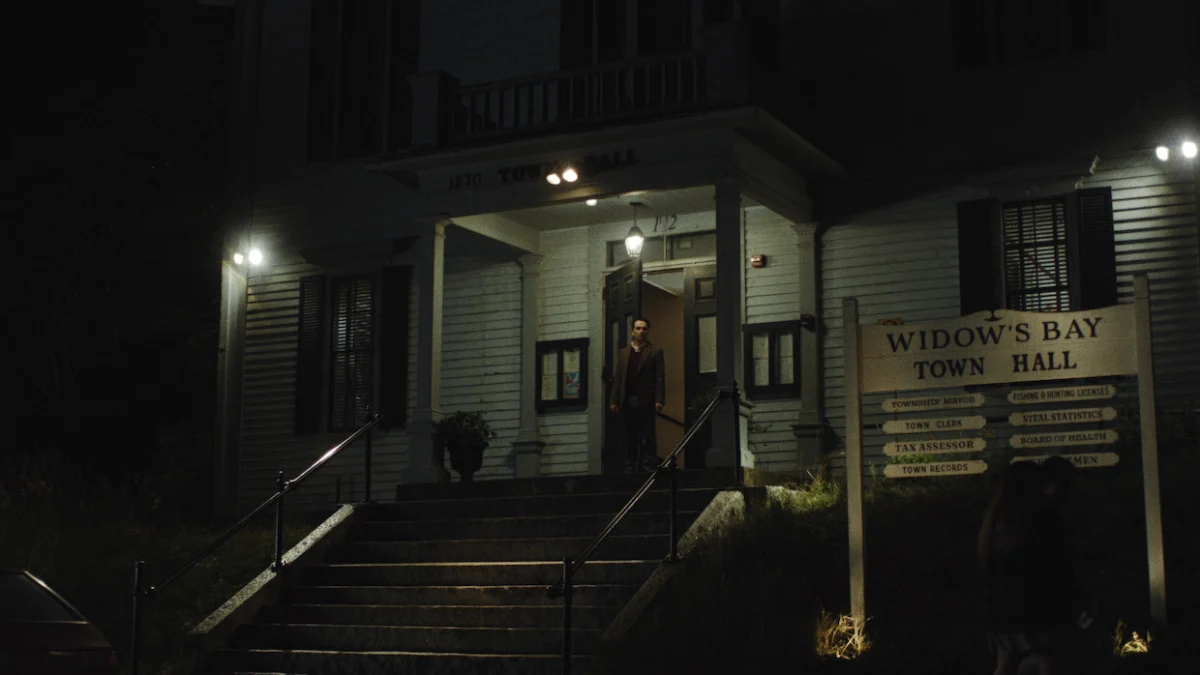
Widow’s Bay plunges viewers into the eponymous New England island community, a seemingly picturesque yet profoundly cursed locale. Matthew Rhys stars as Tom Loftis, the perpetually optimistic mayor whose primary goal is to transform the island into a thriving vacation destination, despite its unsettling supernatural undercurrents. His unwavering belief in the town’s potential provides a comedic counterpoint to the escalating horrors, reminiscent of a Jaws-esque mayor, but imbued with Rhys’s signature lovable charm rather than Murray Hamilton’s cynicism. Tom’s earnest skepticism is constantly challenged by the island’s grim reality, and by the fervent warnings of Wyck, the town crankpot brilliantly portrayed by Stephen Root, who is convinced the island is irrevocably cursed. Wyck serves as Tom’s primary foil, a harbinger of doom whose pronouncements are often tragically accurate.
The island’s assortment of evils manifests in a variety of increasingly outlandish and genuinely unsettling ways. Ominous fogs roll in, shrouding the town in mystery; a sinister killer clown stalks unsuspecting residents; an amorous sea hag, notorious for smothering her male victims by sitting on their faces, provides both horrifying and physically comedic moments (including one memorable scene where she is propelled across Tom’s living room by a well-timed reclining armchair). A haunted inn, with an innkeeper so terrified he refuses to stay overnight, becomes the site of Tom’s ill-fated attempts to debunk the supernatural. Furthermore, an ancient spellbook nearly turns a seemingly innocuous cocktail party into a mass drowning, showcasing the deadly seriousness underlying the show’s comedic facade.

While its supernatural elements are crafted to be genuinely unsettling, Widow’s Bay operates primarily as a comedy, with horror serving as its disorienting backdrop. Much of the show’s humor stems from the characters’ remarkably grounded, almost bureaucratic reactions to the absurd supernatural phenomena besieging their town. Tom’s attempts to rationalize the unexplainable, or his earnest efforts to promote tourism amidst escalating paranormal activity, provide a constant source of comedic gold. Like the best character-driven sitcoms, the series finds its stride in observing how its well-defined characters navigate increasingly bizarre and unhinged scenarios, often with a sense of exasperated normalcy that heightens the comedic effect.
The brooding visual tone of Widow’s Bay is a direct result of Dippold’s collaboration with executive producer Hiro Murai, an Emmy-winning director known for his distinctive work on critically acclaimed series such as The Bear, Atlanta, and Station Eleven. Murai, who helmed five of the season’s ten episodes, brought a sophisticated visual language that grounded the supernatural elements in a tangible, atmospheric reality. The pair drew inspiration from a vivid memory from Dippold’s teenage years: a visit to a "lawless" haunted house in Long Branch, New Jersey, during the 1980s. Dippold recalls, "They could chase you around and grab you. That mix of being scared, but you’re having the time of your life, is a feeling I’ve wanted to capture ever since." This formative experience perfectly encapsulates the show’s core ethos: the thrilling, exhilarating blend of fear and fun. Murai’s expertise in crafting surreal, darkly comedic, and often melancholic visual narratives perfectly complements Dippold’s comedic sensibilities, ensuring that the show’s horror elements are visually impactful and genuinely chilling, even when played for laughs.
A crucial element enabling Widow’s Bay to meld its disparate tones effectively is its meticulously chosen cast. Alongside Matthew Rhys and Stephen Root, the ensemble features Kate O’Flynn as Tom’s mousy yet increasingly capable assistant Patricia, Kevin Carroll as the pragmatic town sheriff Bechir Clemmons, and Dale Dickey as Rosemary, one of Tom’s no-nonsense employees. With the notable exception of Stephen Root—a versatile actor celebrated for his comedic roles in NewsRadio and Office Space, his Emmy-nominated turn in Barry, and his voice work in Strip Law—many of the main cast members are more widely recognized for their work in television dramas. This deliberate casting choice was fundamental to Dippold’s vision.
Dippold initially considered populating her fictional town with comedic performers she had admired since her days performing improv at the Upright Citizens Brigade Theatre in New York two decades prior. However, she realized this approach might disrupt the delicate comedy-horror equilibrium she aimed for. "When I imagined an actor that you know from comedy starring in it, it just took me out of it," she explains. "Like, I don’t believe it’s a real place, and I don’t know that I would watch the show. As a horror fan, I want to know that they’re taking it seriously." This insight led to the strategic decision to cast actors with strong dramatic backgrounds in the leading roles. Matthew Rhys, a fan-favorite for his Emmy-winning performance in The Americans, was suggested by casting director Allison Jones and proved to be the ideal choice for Tom Loftis. Dippold praises Rhys’s approach: "He always just plays the truth of the scene. He never goes for the joke. He’s so naturally funny, and he understands what’s funny about [the scene]."
This philosophy echoes a classic anecdote about the film Tootsie, which director Sydney Pollack once noted felt like making a drama on set, despite its comedic brilliance. Dippold resonates deeply with this sentiment. While she often cites influences like Stephen King, John Carpenter, Atlanta, and Parks and Recreation, she admits to secretly drawing inspiration from Tootsie. The film’s enduring humor, she agrees, stems from Dustin Hoffman’s unwavering commitment to playing his character’s reality, even in the most farcical situations. "I mean, he’s in a drama," Dippold laughs. "If he was playing it any differently, it would feel terrible. And I think the actors on this show are doing something very similar. They don’t look at it like they’re in a comedy or a horror show; they’re just playing the scenes and they’re not thinking about the genres. And I think that helps a great deal." This commitment to character and truth, irrespective of genre labels, is what allows Widow’s Bay to successfully deliver both genuine laughs and authentic scares.
As Widow’s Bay enters the awards conversation, it faces a unique challenge. The series will be submitted for Emmy consideration in the comedy series category, positioning it as arguably the most gruesome comedy of the year. Historically, the Emmys have shown a cautious approach to genre-bending shows within comedy categories, though recent exceptions indicate a potential shift. Netflix’s Wednesday, a fantasy horror-comedy, garnered significant nominations and wins, demonstrating a willingness to embrace genre elements. Similarly, FX’s What We Do in the Shadows, a critically acclaimed mockumentary horror-comedy, has consistently received Emmy recognition. These precedents, while tonally distinct from Widow’s Bay, suggest a growing receptiveness to narratives that defy easy classification. In contrast, film awards, such as the Golden Globes, have often seen horror films like Get Out and The Substance successfully campaign in comedy categories, acknowledging their subversive humor.
Widow’s Bay presents a compelling argument to Emmy voters: Can the comedy series Emmy become as inclusive and expansive as its dramatic counterpart? The drama category has notably broadened its scope in recent years, embracing science fiction, fantasy, and horror series, including multi-award winners like Game of Thrones, and nominees such as The Boys, The Last of Us, Lovecraft Country, The Mandalorian, and Stranger Things. In these shows, the dramatic weight is intrinsically woven into their fantastical and terrifying premises. Likewise, in Widow’s Bay, the meticulously crafted jokes are as integral and vital to the show’s identity as its chilling jump scares. The series implicitly suggests that achieving a perfectly timed punchline requires a similar level of artistry, precision, and narrative understanding as executing a genuinely terrifying moment.
The broader implications of Widow’s Bay‘s success and potential Emmy recognition extend beyond mere accolades. It signifies a maturation of the horror-comedy subgenre, moving it from niche appeal to mainstream critical and popular acceptance. It reinforces the idea that television storytelling can fluidly traverse genre boundaries, offering audiences multifaceted viewing experiences that are simultaneously hilarious and horrifying. Dippold’s work, along with that of Peele and Cregger, marks a pivotal moment in how audiences and critics perceive genre, pushing creative boundaries and ultimately enriching the tapestry of modern television. As these auteurs continue to blend the absurd with the terrifying, they are not just making great television; they are redefining the very parameters of what a "comedy" or "horror" show can be, demonstrating that sometimes, the biggest laughs are found just before the loudest screams.