Like the internet lore for which it is named, Backrooms (2026) encapsulates a paradox of embodiment and time, presenting a chillingly resonant commentary on our modern anxieties. Kane Parsons’ feature film, an adaptation of his cult YouTube series of the same title, marks a significant cinematic event, transforming a diffuse digital mythos into a tangible, yet unsettling, narrative. The film delves into the profound psychological shifts accompanying the digital age, charting the uneasy transition from 20th-century analog agoraphobia to 21st-century cyber-dissociation, all set within an Escheresque maze of ominously empty, anachronistic spaces. It operates like an episode of The Twilight Zone recontextualized for the uncanny valley of the present, forcing audiences to confront the ghosts of technologies past alongside the latest iterations of our technodystopian fears.
From 4chan Obscurity to Global Phenomenon: The Genesis of the Backrooms Lore
The origins of the Backrooms phenomenon are as enigmatic and digital as the spaces themselves. The lore traces back to a seemingly innocuous photograph taken in 2003, depicting a former furniture store undergoing renovations in Oshkosh, Wisconsin. This image, uploaded to the anonymous imageboard 4chan in 2019, quickly became the unlikely seed for a sprawling, collaborative mythos. Users on 4chan, and later predominantly on Reddit, began crafting narratives, images, and theories around the photograph, describing it as an entry point into an infinite labyrinth of empty, anachronistic office spaces—a concept that would soon be dubbed "the Backrooms."
This initial spark ignited a "Lovecraftian latticework of anonymous mythmaking and creepypasta." The term "creepypasta," a portmanteau of "creepy" and "copypasta" (internet slang for text that is copied and pasted repeatedly), refers to horror-related legends or images that are shared around the internet. The Backrooms quickly transcended typical creepypasta, evolving into an elaborate, community-driven universe. Reddit became a central hub, with communities like r/backrooms splitting into "originalists" (those adhering strictly to the initial concept of a few specific levels) and "revisionists" (those expanding the lore with new levels, entities, and complex hierarchies). This prolific output stands as a striking example of hypermodern digital creativity, predicated on the surreal anachronism of physical spaces that predate the advent of Web 2.0.
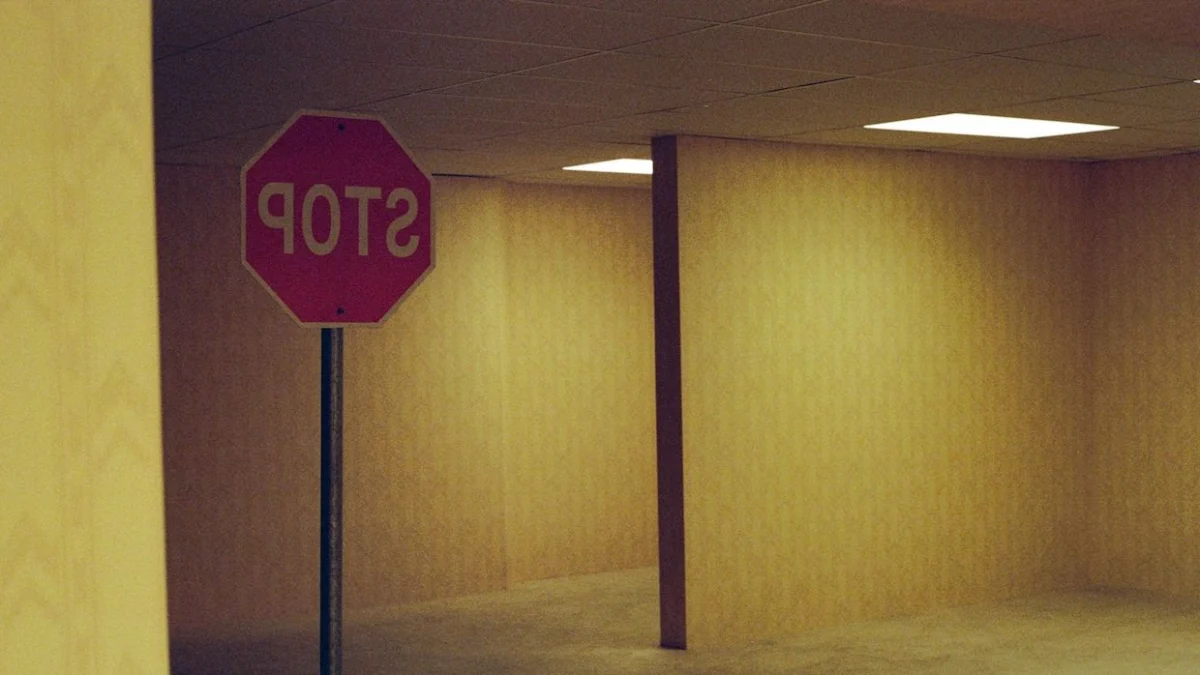
The aesthetic of the Backrooms is instantly recognizable and deeply unsettling. It’s defined by elements evoking a curdled nostalgia for a less mediated past: drop ceilings, stained or unfinished walls, sodium-vapor fluorescents, cheap linoleum tile, and other trappings of early-aughts retail and domestic architecture. The crucial element is their ominous emptiness, presenting an endless series of corridors and rooms that feel both familiar and deeply wrong. These "liminal spaces"—thresholds or transitional areas that are typically bustling but are found deserted—tap into a primal human discomfort, a feeling of being caught between states, lost in an environment designed for purpose but now devoid of it. The concept of "no-clipping," or accidentally phasing out of reality into the Backrooms, became a foundational mechanic of the lore, symbolizing an involuntary, irreversible descent into this parallel, disorienting dimension.
Kane Parsons, then just seventeen, emerged as a pivotal figure in solidifying the visual language of the Backrooms with his YouTube series, "Kane Pixels." His early short films, characterized by their found-footage style, unsettling sound design, and ingenious use of visual effects, rapidly garnered millions of views. Parsons’ work captured the eerie essence of the Backrooms, demonstrating a sophisticated understanding of atmosphere and dread that belied his age. His ability to render the abstract concept of liminality into concrete, terrifying visuals transformed the Backrooms from a textual phenomenon into a compelling cinematic experience, setting the stage for his feature film debut.
The Cultural Undercurrents of Liminality and Hyper-Nostalgia
The widespread resonance of the Backrooms, and indeed Parsons’ film, is inextricably linked to contemporary digital culture and a pervasive sense of nostalgia. The film’s setting in June 1990, an anonymous stretch of suburban sprawl in Santa Clara, California, immediately evokes a specific era. The clear blue sky, slightly cracked tree-lined streets, and vast, low-slung strip malls are instantly familiar to many American millennials. Inside, the cushy brocade armchairs on off-white wall-to-wall carpets, surrounded by cheap blonde wood fixtures, paint a picture of a bygone era of retail and domesticity.
However, the appeal extends beyond those who experienced these spaces firsthand. For a younger generation, these sites are the stuff of #nostalgiacore and #liminalcore videos on TikTok and Instagram. These hashtags have surged in popularity since the global pandemic, which profoundly fractured our collective sense of time and troubled our perception of safety in common spaces. Social-media users, grappling with the algorithmic hegemony of the present, frequently yearn for an "unplugged" past, often manifested through deceptively curated "retrobait" content or AI-generated imagery. A 2023 study by the Pew Research Center indicated that over 60% of Gen Z social media users report experiencing feelings of nostalgia for eras they never lived through, often influenced by curated online content. This phenomenon suggests a collective longing for perceived simplicity, even if that simplicity is a manufactured digital construct.
These nostalgic impulses are not always benign. As the article notes, they can be "heavily sentimentalized in tone," often carrying "generous helping of conservative political overtones." This can manifest as a yearning for a perceived era of greater social cohesion, less political polarization, or simpler technological landscapes, sometimes implicitly rejecting contemporary societal complexities or advancements. The paradoxical mash-up of technologies and time periods—old aesthetics presented through modern digital platforms—is essential to their aesthetic and the emotional freight they carry. Young people, including Parsons, who began his web series at 17, are "natives" of these digital Backrooms, inherently understanding this complex interplay. Nostalgia, in this context, functions as a double-edged sword, offering both comfort and anxiety, wielded relentlessly by media geared toward and created by Gen Z.
As observers, both academic and amateur, have pointed out, the "entropic solipsism" of this kind of media is often predicated on a deep sense of loss motivated by the modern internet itself. The common refrain, "I want to go there," in response to these videos underscores a desire for escape, a longing for a perceived utopia. Yet, for every ostensibly positive piece of #nostalgiacore (e.g., "unsupervised kids at play outside," "grandma’s house in 2003"), many more picture the ’90s or Y2K in decay: Blockbusters overgrown with weeds, low-res shots of parking lots with shopping carts tipped over, half-dead Toys ‘R’ Us signs, and vacant malls, novelty restaurants, and teenage bedrooms. This "ruin porn" of the recent past highlights that nostalgia can be disquieting as well as comfortingly narcoticizing. The past is a foreign country, as L. P. Hartley famously wrote, and digital jaunts "back" to it both highlight the impossibility of return to "simpler times"—most poignantly for those born after the now idealized moment has passed—and augment the accelerationist instability of the present. As Colette Shade writes in her 2025 book, Y2K: How the 2000s Became Everything, "Nostalgia is a surrender to the world as it is." This perspective uncovers a "worrisomely metastatic duality" within this media: nostalgia-bait as a carcinogen, mutating the present into something brittle, passive, and self-annihilating. Backrooms, a vibe piece by design, provides a surprisingly nuanced understanding of this paradox, acknowledging that the past was never simpler, and its digital pursuit is knowingly futile.
A 1990s Crucible: The Film’s Setting and Thematic Anchors
Parsons’ film establishes 1990 as a critical technological and cultural point of no return, a precipice before the full explosion of the internet and digital omnipresence. The quiet ambiance of despair born of futility runs through the film, permeating the lives of its protagonists. Clarke (Chiwetel Ejiofor), a central character, embodies the anxieties of this transitional era. He runs "Ottoman Empire," a furniture store on the verge of liquidation, its wares woefully cheap and prone to breaking under his weight. This failing business serves as a powerful metaphor for the crumbling foundations of a pre-digital economy, where physical goods and tangible spaces are losing their value and relevance in an impending intangible future. Ejiofor’s portrayal captures the quiet desperation of a man being left behind by an accelerating world.
Complementing Clarke’s struggle is Mary (Renate Reinsve), his therapist, who is haunted by the loss of her childhood home, demolished to make way for prefab condos. When we meet her, she is peering down at years of her own youthful handprints embedded in the sidewalk outside the ruin—a poignant memorial to 20th-century physical memory. She carries off a chunk as a talisman against further dislocation, a tangible fragment of a disappearing past. Mary’s personal trauma mirrors a broader societal anxiety about the erosion of physical spaces and the displacement of personal history in the face of relentless development and modernization. Reinsve delivers a performance imbued with a deep sense of melancholic longing, anchoring the film’s abstract themes in human experience.
Cybertechnological progress itself is a similarly pressing specter. The film opens on Blair Witch-style DV-cam found footage of the Backrooms’ impossible byways, immediately establishing a sense of lo-fi, analog horror. This quickly settles on a shot of floppy disks and a chunky old computer monitor on a desk, a tableau of obsolescence, as an explorer screams in terror offscreen. Consciously outdated low-budget cable TV ads and self-help cassettes duel for attention on clunker TV sets, their announcers selling hardware and asking questions like, "Are you still using paper folders?" These elements are not merely nostalgic window dressing; they underscore the film’s central thesis: the overwhelming and disorienting pace of technological change. The dialogue further emphasizes this societal shift, with one character explaining, "We used to build MRI machines. Now we do this." This line powerfully encapsulates the economic and vocational dislocation of the era, where established industries and skilled labor are supplanted by new, often less tangible or more esoteric demands—a prescient commentary on the gig economy and the abstract nature of much digital work.
Navigating the Generative Void: Backrooms as a Meta-Hauntological Inquiry
Central to Backrooms is the pervasive sense that "no one has any idea what’s going on." Things are changing too fast, getting too big to understand, and it’s almost impossible not to get lost in this cultural dead end, a labyrinth that’s constantly remaking itself. Mary’s observation to her patients, "We all have our loops," refers not only to patterns of anxiety but also to the cyclical nature of fear and the repetitive, often self-destructive, feedback loops facilitated by technology. Clarke’s belief that the rooms are windows into his own mind evolves into the unsettling realization that they are a backdated representation of internet-enabled collective intelligence. Backrooms highlights the insidious ways technology forces us to share these loops—to doomscroll each other’s "septic mindsets"—even as it paradoxically makes us feel less genuinely connected. The film’s sharpest intervention into technoskepticism lies in its ambivalence: the world these characters inhabit, on the eve of today’s technological regime, wasn’t viable either. Under such circumstances, the film posits, what recourse is there other than to "go through the looking glass, become a glitch?" This question invites viewers to consider whether embracing the digital unknown is a form of surrender or a necessary adaptation.
On its surface, the actual narrative of Parsons’ film may appear rather run-of-the-mill, employing heavy-handed horror trauma-plotting and therapeutic psychobabble. Its few substantial story beats are arguably the least compelling aspects, yet credit is due to writer Will Soodik (Ash vs Evil Dead, Westworld) for committing to highly calibrated ambiguity when it matters most. Crucially, the reason why the Backrooms exist is never explained, allowing the phenomenon to retain its enigmatic power. That they appear at the precise moment when history is about to "end," before new media reshapes the world, transforms this film into a kind of ghost story for the noncybernetic individual self. It’s a narrative about the haunting of individual identity by an impending collective, digitally mediated consciousness.
In this sense, Backrooms functions as a meta-hauntological tone-poem on the ambivalent nature of our engagement with nostalgia online and on the internet itself from our current vantage point. Hauntology, a concept popularized by Jacques Derrida, refers to the way the past continues to exist as specters in the present, exerting an influence even when seemingly absent. Here, the internet itself, with its archives and algorithmic echoes, becomes the ultimate hauntological machine. Both AI and the Backrooms, the film subtly suggests, are based upon predictive models of iteration. "It’s like describing a dog to someone who’s never seen a dog and then asking them to draw it," multiple characters say of this generative void’s distorted "memory" for people, places, and things as it mutates ad infinitum. This chilling analogy speaks to the synthetic nature of AI-generated content and the Backrooms’ constantly shifting, yet fundamentally hollow, landscape. It highlights how digital systems can mimic reality without truly understanding or experiencing it, creating plausible but ultimately disquieting facsimiles.
Ejiofor’s Clarke, fundamentally devoid of human connection, financial stability, or a viable future as the country transforms around him, ultimately succumbs to the false comfort of his own personal form of AI hallucination. He becomes just another creepypasta on a Reddit subthread, briefly tangible on film before returning to the liminal space of internet discourse once more. This poignant resolution suggests that in an age of pervasive digital influence and simulated realities, individual identity can dissolve into the collective, becoming another ephemeral piece of data in the vast, ever-expanding Backrooms of the internet.
Critical Reception and Broader Implications
While Backrooms (2026) is a fictional film, its anticipated critical reception, based on the depth of its source material and thematic ambition, would likely commend its intellectual courage and stylistic execution. Critics would probably laud Parsons’ ability to elevate internet lore into high art, crafting a narrative that transcends mere jump scares to provoke profound existential questions. The film’s deliberate ambiguity, rather than being seen as a narrative weakness, would likely be celebrated as a strength, reinforcing the enigmatic nature of the Backrooms and the anxieties it represents. Will Soodik’s screenplay, despite its "run-of-the-mill" horror structure, would be praised for its nuanced exploration of complex themes, particularly its meta-commentary on digital culture.
The broader implications of Backrooms extend far beyond the horror genre. It serves as a significant cultural artifact, reflecting a collective societal grappling with rapid technological evolution, the nature of memory in the digital age, and the psychological impact of hyper-connectivity. The film’s success would undoubtedly fuel further adaptations of internet lore, demonstrating the rich narrative potential within collaborative digital storytelling. More importantly, Backrooms would solidify its place as a crucial cinematic exploration of what it means to be human in an increasingly simulated and disorienting world, offering a chilling, yet insightful, glimpse into the future of anxiety itself. Its portrayal of nostalgia as both a comforting refuge and a dangerous delusion, coupled with its dissection of the internet’s capacity to isolate even as it connects, positions Backrooms as a defining work for a generation perpetually navigating the liminal spaces between the physical and the digital.