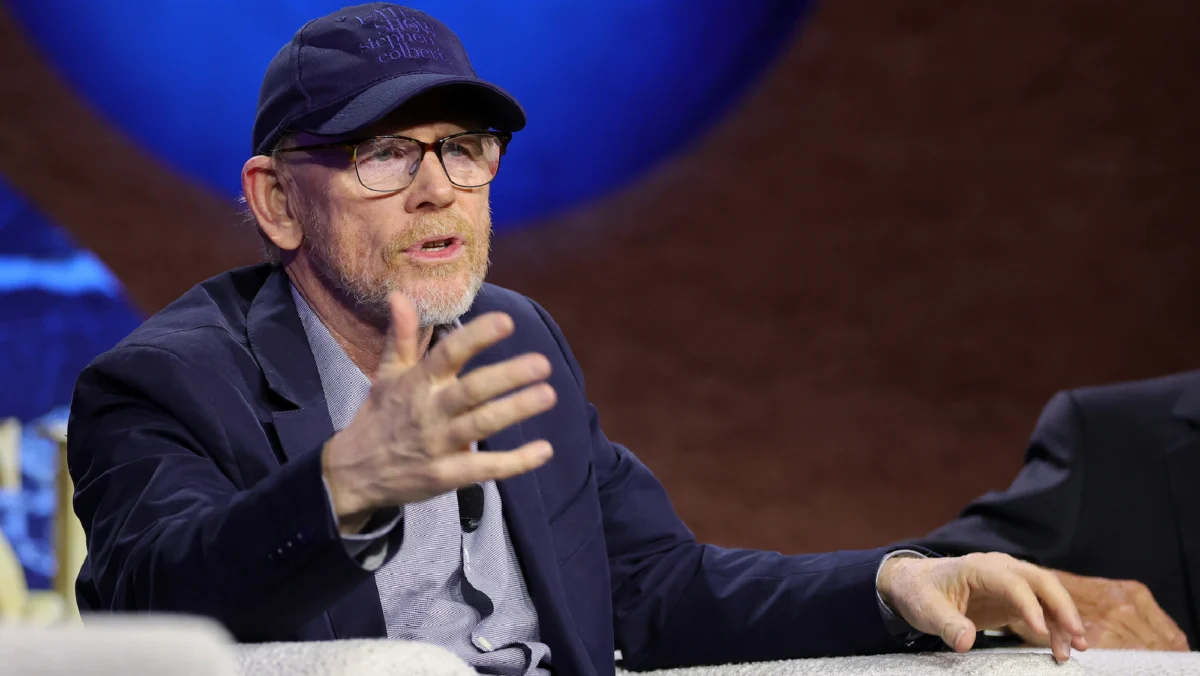
The landscape of modern cinema is currently navigating a period of profound technological disruption, and veteran director Ron Howard has emerged as a prominent voice advocating for the integration of artificial intelligence in the creative process. Speaking at the Runway AI Film Festival held at Lincoln Center in New York, Howard, the Academy Award-winning filmmaker behind such classics as Apollo 13, A Beautiful Mind, and Splash, articulated a vision of AI not as a threat to human creativity, but as a transformative utility that will eventually become an industry standard. Howard’s appearance at the festival, where he engaged in a fireside chat with Runway co-founder Cris Valenzuela, signals a significant shift in how Hollywood’s "old guard" perceives generative technology.
During the discussion, Howard characterized the potential of AI as "very exciting," emphasizing its ability to democratize storytelling by making the production process more efficient and accessible. While acknowledging the myriad of legal, ethical, and technical "facts yet to be sorted out," Howard maintained an optimistic stance, suggesting that the drive for innovation will inevitably lead the industry toward adoption. "We will want it," Howard told the audience, framing the technology as an irresistible tool for creators who wish to broaden the scope of their ideas without the traditional barriers of high-cost production logistics.
A Legacy of Innovation: From Puppetry to Pixels
Howard’s endorsement of AI is rooted in his historical perspective on cinematic innovation. During his talk, he drew a striking parallel between modern generative tools and the creative philosophy of the late Jim Henson. Howard, who recently directed the 2024 documentary Jim Henson Idea Man, noted that the Muppets creator was a relentless innovator who would likely have embraced AI with enthusiasm. According to Howard, Henson’s primary motivation was the act of creation itself—staying busy "making things"—and AI represents a modern extension of that impulse.
This comparison serves to bridge the gap between traditional "hand-crafted" entertainment and the digital frontier. By invoking Henson, a figure synonymous with warmth and human touch, Howard challenged the notion that AI is inherently clinical or soul-less. Instead, he presented it as a medium for rapid prototyping and experimentation, allowing artists to visualize complex concepts that were previously confined to the imagination or prohibited by budgetary constraints.
The Divided Front: A New Class of Filmmakers
The discourse surrounding AI in Hollywood has created a distinct ideological divide among top-tier directors. Howard’s comments place him in a growing "pro-tech" camp that includes Martin Scorsese, James Cameron, and Steven Soderbergh. Recently, Scorsese faced significant industry backlash after backing an AI company specifically for storyboarding purposes. Howard, however, chose not to address the controversy surrounding Scorsese, focusing instead on the practical necessity of experimentation.
"You’re talking about change and people are worried about it," Howard remarked when questioned about the potential backlash from labor groups and traditionalists. "I’m worried about it, on a professional level. But again, our job is to experiment with it and learn from it and work with it."
This pragmatic approach stands in contrast to "analogue purists" like Christopher Nolan and Guillermo del Toro, who have championed traditional film stock and practical effects as the essential components of cinematic authenticity. Nolan has famously critiqued the overuse of digital tools, suggesting that the reliance on algorithms can dilute the visceral impact of a scene. Howard’s counter-argument suggests that the "authenticity" of a film is determined by the final emotional output rather than the tools used to achieve it. He noted that the evolution of the medium is ultimately dictated by the viewers: "It’s going to evolve. And audiences are going to tell us."
Corporate Integration and the Runway-Lionsgate Partnership
The context of Howard’s speech is amplified by significant corporate movements within the industry. On the same day as the festival, Runway announced a landmark partnership with Lionsgate, the studio behind massive franchises such as The Hunger Games and John Wick. This deal marks a pivotal moment in the commercialization of generative AI for film production. Under the agreement, Lionsgate will utilize Runway’s technology to develop a custom AI model based on its own vast library of intellectual property.
This "IP-centric" model is designed to assist the studio’s filmmakers in pre-production and post-production, potentially saving millions of dollars in visual effects and storyboarding. Runway, which currently boasts a valuation of approximately $5.3 billion and has secured over $800 million in financing, is positioning itself as the primary infrastructure provider for this new era. The partnership also includes an investment from Lionsgate, signaling a long-term commitment to integrating AI into the "film pipeline."
Other major players are following suit. Netflix and Amazon Studios have already begun incorporating AI-driven tools into their production ecosystems, offering them to directors as a way to streamline workflows. The trend indicates that while the debate over AI’s role in art continues, the logistical and financial machinery of Hollywood is already moving toward a future defined by algorithmic assistance.
Economic Implications: The Myth of Lowered Costs
One of the most persistent arguments in favor of AI is its potential to lower production costs. However, Howard offered a sobering caveat based on his decades of experience navigating technological transitions. Reflecting on the shift from celluloid to digital filmmaking in the early 2000s, Howard noted that the expected savings never fully materialized.
"I would have thought digital filmmaking would have lowered costs more than it did," Howard admitted. He explained that as the tools become more efficient, audience expectations for visual spectacle rise proportionally. To meet these heightened expectations, studios often reinvest the saved capital back into the project to achieve even more complex visual feats, keeping the overall budget high.
This cycle suggests that while AI may make certain tasks "cheaper," the total cost of a "tentpole" Hollywood production is unlikely to drop significantly. Instead, the technology will likely allow for a higher density of visual information and a more polished "look" within the same financial frameworks. For Howard, the true value of AI lies not in the "bean-counting" aspects of the business, but in the creative possibilities it unlocks.
Defining the "New Aesthetic"
Perhaps the most forward-looking aspect of Howard’s talk was his prediction regarding the visual future of cinema. When asked by Valenzuela what he believes AI tools will ultimately yield for the industry, Howard responded with a succinct and powerful phrase: "A new aesthetic."
This "new aesthetic" refers to a departure from the traditional CGI looks that have dominated the last two decades. Generative AI has the capacity to create textures, lighting, and environments that do not follow the rigid rules of traditional 3D modeling. This could lead to a more "painterly" or surreal style of filmmaking that blends the boundaries between reality and digital fabrication in ways that were previously impossible.
Industry analysts suggest that this aesthetic shift will first be seen in independent cinema and experimental shorts, such as those showcased at the Runway AI Film Festival, before migrating to mainstream blockbusters. Howard’s interest in this evolution highlights his willingness to remain a student of the craft, despite his status as a legendary figure in the industry. "I’m not particularly tech-savvy," he confessed. "I’m not going to be that person. But when I see it and start to work with it, I get very excited about it."
Conclusion: The Path Forward
The endorsement of Ron Howard marks a turning point in the cultural acceptance of AI within the film community. By framing the technology as a natural successor to the innovations of Jim Henson and as a necessary evolution for modern storytellers, Howard has provided a blueprint for how legacy filmmakers can navigate the digital transition.
As the industry moves forward, the focus will likely shift from whether AI should be used to how it can be used responsibly and creatively. The collaboration between major studios like Lionsgate and tech innovators like Runway suggests that the infrastructure for an AI-powered Hollywood is already being built. For directors like Howard, the goal remains the same as it was when he first stepped behind the camera: to find the most effective way to share a story with the world. Whether through the lens of a traditional camera or the prompt of an AI model, the pursuit of the "new aesthetic" continues to drive the cinematic medium toward its next great frontier.