The Genesis of a Digital Myth: From 4chan to Feature Film
The origins of Backrooms are as amorphous and unsettling as the phenomenon itself. Its journey began in 2003 with a seemingly innocuous photograph taken in Oshkosh, Wisconsin, depicting a former furniture store undergoing renovations. This image, characterized by its oddly empty, almost unsettlingly familiar aesthetic, lay dormant for over a decade before being uploaded to the anonymous imageboard 4chan in 2019. It was here that the photograph sparked an immediate, visceral reaction, becoming the accidental genesis of what would rapidly evolve into a global internet mythos.
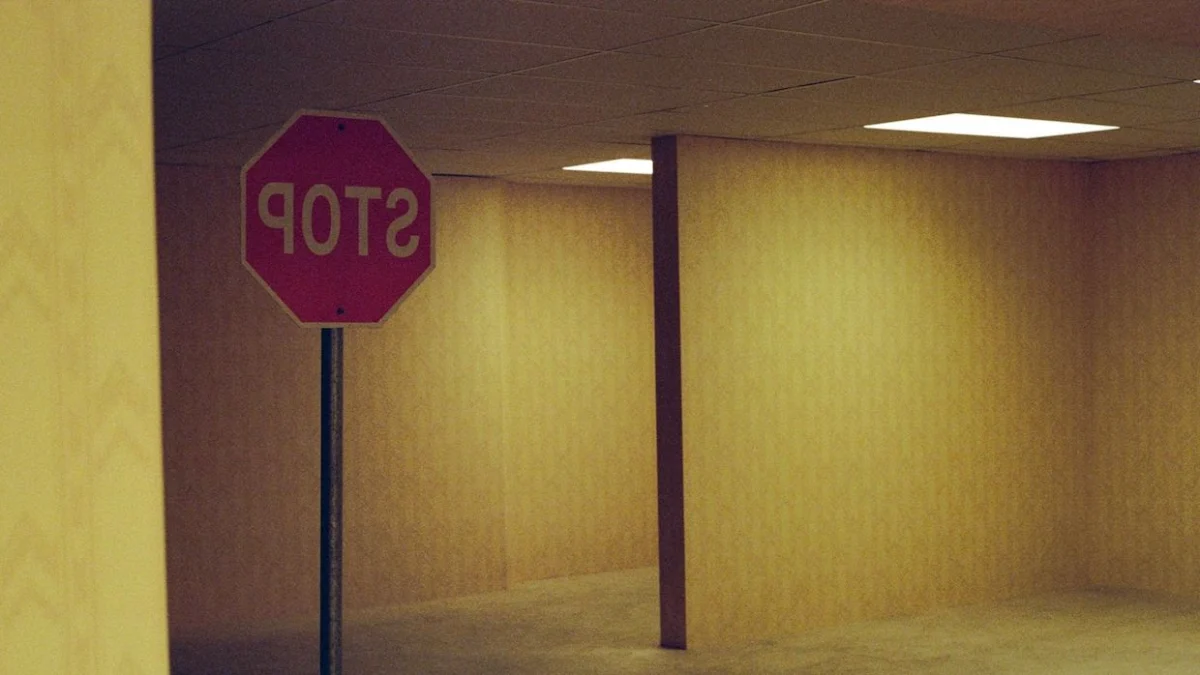
Users on 4chan, known for its fertile ground for viral content and collaborative storytelling, began to imbue the image with a narrative of an infinite, empty labyrinth—a parallel dimension of mundane, abandoned spaces. This concept, dubbed "The Backrooms," quickly transcended its initial photograph, giving rise to "creepypasta"—horror-related legends or images that have been copied and pasted around the internet. The lore described vast, desolate environments of yellowing wallpaper, humming fluorescent lights, and damp carpets, evoking a profound sense of unease and existential dread. The most important characteristic was their ominous emptiness, presenting an Escheresque maze to be explored at one’s own risk.
The burgeoning mythology soon outgrew 4chan, migrating to platforms like Reddit, where dedicated communities emerged. These communities, such as r/backrooms and r/liminalspaces, became hotbeds for collaborative world-building, splitting into "originalists" who adhered to the initial, sparse concept, and "revisionists" who expanded the lore with new levels, entities, and complex narratives. This prolific output exemplified a striking form of hypermodern digital creativity, predicated on the surreal anachronism of physical spaces that predate the advent of Web 2.0, yet are tinged with a curdled nostalgia for a less mediated past. The aesthetic hallmarks—drop ceilings, stained or unfinished walls, sodium-vapor fluorescents, cheap linoleum tile—became universally recognized symbols of this digital uncanny, tapping into a collective subconscious memory of early-aughts retail and domestic architecture.
It was against this rich, digitally-native backdrop that Kane Parsons, then a mere seventeen years old, began his YouTube series. Parsons’ short films quickly garnered a cult following, demonstrating an innate understanding of the lore’s atmospheric power and psychological impact. His innovative use of found footage, unsettling sound design, and clever visual effects brought the abstract terror of the Backrooms to life, accumulating millions of views and establishing him as a key figure in the digital horror landscape. The series’ critical and popular success ultimately paved the way for the feature film adaptation, a testament to the enduring power of crowdsourced storytelling and the unique appeal of liminal horror.
The Uncanny Valley of the Present: Digital Nostalgia and Liminalcore
Backrooms (2026) arrives at a moment when society grapples with an intense yearning for an "unplugged" past, frequently expressed through digital nostalgia. The film’s narrative is cleverly anchored in a pre-internet era, specifically June 1990, in an anonymous stretch of suburban sprawl in Santa Clara, California. This setting, with its clear blue skies, slightly cracked tree-lined streets, and vast, low-slung strip malls, evokes a bygone era. Inside these structures, past heavy curtains, plush brocade armchairs sit atop off-white wall-to-wall carpets, surrounded by cheap blonde wood fixtures. These scenes resonate deeply with American millennials who experienced such environments firsthand, but also powerfully with younger generations who encounter them through the curated lens of social media.
For Gen Z and younger audiences, these sites are the stuff of #nostalgiacore and #liminalcore videos on platforms like TikTok and Instagram. These hashtags have surged dramatically in popularity since the onset of the COVID-19 pandemic, which profoundly fractured our collective sense of time and troubled our perception of safety in common spaces. Millions of videos showcasing empty malls, abandoned playgrounds, and deserted suburban streets have accumulated billions of views, reflecting a widespread fascination with places that feel "in-between" or unsettlingly familiar yet devoid of human presence. Social media users now actively reckon with the algorithmic hegemony of the present by yearning for a seemingly simpler, unplugged past.
This digital yearning often manifests through deceptive "retrobait" content or AI-generated imagery, frequently infused with a generous helping of conservative political overtones that subtly critique modern societal changes. While some #nostalgiacore content depicts ostensibly positive memories—unsupervised kids at play, "grandma’s house in 2003"—many more lean into decay and desolation: Blockbusters overgrown with weeds, low-res shots of parking lots with tipped-over shopping carts, half-dead Toys "R" Us signs, and vacant malls, novelty restaurants, and teenage bedrooms. Even at their most ominous, these videos are often heavily sentimentalized, creating a paradoxical mash-up of technologies and time periods essential to their aesthetic and emotional freight.
Nostalgia, as the film and its underlying cultural phenomena suggest, is a double-edged sword of comfort and anxiety. Media geared toward and created by Gen Z, including Parsons (who began his web series at 17), wields this sword relentlessly. They are, in a sense, "natives" of these digital Backrooms, inherently understanding the complex interplay between longing for the past and the unsettling reality of its unreachability.
A 1990s Setting: The Pre-Digital Brink
Parsons’ film establishes 1990 as a technological and cultural point of no return, a crucial moment on the cusp of today’s digital regime. The narrative introduces Clarke (Chiwetel Ejiofor), the proprietor of "Ottoman Empire," a furniture store teetering on the brink of liquidation. His wares are woefully cheap, prone to breaking, mirroring the fragility of his own existence. Clarke’s therapist, Mary (Renate Reinsve), is herself haunted by a profound sense of loss, stemming from the demolition of her childhood home to make way for prefab condos. We encounter her peering at her own youthful handprints embedded in the sidewalk outside the ruin—a poignant memorial to 20th-century physical memory—and she carries off a chunk as a talisman against further dislocation.
Cybertechnological progress looms as a similarly pressing specter. The film opens with Blair Witch-style DV-cam found footage exploring the Backrooms’ impossible byways, a direct nod to the analog origins of the internet lore. This quickly transitions to a shot of floppy disks and a chunky old computer monitor on a desk, while an unseen explorer screams in terror offscreen. Consciously outdated low-budget cable TV ads and self-help cassettes duel for attention on clunky TV sets, with announcers selling hardware asking questions like, "Are you still using paper folders?" This juxtaposition of emerging digital tools with obsolete analog media creates a powerful sense of impending transition and obsolescence. The characters themselves reflect this shift: "We used to build MRI machines," one explains of their former profession. "Now we do this," highlighting a societal pivot towards new, often less tangible, forms of labor.
The Despair of Futility: Navigating Cultural Dead Ends
A quiet ambiance of despair, born of futility, pervades Parsons’ film. It underscores the overwhelming sensation that things are changing too fast, becoming too vast to comprehend, and that getting lost in this cultural dead end—a labyrinth that constantly remakes itself—is almost inevitable. Mary tells her patients, "We all have our loops," referring to the repetitive patterns of anxiety that characterize modern existence. The rooms Clarke comes to believe are windows into his own mind are, in fact, a backdated representation of internet-enabled collective intelligence.
Backrooms highlights the insidious ways technology compels us to share these loops—to doomscroll each other’s septic mindsets—even as it fosters a profound sense of disconnection. However, the film’s sharpest intervention into this now familiar strain of technoskepticism lies in the ambivalence built into its premise: the world these characters inhabit, on the eve of today’s technological regime, wasn’t viable either. This underlying truth suggests that the current anxieties are not merely a product of technology but an amplification of pre-existing societal fissures. Under such circumstances, the film implicitly asks, what recourse is there other than to go through the looking glass, to become a glitch within the system?
A Meta-Hauntological Tone-Poem for the Digital Age
On its surface, the narrative of Parsons’ film, penned by writer Will Soodik (Ash vs Evil Dead, Westworld), might appear to lean into a familiar, perhaps heavy-handed, horror trauma-plotting, complete with therapeutic psychobabble. However, its few substantial story beats are arguably the least compelling aspects of the film, with its true strength lying in its highly calibrated ambiguity. Crucially, the reason why the Backrooms exist is (thankfully) never explicitly explained. Their appearance at the precise moment when history is about to "end," before new media entirely reshapes the world, transforms the film into a unique ghost story for the non-cybernetic individual self.
In this sense, Backrooms functions as a meta-hauntological tone-poem, meditating on the ambivalent nature of our engagement with nostalgia online and with the internet itself from our current vantage point. Both AI and the Backrooms are predicated on predictive models of iteration and pattern recognition. As multiple characters in the film observe, describing this generative void’s distorted "memory" for people, places, and things as it mutates ad infinitum is "like describing a dog to someone who’s never seen a dog and then asking them to draw it." This analogy perfectly encapsulates the uncanny, iterative nature of both AI-generated content and the endlessly expanding, yet fundamentally featureless, Backrooms.
Ejiofor’s Clarke, fundamentally devoid of human connection, financial stability, or a viable future as the country transforms around him, succumbs to the false comfort of his own personal form of AI hallucination. He becomes just another creepypasta on a Reddit subthread, made briefly tangible on film before inevitably returning to the liminal space of internet discourse once more. The film thus provides a surprisingly nuanced understanding of the paradox inherent in nostalgia-bait: a potentially carcinogenic force mutating the present into something brittle, passive, and self-annihilating. It asserts that the past was never truly simpler, and the relentless digital pursuit of it is a knowingly futile exercise.
Broader Implications and Cultural Legacy
Backrooms (2026) is more than just a horror film; it is a profound cultural commentary on the digital age. It captures the essence of a generation’s anxieties about authenticity, connection, and the relentless march of technological progress. The film’s success, following the viral popularity of its source material, underscores the power of emergent digital folklore to shape mainstream entertainment. It highlights how platforms like TikTok and Reddit, often dismissed as superficial, are in fact vital incubators for new forms of storytelling and collective myth-making.
Cultural commentators and digital anthropologists have noted that the entropic solipsism of this kind of media is predicated on a deep sense of loss, motivated by the modern internet itself. The common refrain "I want to go there" in response to liminal space videos speaks to a yearning for places and times that feel both familiar and terrifyingly out of reach. The film, by grounding this digital phenomenon in a specific historical context—the cusp of the internet era—offers a powerful lens through which to examine our current relationship with technology and memory.
Backrooms joins a growing body of media that explores the "uncanny valley" of digital existence, where simulations and representations of reality become almost indistinguishable from the real thing, yet retain an unsettling quality. It serves as a stark reminder that while technology offers unprecedented connectivity, it can also foster deep-seated feelings of isolation and disorientation. The film’s critical reception is anticipated to be a discussion point for its atmospheric depth and unsettling relevance, drawing parallels to modern societal anxieties around AI, virtual reality, and the pervasive influence of social media. Its legacy will likely be as a touchstone in understanding how digital phenomena transition from niche internet lore to impactful cinematic art, reflecting and shaping our collective understanding of fear, nostalgia, and the evolving nature of reality itself.