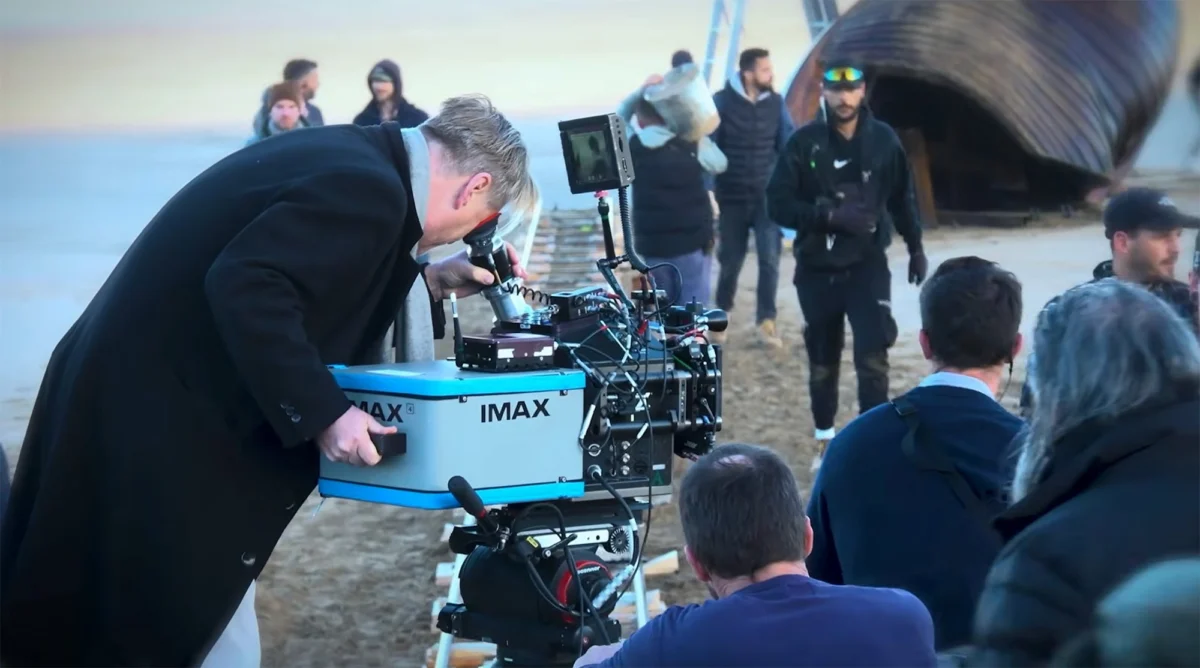
The cinematic landscape is preparing for a transformative milestone as director Christopher Nolan nears the release of his latest project, The Odyssey, which has been confirmed as the first feature film in history to be shot entirely using IMAX cameras. In a newly released four-minute technical featurette, IMAX and Universal Pictures have provided an exhaustive look at the production’s logistical and technological hurdles, marking the fulfillment of what Nolan describes as a "long-held dream" to utilize the large-format system for an entire production. The film, an ambitious adaptation of Homer’s ancient Greek epic, is scheduled for a global theatrical release on July 17, 2026, and represents a significant leap in the evolution of high-fidelity filmmaking.
For over a decade, Nolan has been the primary advocate for the 15-perforation, 70mm film format, beginning with select sequences in 2008’s The Dark Knight. However, the weight and noise of the cameras previously made it impossible to record dialogue-heavy scenes or sustain the format for a full two-to-three-hour runtime. The Odyssey breaks this barrier, utilizing newly developed technology and specialized equipment to ensure that every frame—from intimate character exchanges to sweeping naval battles—maintains the native IMAX resolution.
A Technical Revolution in Large-Format Filmmaking
The centerpiece of the recent production update is the revelation of the "blimp," a sophisticated sound-dampening housing designed specifically for this production. Traditionally, IMAX cameras are notoriously loud, producing a mechanical whirring sound that interferes with on-set audio recording. This forced Nolan and his long-time cinematographer, Hoyte van Hoytema, to limit IMAX usage to action sequences or silent vistas in previous films like Dunkirk and Oppenheimer.

The invention of the "blimp" allows the production team to encase the camera in a vacuum-sealed or insulated shell that suppresses the motor noise without compromising the camera’s mobility. Van Hoytema, who has collaborated with Nolan since Interstellar, noted in the featurette that the goal was to achieve a level of intimacy previously reserved for smaller 35mm or digital cameras. By neutralizing the acoustic footprint of the IMAX hardware, the crew was able to capture the performances of the ensemble cast in real-time, eliminating the need for extensive automated dialogue replacement (ADR) in post-production.
Furthermore, the decision to shoot entirely on film—specifically 65mm stock for a 70mm IMAX projection—ensures a level of detail equivalent to approximately 18K digital resolution. This technical choice serves Nolan’s broader philosophy of "immersion," providing the audience with a field of vision that mimics human eyesight more closely than any other medium.
Narrative Scope and the Adaptation of Homeric Myth
The Odyssey serves as a mythic action thriller that reframes the foundational Western saga for a modern audience. The narrative follows Odysseus, the legendary King of Ithaca, as he embarks on a decade-long journey home following the conclusion of the Trojan War. The film reportedly covers the most iconic segments of the poem, including the encounter with the Cyclops Polyphemus, the seductive and deadly songs of the Sirens, and the transformative magic of the witch-goddess Circe.
Nolan’s screenplay, adapted from the original poem attributed to Homer, focuses on the psychological toll of the journey and the protagonist’s desperate quest to reunite with his wife, Penelope, and his son, Telemachus. While the source material is thousands of years old, the production team has emphasized that the film is treated with the same grounded, visceral intensity as Nolan’s historical or science-fiction works. The featurette showcases various global locations, suggesting that the "islands" of the Mediterranean have been captured with a scale that emphasizes the isolation and peril of the ancient world.

An Ensemble Cast of Unprecedented Scale
To bring this foundational epic to life, Universal Pictures and Syncopy have assembled an expansive cast led by Matt Damon in the role of Odysseus. This marks Damon’s third collaboration with Nolan, following his roles in Interstellar and his award-winning turn in Oppenheimer. Damon’s portrayal is described as a "war-weary but resilient" interpretation of the Greek hero, focusing on the character’s famed "metis" or cunning intelligence.
The supporting cast includes Academy Award winner Anne Hathaway as Penelope, Odysseus’s steadfast wife who must navigate the political dangers of Ithaca in his absence. Tom Holland joins the Nolan cinematic universe as Telemachus, the son who grows to manhood while searching for his father. The ensemble is further bolstered by a roster of high-profile actors, including Charlize Theron, Zendaya, Lupita Nyong’o, Robert Pattinson, Jon Bernthal, John Leguizamo, Elliot Page, and Himesh Patel.
The inclusion of such a diverse and decorated cast suggests a narrative that gives significant weight to the secondary characters and the various gods and monsters Odysseus encounters. While specific roles for actors like Theron and Zendaya have been kept under wraps, industry analysts suggest they may portray the divine or supernatural entities that influence Odysseus’s fate.
Production Timeline and Global Distribution
The Odyssey began its production cycle shortly after the massive success of Oppenheimer in 2023. Following a period of intense script development and technical testing, principal photography commenced in 2025. The shoot spanned multiple continents, utilizing coastal regions in Europe and specialized water tanks to simulate the treacherous voyages of the Greek fleet.

The marketing campaign for the film has been meticulously phased:
- Late 2025: The first teaser trailer was released, focusing on the scale of the Mediterranean and Matt Damon’s transformation.
- Early 2026: A second, more narrative-focused trailer introduced the supporting cast and the supernatural elements of the story.
- June 2026: The release of the "Completely in IMAX" featurette, highlighting the technical achievements of Nolan and Van Hoytema.
- July 17, 2026: The scheduled worldwide theatrical release, occupying a prime mid-summer window that Nolan has successfully utilized for over a decade.
The film is produced by Emma Thomas and Christopher Nolan through their Syncopy banner, with distribution handled by Universal Pictures. This partnership continues the relationship established with Oppenheimer, which saw Nolan move away from his long-time home at Warner Bros. following disputes over streaming release strategies.
Musical Composition and Aesthetic Collaboration
The Odyssey also sees the return of composer Ludwig Göransson, who previously won an Academy Award for his work on Oppenheimer. Göransson’s score for The Odyssey is expected to blend ancient instrumentation with modern orchestral and electronic elements to create a "timeless yet urgent" soundscape. A separate "First Listen" featurette released earlier in the year highlighted Göransson’s use of reconstructed ancient Greek lyres and percussion, integrated with the thunderous, high-stakes motifs characteristic of a Nolan thriller.
The collaboration between Nolan, Van Hoytema, and Göransson has become a hallmark of 21st-century prestige cinema. By maintaining a consistent creative team, Nolan ensures a visual and auditory continuity that has become a brand in itself—one that guarantees a specific level of craftsmanship and sensory intensity.

Industry Impact and the Future of the Theatrical Experience
The release of The Odyssey is being closely watched by industry analysts and theater exhibitors. In an era dominated by digital streaming and CGI-heavy blockbusters, Nolan’s insistence on practical effects and physical film stock represents a counter-movement that has proven highly lucrative. Oppenheimer’s nearly $1 billion box office performance demonstrated that there is a massive global audience for sophisticated, large-format cinema.
By shooting entirely in IMAX, Nolan is effectively creating a product that cannot be fully replicated in a home theater environment. This "event cinema" model is crucial for the survival of theater chains, particularly the Premium Large Format (PLF) screens that command higher ticket prices. IMAX CEO Richard Gelfond has frequently cited Nolan as a key driver of the company’s growth, and The Odyssey is expected to be the ultimate showcase for the format’s capabilities.
As the July 17 release date approaches, the film is projected to dominate the summer box office. The combination of a world-renowned director, a legendary literary source, a star-studded cast, and a record-breaking technical hook positions The Odyssey as a potential defining moment in film history. For Nolan, the project is more than a movie; it is the culmination of a twenty-year journey to master the most immersive tools available to the medium of film. For the audience, it promises a journey through the ancient world on a scale never before seen on screen.