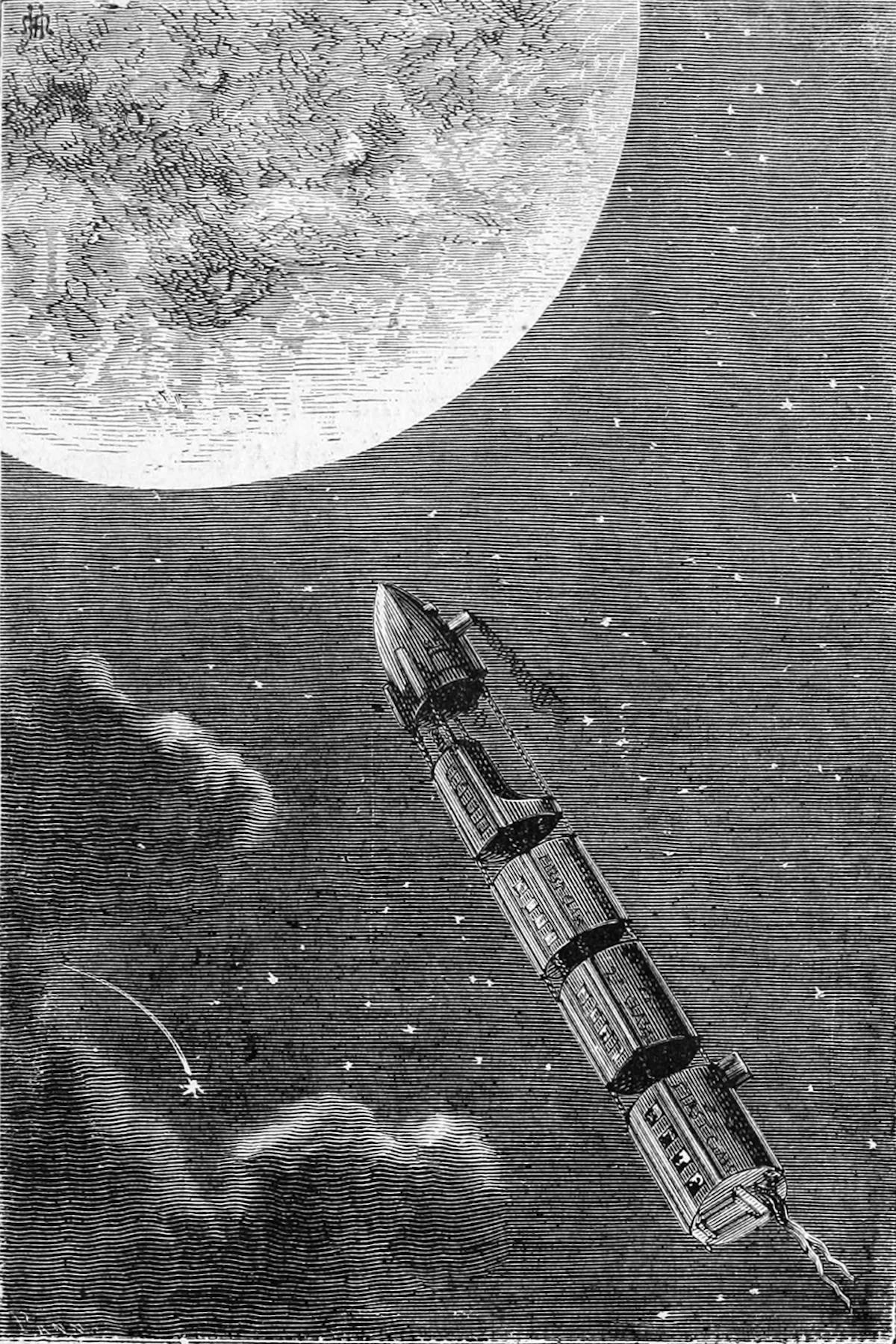
During an immersive theatrical exhibition in Paris, visitors are guided through a multi-sensory journey of Jules Verne’s life, exploring the physical and conceptual manifestations of his most enduring literary creations. The experience traverses the print shop of nineteenth-century publisher Hetzel, the claustrophobic iron interior of the Nautilus, and the gentleman’s club where Phileas Fogg wagered his fortune on an eighty-day global circumnavigation. The exhibition culminates in a recreation of a scene from From the Earth to the Moon, featuring the character Barbicane addressing the Baltimore Gun Club regarding an ambitious lunar expedition. Following this historical vignette, attendees are transitioned forward by a century into a meticulously detailed replica of NASA Mission Control, complete with authentic telemetry terminals and whiteboards inscribed with the genuine rocket equations of foundational pioneers Konstantin Tsiolkovsky, Hermann Oberth, and Wernher von Braun.
This curated juxtaposition highlights a pervasive cultural narrative: the persistent belief that nineteenth-century speculative fiction functioned as a literal blueprint for twentieth-century technological achievements. While this perception grants science fiction a degree of mainstream cultural validity, it often obscures the deeper sociological and political critiques embedded within these foundational texts.
The Historical Chronology of Technological Convergence
The trajectory linking nineteenth-century speculative literature to twentieth-century aerospace milestones is frequently cited as a linear progression. In 1865, Jules Verne published From the Earth to the Moon, detailing an enterprise wherein the Baltimore Gun Club constructed a colossal cannon in Tampa, Florida, to propel a crewed projectile toward the lunar surface. A century later, in July 1969, NASA executed the Apollo 11 mission, launching the spacecraft Columbia from Cape Canaveral, Florida, and returning the crew to a splashdown in the Pacific Ocean—parallels explicitly acknowledged by astronaut Neil Armstrong during a broadcast on the return journey from the moon.

This phenomenon is not isolated to the Apollo program. Historical reviews of technological development frequently catalogue instances where science fiction concepts preceded real-world innovations. The electrical submarine, popularized by Captain Nemo’s Nautilus in Twenty Thousand Leagues Under the Seas, is often attributed to Verne’s inventive foresight, much like the vertical flight concepts later realized as helicopters.
However, historians of science emphasize that Verne’s creative output did not emerge from a vacuum of solitary genius. During the 1860s through the 1880s, submarines powered by compressed air were actively developed and discussed within naval and military circles. The next logical frontier for military strategists was electrical propulsion, a development driven by international arms races and strategic anxieties among European powers regarding maritime supremacy. Verne synthesized these contemporary technological discussions into narrative form, examining the geopolitical consequences of such innovations rather than inventing the underlying mechanics single-handedly.
Unpacking the Rhetoric of Inevitable Progress
The cultural habit of framing science fiction as prophetic is deeply intertwined with the ideology of technological progress—a framework born during the seventeenth-century Scientific Revolution. Thinkers such as Francis Bacon articulated the premise that systematic empirical observation could yield continuous, indefinite improvements in human life and societal welfare. By the nineteenth century, the tangible impacts of industrialization solidified this philosophy as a cornerstone of modern Western identity.
Within Verne’s works, characters frequently articulate this worldview. In From the Earth to the Moon, the charismatic adventurer Michel Ardan asserts that traveling to the moon is an absolute inevitability, governed by an immutable "law of progress." Yet, literary analysts argue that attributing Ardan’s optimistic proclamations directly to Verne is analytically flawed. Verne’s early, unpublished manuscript Paris in the Twentieth Century presents a starkly dystopian society where unbridled technological expansion and commercialism erode human culture and artistic expression. Similarly, From the Earth to the Moon can be interpreted as a satire targeting the jingoistic militarism of post-Civil War industrialists who repurpose ballistic weaponry for nationalist spectacles disguised as scientific endeavors.

When cultural retrospectives reduce science fiction to a checklist of successfully predicted gadgets, they risk stripping the literature of its critical context. Speculative fiction frequently operates by exaggerating contemporary societal tendencies to issue warnings rather than blueprints. Confusing dystopian satire or sociological critique with aspirational engineering risks overlooking the environmental and ethical costs associated with modern industrial developments.
Sociological Implications and the Spacefaring Age
The modern aerospace sector continues to draw heavily from speculative iconography. The nomenclature of NASA’s initial space shuttle fleet—most notably the Enterprise, named in tribute to Gene Roddenberry’s Star Trek—demonstrates a persistent symbiosis between popular science fiction and institutional space policy.
While space exploration programs often invoke universalist rhetoric, such as the plaque left on the moon stating that Apollo 11 "Came in Peace for All Mankind," critical observers note that these endeavors remain rooted in complex geopolitical and economic rivalries. The initial development of heavy-lift rocketry was catalyzed by military imperatives during the Cold War following the acquisition of ballistic missile technology and aerospace personnel from World War II.
By prioritizing technological milestones over sociological analysis, public discourse often evades fundamental ethical inquiries regarding space exploration. Contemporary debates surrounding commercial lunar missions and resource extraction frequently echo the expansionist paradigms critiqued by classic speculative authors. Analysts suggest that true engagement with the legacy of foundational science fiction requires looking beyond the hardware to examine how technology mediates human relationships, state power, and environmental stewardship.

Ultimately, reframing the legacy of authors like Jules Verne shifts the analytical focus from predictive accuracy to cultural commentary. By recognizing that speculative literature is primarily concerned with the human dimensions of innovation—exploring the traffic jams alongside the automobiles—scholars and engineers alike can better navigate the ethical responsibilities of contemporary technological advancement.