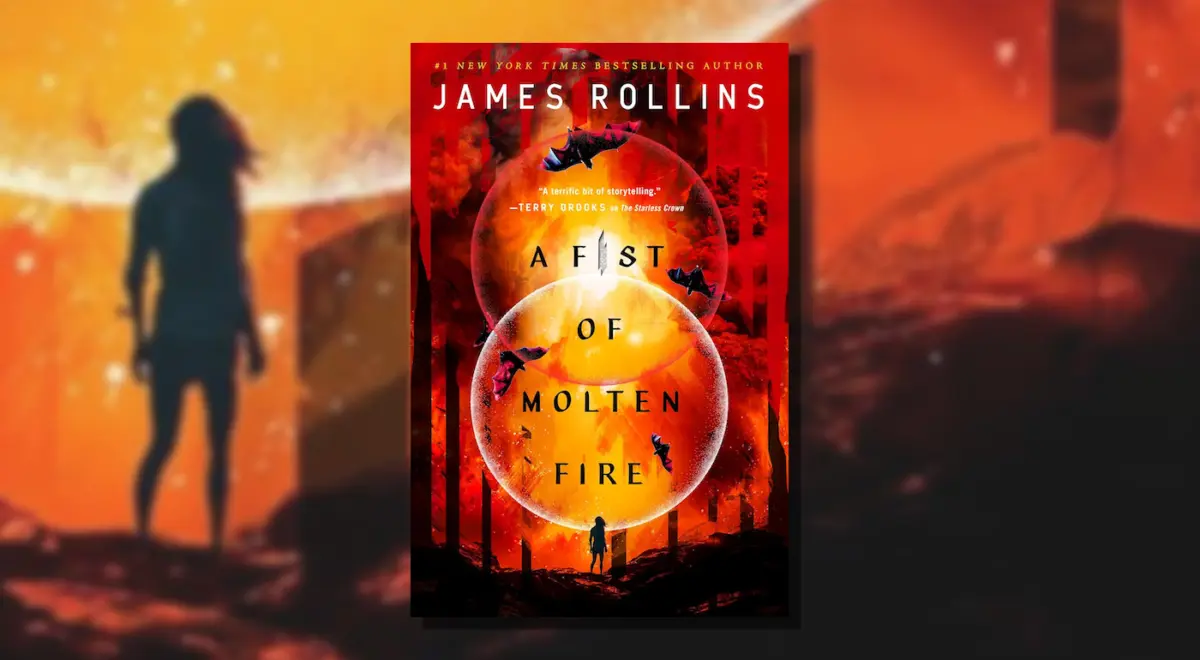
Tor Books has announced the upcoming publication of A Fist of Molten Fire, marking the dramatic and climactic conclusion to James Rollins’s acclaimed speculative fiction sequence, the Moonfall series. Scheduled for commercial release on December 1, the novel brings together years of meticulous world-building, high-stakes political intrigue, and cataclysmic planetary peril. As the overarching narrative reaches its zenith, the central protagonist, Nyx, faces a terminal timeline to save a dying world from impending cosmological annihilation.
Background Context of the Moonfall Crisis
The foundational premise of the Moonfall series centers on an existential planetary crisis: the catastrophic descent of Earth’s moon. Unlike traditional orbital mechanics in real-world astrophysics, the fictional cosmos of the series operates under ancient, altered laws where the celestial body has broken free from its stable trajectory and is steadily hurtling toward the planet, designated in the narrative as Urth.
Over the course of the preceding three novels, readers have witnessed the compounding systemic failures brought on by this gravitational closing. Continents are routinely fractured by seismic upheavals, coastal territories suffer from unprecedented tidal flooding, and the skies are continuously ravaged by unnatural meteorological storms. The physical approach of the moon is visually and physically manifested by an ominous crimson corona that surrounds the silvery lunar orb, intensifying in color and menace with each passing month. Within the internal chronology of the story, nearly two years have elapsed since the initial prophetic warnings delivered by Shiya, an ancient bronze-crafted entity of the ta’wyn class.
Chronology of the Final Race Against Time
The narrative arc of A Fist of Molten Fire compresses a multi-year geopolitical struggle into a terrifyingly narrow window of operational execution. According to the latest scientific assessments conducted aboard the wyndship Fyredragon—utilizing farseeing lenses and cross-referencing vast historical archives from Kepenhill—the threshold for planetary salvation is rapidly closing.
While original projections estimated a grace period of one to two years before total impact, updated data reveals that mechanical intervention must occur no later than midsummer—a mere two months away. This deadline dictates the pacing of the final installment, transforming a sprawling geopolitical conflict into an urgent, high-stakes tactical sprint. Nyx and her coalition of alchymists, navigators, and former adversaries must navigate treacherous terrain, hostile fauna, and encroaching military forces to avert total planetary extinction.
Strategic Objectives and the Mystery of the Turubya
To reverse the planetary collapse, Nyx and her allies previously succeeded in embedding two colossal engines, known as the turubya, deep within the core of the planet. These subterranean thermal forges possess the requisite kinetic energy to restore Urth’s rotational spin and cast the moon back into a stable orbit. However, activating these dormant world-engines requires a lost operational key.

The search for this artifact leads the coalition to The Fist, a formidable volcanic stronghold hidden within the treacherous depths of the Mǐr swamps. The location presents immense operational hurdles:
- Extreme Geographical Hazards: The volcanic mountain is characterized by unstable terrain, boiling vents, and massive cauldrons of molten rock.
- Biological Threats: The slopes are heavily defended by indigenous colonies of venomous, bat-like entities capable of inflicting lethal toxins.
- Hostile Military Presence: Hälendiian legions, guided by the antagonist Eligor, are actively mobilizing to secure the region and lock down the mountain perimeter.
Intelligence gathered by network informants suggests that Eligor, a rogue Kryst of the ancient ta’wyn order, originally concealed the key prior to the collapse of his armies during the Forsaken Ages. Because Eligor possesses direct knowledge of the artifact’s resting place, his forces hold a distinct tactical advantage in the race to the stronghold.
Statements and Reactions from Related Parties
The revelation of the two-month deadline has triggered intense internal friction and strategic realignment among Nyx’s companions. Captain Darant hy Tarn of the Klashean forces has openly expressed dismay at the compressed timeline, emphasizing the logistical impossibility of thoroughly searching a volcanic caldera under heavy military surveillance.
Similarly, Graylin sy Moor, a veteran Hälendiian knight whose complex lineage intersects with Nyx’s own history, has raised serious concerns regarding the hostile mobilization of the Hälendiian army under Eligor’s command. The presence of Eligor—a resurrected military commander constructed from bronze and sustained by advanced alchymy—represents an existential threat that transcends simple territorial conquest. Because Eligor and his fellow Revn-kree do not require organic life or atmospheric stability to survive, the successful acquisition of the key by enemy forces would effectively weaponize the moonfall event, ensuring total planetary eradication rather than salvation.
Broader Impact and Narrative Implications
As the narrative conflict narrows to its focal point within The Fist, the thematic weight of the novel rests squarely upon the shoulders of its protagonist. Nyx is forced to confront an impossible moral dichotomy: execute a precise, high-risk intervention that could cement her legacy as the savior of Urth, or falter and bear witness to the absolute erasure of civilization.
James Rollins utilizes this final volume to explore complex motifs of resilience, generational scars, and the tenacity of life against insurmountable odds. Even as ancillary characters—such as Jace hy Shanan, who struggles with a lingering phantom born from dysmeld, and Fenn, the Bhestyan navigator—adapt to the physical and psychological toll of their prolonged journey, the overarching narrative maintains a relentless momentum.
A Fist of Molten Fire is poised to deliver a definitive conclusion to one of modern speculative fiction’s most ambitious infrastructural apocalypses. As publication day approaches, readers and critics alike await the resolution of a narrative where every tremor in the earth serves as a literal countdown to the end of days.