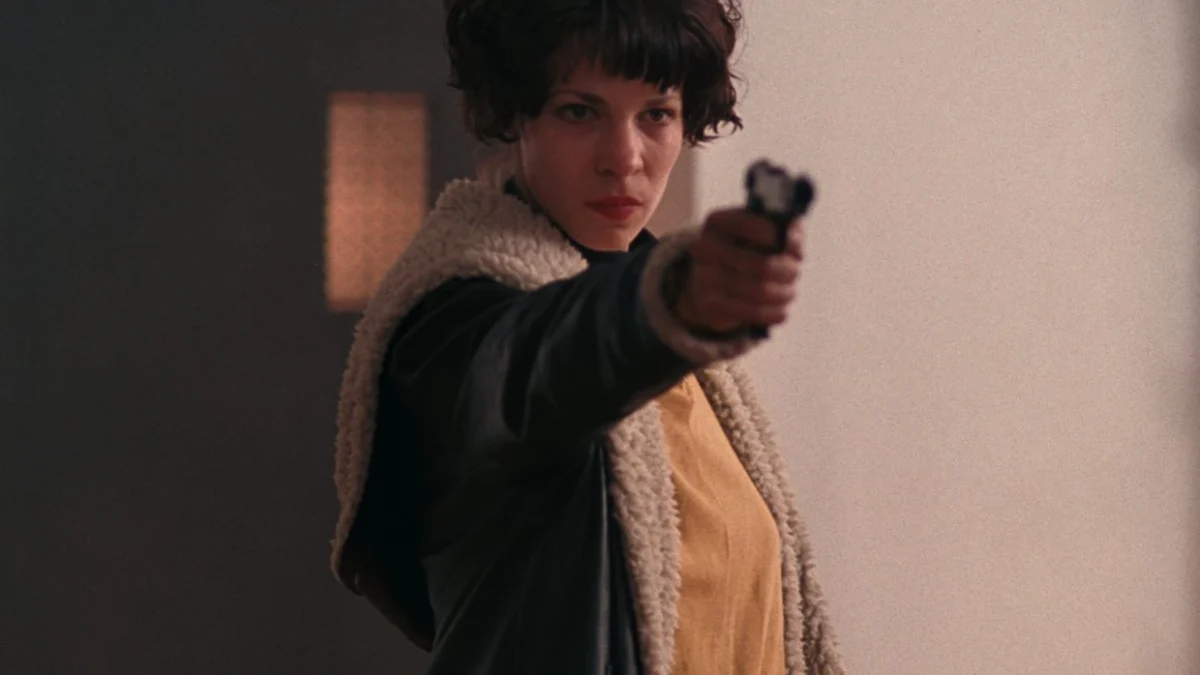
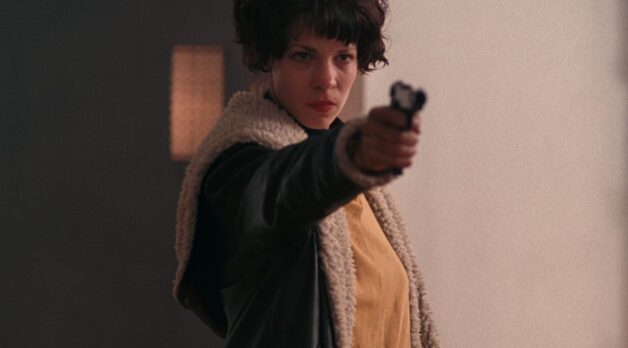
Decades before she brought the chilling, slick pathology of corporate American ambition and serial murder to life in 2000’s American Psycho, director Mary Harron turned her lens toward a different, more marginalized brand of New York City pathology with her 1996 debut feature, I Shot Andy Warhol. Long before it attained cult status, the film served as a defining pillar of 1990s independent cinema, captured vividly on countless college dormitory walls by a poster featuring Lili Taylor—the undisputed patron saint of that era’s indie movement—staring intensely down the camera lens with a firearm gripped in her hand. The image carried an undeniable, dangerous charge, chronicling the life of Valerie Solanas, the radical feminist who walked into Warhol’s Factory on June 3, 1968, and shot the pop art icon, narrowly missing a fatal blow. As Solanas’s infamous 1967 tract, the SCUM Manifesto, continues to circulate as one of the most polarizing and fiercely debated documents of 20th-century radical politics, Harron’s feature is returning to theatrical circuits in a newly struck 4K restoration. This milestone offers a timely opportunity to reevaluate a film that refuses easy categorization, exploring the complex intersections of art, gender, mental illness, and historical revisionism.
Chronology and Narrative Framework of the 1996 Feature
Harron’s debut follows Solanas through the gritty, economically depressed margins of New York City’s downtown art and underground theater scenes. The narrative tracks Solanas as she hawks mimeographed copies of her self-published manifesto—famous for its sliding price scale of two dollars for men and one dollar for women—while desperately trying to get her avant-garde play, Up Your Ass, produced. Her erratic trajectory eventually pulls her into the orbit of Andy Warhol’s legendary studio, The Factory. Taylor’s performance imbues Solanas with a deadpan swagger, painting her not as a simple caricature of mental instability, but as a deeply alienated outsider who could neither be easily contained nor ignored by the cultural elites of the era.
The production itself captured the authentic, frayed aesthetic of the 1960s underground arts community. Backed by a supporting cast that included Martha Plimpton, Michael Imperioli, and Stephen Dorff—whose portrayal of transgender icon Candy Darling remains a standout—the film matched its visual texture with a soundtrack featuring indie royalty like Yo La Tengo and Pavement. When original Velvet Underground co-founder Lou Reed denied Harron permission to use the band’s catalog, the director enlisted John Cale to compose an original score. The resulting soundscape helped cement the film not as a sterile, direct period reconstruction, but as a living, breathing document of New York at a volatile crossroads in its cultural history.
Behind the Restoration: Visuals and Cinematography
The newly minted 4K restoration, supervised by acclaimed cinematographer Ellen Kuras, brings a fresh clarity to the film’s deliberate visual design. In recent discussions regarding the restoration’s rollout, Harron noted the striking quality of the upgraded master, particularly when viewed without sound to fully appreciate Kuras’s naturalistic lighting choices.
While The Factory has frequently been mythologized as a glamorous, untouchable dream world in popular culture, Kuras and Harron grounded the space in a grimy, tactile reality. Colored lighting schemes were deployed pragmatically to reflect actual lamps and environments within the loft, striking a delicate balance between magical escapism and urban decay. This aesthetic choice aligns with the production’s broader mission to reject glossy Hollywood tropes in favor of the poetic realism championed by mid-1990s indie cinema, drawing visual cues from documentary photography of the late 1960s, including the stark, negative-space compositions reminiscent of Diane Arbus.
Cultural Legacy of the SCUM Manifesto and Historical Context
To understand the impact of I Shot Andy Warhol, cultural historians must contextualize how the SCUM Manifesto was perceived during the late 1980s and early 1990s, when Harron was first researching and developing the screenplay. Unlike foundational second-wave feminist texts by theorists like Shulamith Firestone, Solanas’s tract was largely viewed by mainstream society as a bizarre historical outlier—a dark, eccentric curiosity circulated primarily among fringe radical political circles.
Harron initially encountered the manifesto while working as a researcher on a documentary about Warhol. Sitting on a New York City subway car after purchasing a copy from a left-wing bookstore, she was struck by the text’s literary elegance and biting irony, comparing its stylistic sophistication to the works of Evelyn Waugh. Yet, the document’s dual nature—simultaneously brilliant in its critique of patriarchal power structures and deeply disturbing in its nihilistic rejections of human reproduction—has continually invited varied interpretations.
In contemporary cultural discourse, the manifesto has been alternately claimed and aggressively debated by radical feminists, contemporary academic theorists, and gender-critical groups. Some modern critics have even reinterpreted the text through a trans-affirming lens, highlighting the fluid and often contradictory ways historical documents are metabolized by successive generations. Harron remains pragmatic about these modern re-readings, noting that audiences invariably extract whatever meaning they require from complex, provocative literature.
Re-examining the Warhol-Solanas Dynamic
One of the film’s most enduring achievements is its refusal to rely on lazy narrative binaries of heroes and villains. In depicting the volatile relationship between Warhol and Solanas, Harron resisted assigning simple moral blame. Warhol is portrayed not as a malicious tyrant, but as a passive, fragile, and elusive figure who collected eccentric personalities, nurtured their need for attention, and abruptly discarded them when they proved too difficult or emotionally demanding.
Jared Harris’s portrayal of Warhol captured this delicate vulnerability, presenting an artist who was simultaneously capable of immense sensitivity and devastating emotional coldness. Solanas, entering The Factory from a position of profound despair and marginalization, viewed Warhol and her subsequent literary publisher, Maurice Girodias, as gatekeepers who wielded total control over her art and her livelihood. While Girodias undeniably operated within the exploitative traditions of mid-century publishing—frequently neglecting royalty payments to emerging authors—Solanas’s inability to navigate collaborative social structures ultimately sealed her isolation.
Contemporary critics initially faulted Harron for refusing to deliver a clear-cut moral verdict on the shooting, arguing that the narrative’s ideological ambiguity left viewers without a definitive stance. However, this refusal to simplify historical trauma is precisely what has allowed the film to endure. By forcing audience sympathies to ping-pong between the alienated assailant and her emotionally detached victim, the film mirrors the chaotic, unresolved nature of artistic ambition and institutional rejection.
Broader Implications and Modern Relevance
As I Shot Andy Warhol returns to theaters in its restored format, industry analysts and film historians have noted its eerie resonance with contemporary cultural currents. The socio-political landscape of the mid-1990s—characterized by a fierce conservative backlash against feminist gains, as documented by authors like Susan Faludi—echoes the rapid shifts in gender politics and online discourse observed today.
In an era defined by social media hyper-visibility, algorithmic radicalization, and the rapid, decentralized generation of public notoriety, commentators have observed that a figure like Valerie Solanas might have found a vastly different platform for her grievances today than she did in the rigidly guarded media ecosystem of 1968. Conversely, the film’s underlying themes regarding the commodification of outsider artists, the gendered economies of creative spaces, and the explosive nature of institutional marginalization remain intensely relevant.
Ultimately, Mary Harron’s debut feature stands as a testament to the power of independent cinema to tackle subjects that mainstream culture struggles to metabolize. By rescuing Valerie Solanas from the dustbin of sensationalist true-crime trivia and resituating her within the vibrant, ruthless ecosystem of 1960s New York, the film offers a masterclass in historical complexity—one that looks sharper, grittier, and more urgently provocative today than it did nearly thirty years ago.