The late-summer publishing cycle of August 2026 proved to be an exceptionally dynamic period for the speculative fiction community, marked by a convergence of major literary conventions, the resumption of the academic calendar, and the rollout of highly anticipated autumn publishing slates. Amidst this demanding operational tempo, editors, critics, and readers alike turned to short-form speculative fiction as a vibrant focal point of the literary arts. The month delivered a robust compilation of works spanning traditional folklore, dark fantasy, eco-surrealism, and socio-political satire, drawing from both established periodicals and emerging literary outlets. A comprehensive review of the month’s releases highlights ten standout short stories that have captured the critical attention of the speculative fiction sector.
Revival of Periodicals and Folkloric Dark Fantasy
The publication schedule for August 2026 was notably galvanized by the return of several prominent literary magazines following operational hiatuses. Among the most anticipated reappearances was the release of Omenana Issue 35, which hit digital stands on August 25, 2026. The issue featured Kevin Rigathi’s structurally complex and atmospheric piece, “Beneath the flower’s gaze.” Divided into distinct narrative movements, the story follows a young boy, an adult man, and a local fisherman who independently encounter a seemingly innocuous floral specimen situated within the neglected garden of an abandoned homestead.
As each character attempts to harvest the flora for personal acquisition, their actions inadvertently summon a malevolent, metamorphic entity. Literary analysts noted the work’s deliberate pacing, which mirrors the structural mechanics of classic Brothers Grimm fairy tales by escalating atmospheric dread through incremental revelations. The return of Omenana has been widely praised by publishing industry observers as a vital anchor for speculative literature originating from African literary traditions, reinforcing the magazine’s role in the global short fiction ecosystem.
Minimalist Speculative Fiction and Micro-Narratives
In contrast to multi-part folkloric epics, the micro-fiction sector demonstrated significant narrative impact through extreme brevity. Tatiana Shokhan’s “How to Save a Witch,” published in the August 2026 edition of Quotidian Bagatelle (Issue 8), achieves its thematic resonance within a strict 102-word constraint. While literary reviewers have noted the work’s thematic alignment with seasonal nostalgia—drawing tonal parallels to enduring cinematic representations of witchcraft and domestic magic—the story’s precise economy of language exemplifies the growing market demand for flash fiction capable of delivering emotional resonance without expositional overhead. The inclusion of such works in contemporary journals underscores a broader editorial shift toward accessible, high-impact micro-narratives designed for digital consumption habits.
Mythologies of Devotion and Corporeal Reclamation
The thematic exploration of servitude, resurrection, and bodily autonomy emerged as a dominant trend across several mid-summer and August publications. In Sara Omer’s "The Mayfly Knight," featured in Volume 10 of Old Moon Quarterly, the narrative interrogates the complex power dynamics between the living and the resurrected. Following a knight’s demise on a chaotic battlefield, a local priestess uses arcane rites to restore the warrior to life, not as an equal, but as an instrument of targeted enforcement, servitude, and elimination. Despite the transactional and emotionally detached nature of the priestess’s stewardship—often reducing the knight to the status of a domesticated animal—the protagonist maintains an unshakeable devotion. Critics have categorized Omer’s prose within the tradition of contemporary dark fantasy championed by authors such as Tasha Suri and Alix E. Harrow, noting its lyrical intensity and psychological depth.
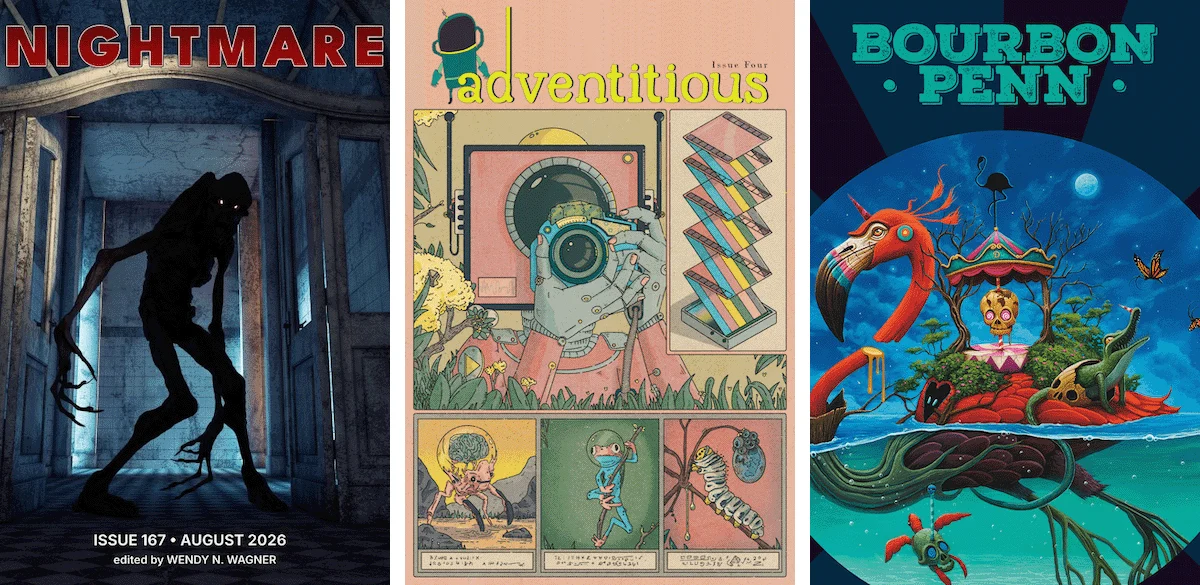
Simultaneously, the physical reclamation of the self is literalized in Melissa A. Watkins’s “My Parts, Collected,” published in Nightmare Magazine (Issue 167). Opening with the striking declaration, "My foot is hidden under a pile of fallen leaves in a ditch near the highway," the story adopts the perspective of a homicide victim whose dismembered remains are geographically scattered across a municipality. The protagonist’s journey to reassemble her physical form serves as a visceral metaphor for trauma, survival, and retributive justice. Because certain anatomical components remain permanently damaged or lost, the narrative emphasizes permanent alteration over simple restoration, channeling bodily trauma into an engine for vengeance. Literary critics have observed that the story resonates deeply with contemporary discussions surrounding institutional failure and the reclamation of agency by marginalized or victimized individuals.
The Intersection of Modern Tech, Grief, and Ecological Satire
Contemporary anxieties surrounding digital media, grief, and public health found sharp expression in several notable releases throughout August 2026. In Corey Farrenkopf’s "The Not-Dog Thing," published in Bourbon Penn (Issue 39), the narrative examines the corrosive nature of unresolved bereavement through the lens of modern social media culture. Following the death of his wife, character Paul Lectre turns to the video-sharing platform TikTok, uploading eccentric nature documentation. During one of these digital excursions, he encounters an anomalous, wide-mouthed organism resembling an infant canine. Adopting the creature and projecting his grief onto it by naming it after his deceased spouse, Paul initiates a downward spiral that ultimately yields catastrophic consequences for all involved. Farrenkopf’s contribution has been lauded by horror critics for its incisive commentary on the performative nature of digital grief and the psychological mechanisms of denial.
Addressing public health complacency and historical myopia, Nisi Shawl’s "Olden," published in Three-Lobed Burning Eye (Issue 48), employs the format of a near-future analytical think piece to critique societal attitudes toward biological safety. The narrative evaluates the historical cohort of individuals living between the mid-20th century and the mid-2020s—typified by a hypothetical figure named Emily AB—who routinely rejected personal protective equipment and consumed unpasteurized dairy. Shawl juxtaposes these historical practices with the rigorous, mandatory biological precautions observed by citizens of the future. The story functions as a pointed critique of modern anti-vaccination movements and wellness subcultures, warning that contemporary public health skepticism risks forcing future generations into a hyper-regulated, contaminated reality where systemic health protection is entirely offloaded onto the individual.
Urban Ecology, Political Satire, and Suburban Surrealism
Animal behavior and socioeconomic rebellion also served as fertile ground for speculative storytelling during the review period. In DC Corvino’s “Rat Song,” published in Trollbreath (Issue 9), urban rodents are depicted with heightened intelligence, physical vigor, and acute resource-sharing capabilities. When human protagonists, suffering from severe deprivation and exposure to extreme cold, encounter these colonies, the animals offer sustenance in a subversion of the classic Pied Piper archetype. However, subsequent human betrayal triggers a narrative arc centered on systemic accountability and poetic justice.
Pushing socio-political satire to visceral extremes, Elijah J. Mears’s "Saul & Noah’s Hot Bouleutophagy Summer," featured in Adventitious (Issue 4), literalizes the popular anti-capitalist slogan "eat the rich." Set against the backdrop of an exurban Pennsylvania town hall meeting, constituents overwhelmed by political corruption and legislative dishonesty collectively execute and consume their congressional representative. Mears’s story explores the mechanics of populist rage and collective action, transforming abstract political rhetoric into dark, satirical fiction that examines the latent power dynamics between civilian populations and elected officials.
Memory, Diaspora, and Psychological Surrealism
Rounding out the significant releases of the month, the exploration of memory and geographic displacement provided deeply reflective narratives. In Meg Elison’s "Small Wonder," published by The Rumpus on August 16, 2026, the protagonist Kathy embarks on a quixotic quest to identify an obscure 1980s television program centered on a robotic adolescent and her creator. As Kathy’s investigation deepens, the narrative dissolves standard suburban realism, sliding into the signature psychological uncanny characteristic of Elison’s bibliography. The work examines the fallibility of collective cultural memory and the comfort humans derive from obsolete media artifacts.
Finally, Rob Cameron’s "When I Heard Calypso," published in Apex Magazine (Issue 154), addresses the physical and emotional toll of chronic hereditary illness alongside the complexities of the diaspora experience. The protagonist, facing terminal degeneration, is taken by their mother to Belize—the homeland she fled during childhood in pursuit of American assimilation. This return journey triggers unexpected biological interactions with the narrator’s degenerative condition. Cameron’s narrative offers a poignant examination of generational longing, the psychological costs of cultural assimilation, and the complex relationship between ancestral homelands and physical healing.
Broader Implications for the Speculative Fiction Market
The editorial diversity displayed across these August 2026 publications indicates a healthy, highly responsive short fiction market. As independent literary journals and digital magazines continue to navigate shifting economic models, the strong output of boundary-pushing narratives demonstrates that creators are increasingly utilizing speculative frameworks to process contemporary anxieties regarding technology, public health, political disenfranchisement, and cultural identity. Industry analysts suggest that the critical reception of these ten works will likely influence award consideration cycles as the publishing year enters its final quarter, cementing August 2026 as a benchmark period for contemporary speculative literature.