The French cinematic landscape of the late 1950s was characterized by a distinct aversion to traditional horror, a genre frequently dismissed by domestic critics as low-brow Anglo-American exploitation. Yet, in 1960, director Georges Franju released Les yeux sans visage (Eyes Without a Face), a film that fundamentally reshaped European art-house horror. Based on the 1959 pulp novel by Jean Redon published within the Fleuve noir Angoisse series, the film bridged the gap between visceral genre thrills and poetic cinematic modernism. Decades after its initial polarizing release, Eyes Without a Face is recognized as a foundational pillar of psychological horror, heavily influencing subsequent generations of international filmmakers.
Production Genesis and the Censorship Paradigm
The genesis of Eyes Without a Face began when producer Jules Borkon acquired the rights to Jean Redon’s gruesome novel. Seeking to capitalize on a burgeoning global appetite for horror, Borkon approached Georges Franju, who had recently completed his first narrative feature, La tête contre les murs (Head Against the Wall) (1959). Franju, previously renowned for his 1949 semi-experimental documentary Le sang des bêtes (The Blood of the Beasts)—an unflinching 22-minute black-and-white examination of Parisian slaughterhouses—possessed a unique visual style capable of blending stark realism with poetic surrealism.
However, bringing Redon’s narrative to the screen required navigating a complex labyrinth of international film censorship. In a 1982 television interview on the French program Ciné-parade, Franju recalled Borkon’s stringent production mandates, dictated by the anticipated hurdles of global distribution: no visible blood, to appease French censors; no animal cruelty, to satisfy British authorities; and no "mad doctor" tropes, which risked reopening psychological wounds in post-war Germany.
Tasked with adapting a story about a guilt-ridden surgeon harvesting facial tissue from young women, Franju enlisted the esteemed literary thriller-writing duo Pierre Boileau and Thomas Narcejac (Boileau-Narcejac), celebrated for penning the source material for Alfred Hitchcock’s Vertigo (1958) and Henri-Georges Clouzot’s Les Diaboliques (1955). Together, Franju and the screenwriters elevated the raw pulp material into a lyrical tragedy, shifting the thematic focus from sensationalist exploitation to a haunting exploration of paternal guilt, obsession, and identity.
Chronology of Production and Creative Collaboration
The realization of Eyes Without a Face relied on a convergence of legendary cinematic talent across multiple departments, establishing a meticulous production timeline:
- 1949: Georges Franju directs Le sang des bêtes, establishing his unflinching visual approach to violence and clinical detachment.
- 1959: Jean Redon publishes the suspense novel Les yeux sans visage within the Fleuve noir collection; producer Jules Borkon acquires adaptation rights.
- 1959: Franju releases his narrative feature debut, La tête contre les murs, starring Édith Scob, which convinces Borkon of Franju’s capability to helm the project.
- Late 1959 to Early 1960: Principal photography takes place in Paris, utilizing cinematography by Eugen Schüfftan—pioneer of the Schüfftan process and future Academy Award winner for The Hustler (1961)—alongside an avant-garde, jarring score by Maurice Jarre, who would subsequently compose the music for Lawrence of Arabia (1962).
- March 1960: The film premieres in France, followed by controversial international distribution, including its U.S. release under the title The Horror Chamber of Dr. Faustus.
Narrative Architecture and Thematic Subversion
The narrative centers on the eminent plastic surgeon Dr. Génessier (played by Pierre Brasseur), whose reckless driving caused the car crash that horribly disfigured his daughter, Christiane (Édith Scob). Consumed by guilt and pathological vanity, Génessier, assisted by the fiercely loyal Louise (Alida Valli)—whose own face he successfully reconstructed—abducts young women sharing Christiane’s physical build. His objective is to surgically graft their faces onto his daughter in a series of desperate, ultimately doomed transplant procedures.
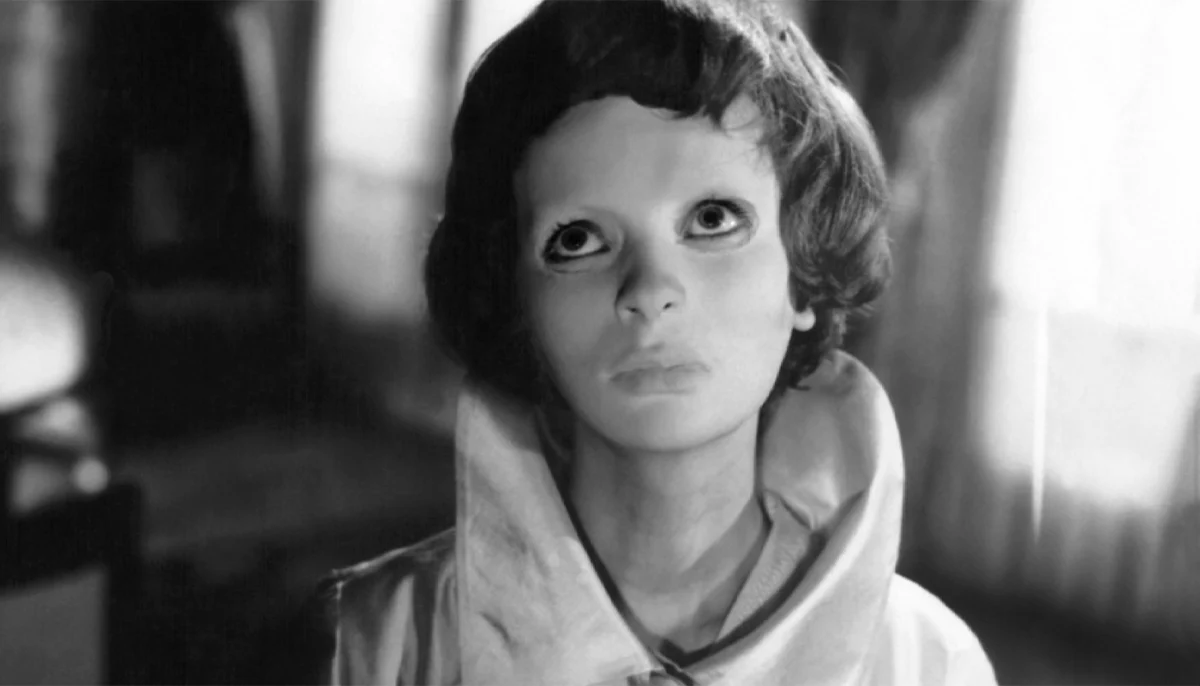
Franju and his writers subverted traditional horror tropes by grounding the atrocities in genuine, albeit warped, parental affection. Dr. Génessier remains outwardly respectable, maintaining a gentle bedside manner with his young patients, which renders his late-night surgical extractions all the more disturbing. The central relationship between Génessier and Christiane—who is forced to haunt her family estate in a blank, expressionless white mask—creates a profound psychological tension. Édith Scob delivered a critically acclaimed performance, conveying deep emotional resonance and vulnerability entirely through body language and vocal inflection while masked for the majority of the runtime.
The film’s aesthetic compounds this discomfort. Eugen Schüfftan’s high-contrast black-and-white cinematography imbues the Parisian suburbs and clinical laboratories with a gothic fairy-tale atmosphere. Concurrently, Maurice Jarre’s brisk, aggressive musical score introduces an unsettling dissonance, contrasting upbeat, almost jaunty rhythms with horrific acts of surgical violence. The most notorious sequence—the meticulous removal of a victim’s facial tissue—was filmed with a clinical precision that reportedly caused audience members to faint during early screenings, establishing a standard for bodily horror on screen.
Release, Critical Reception, and International Distribution
Upon its initial theatrical release in France, Eyes Without a Face met with a fractured critical consensus. Mainstream reviewers accustomed to traditional cinematic norms were divided by the film’s unique tonal hybridization, struggling to categorize a work that seamlessly fused German Expressionist visual motifs, American noir pacing, French poetic realism, and visceral horror. While cinephiles and select critics praised its lyricism and technical brilliance, conservative commentators decried its stark depictions of medical violence.
International distribution posed distinct commercial challenges. In the United States, exploiting the film required aggressive rebranding. Stateside distributors retitled the feature The Horror Chamber of Dr. Faustus and paired it in a bizarre double-feature pairing with The Manster (1959)—an American-Japanese co-production concerning a journalist subjected to a mad scientist’s experiment resulting in a secondary head. This unorthodox marketing strategy further obscured the film’s artistic ambitions for American audiences of the era, delaying its broader critical reassessment.
Broader Impact and Legacy in Modern Cinema
Despite its initial commercial hurdles and regulatory friction, the historical and cultural footprint of Eyes Without a Face expanded exponentially over the subsequent decades. The film’s distinct visual iconography—most notably Édith Scob’s haunting white mask—has permeated popular culture, serving as a direct visual reference for numerous horror icons, musicians, and filmmakers, including director John Carpenter for his creation of Michael Myers in Halloween (1978).
Contemporary film scholars and directors frequently cite Franju’s work as a masterclass in atmospheric tension and empathetic villainy. Esteemed filmmaker Guillermo del Toro famously observed that the film derives its profound disturbing power from the sincerity of the antagonist’s motivations, noting that violence rooted in twisted affection resonates far more deeply than senseless brutality.
Ultimately, Eyes Without a Face endures as a triumph over institutional and commercial limitations. By transforming a sensationalist pulp novel into a melancholic cinematic poem, Georges Franju, alongside his extraordinary roster of collaborators, elevated the horror genre into the realm of high art, securing the film’s permanent status as a masterwork of international cinema.