Director and writer Takashi Yamazaki has officially returned to helm the latest installment in the Toho cinematic universe, tentatively titled Godzilla Minus Zero, following the unprecedented global and critical triumph of 2023’s Godzilla Minus One. Set two years after the harrowing events of its predecessor, the upcoming 135-minute feature expands the post-war Japanese narrative by introducing a new multi-species chimera antagonist, Ghidora, alongside the terrifying resurrection of the franchise’s titular titan. Produced with an ensemble cast featuring the return of Ryunosuke Kamiki, Minami Hamabe, Yuki Yamada, Kuranosuke Sasaki, Miou Tanaka, Sakura Ando, Hidetaka Yoshioka, Jun Kunimura, Masami Nagasawa, and Min Tanaka, the production aims to blend high-stakes kaiju spectacle with deeper geopolitical commentary.
Main Facts and Narrative Premise
Godzilla Minus Zero picks up chronologically in a fragile, recovering Japan, approximately 24 months after the destruction depicted in Godzilla Minus One. The narrative fractures into two distinct yet overlapping crises: the sudden emergence of a dragon-like chimera originating from a crashed meteorite in Nagano, and the unexpected, full cellular reconstitution of Godzilla.
The chimera, identified by scientists as Ghidora, ravages the Nagano region by emitting high-voltage orange lightning bolts from its maw. Concurrently, naval engineer-turned-bureaucrat Kenji Noda (Hidetaka Yoshioka) assumes leadership of the newly formed Large-Scale Disaster Bureau to coordinate defense efforts. Former kamikaze pilot Koichi Shikishima (Ryunosuke Kamiki), now attempting to live a peaceful domestic life with his wife Noriko (Minami Hamabe), adopted daughter Akiko, and neighbor Sumiko (Sakura Ando), finds himself inexorably drawn back into the line of duty.
Faced with a dual-monster threat, the Japanese government finds its sovereign response complicated by the condescending intervention of the U.S. Army. To combat the existential catastrophe, Noda assembles a coalition of specialists, including weather-forecasting prodigy Aoyama (Masami Nagasawa) and unorthodox scientist Kenji Murakami (Min Tanaka), relying on innovative atmospheric and technological countermeasures to achieve what conventional military force failed to accomplish previously.
Chronology of Development and Production History
The greenlighting of Godzilla Minus Zero follows a meteoric trajectory for Toho’s domestic and international operations. Toho Company Ltd. originally revitalized its flagship franchise with Godzilla Minus One, directed, written, and with visual effects supervised by Takashi Yamazaki. Released in late 2023, the film achieved landmark status by grossing over $115 million worldwide on a modest reported budget, establishing itself as a commercial juggernaut in North American and international markets.
Crucially, Godzilla Minus One made cinematic history at the 96th Academy Awards held in March 2024, winning the Oscar for Best Visual Effects—marking the first time a Japanese film, and the first time any Godzilla film in the franchise’s 70-year history, won a competitive Academy Award. Buoyed by this historic win and widespread critical acclaim praising the film’s character-driven focus and post-war socio-political allegories, Toho quickly entered development on a direct continuation.
Pre-production commenced quietly in late 2024 under the auspices of Shirogumi, Yamazaki’s primary visual effects studio. Principal photography utilized advanced long-take blocking techniques and retro-styled cinematography by returning director of photography Kōzō Shibasaki. The inclusion of Ghidora marks a significant expansion of Toho’s classic monster pantheon into Yamazaki’s gritty, grounded universe, setting a production timeline aimed at a theatrical release window reflecting modern blockbuster standards.
Supporting Data and Technical Execution
Technically, Godzilla Minus Zero builds directly upon the workflows established by its predecessor while refining the aesthetic parameters of modern kaiju filmmaking. Operating with a 135-minute runtime, the film employs meticulous long-take master shots rather than standard, rapid-fire shot-reverse-shot editing, creating a heightened sense of spatial continuity and immersive tension during dramatic dialogue sequences.
Composer Naoki Sato returns to score the project, deliberately minimizing musical cues during early character-driven scenes to foster organic emotional resonance, before escalating into oppressive, high-tension orchestral arrangements during kaiju assaults. Akira Ifukube’s iconic, original Godzilla theme remains integrated into pivotal sequences.
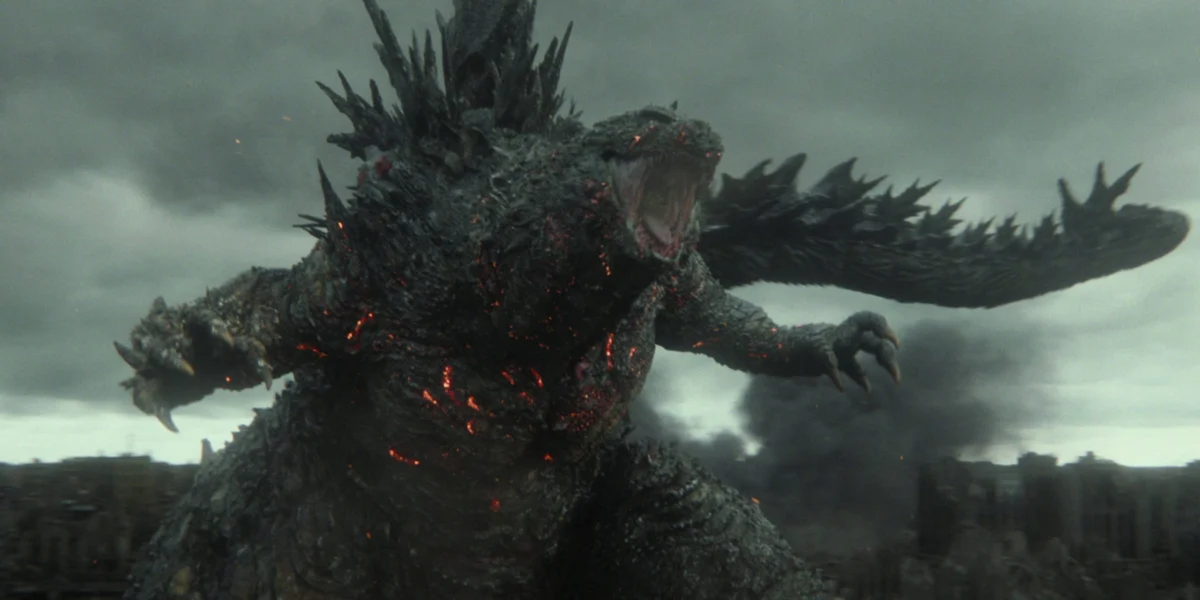
Visually, Shirogumi’s visual effects team has upgraded the physical modeling and digital rendering pipelines. While retaining the homage to suit-mation movement styles pioneered in Godzilla Minus One, the CGI integration for both Godzilla and Ghidora achieves greater fluidity and weight realism. Physical sets, practical pyrotechnics, and green-screen compositions are calibrated to evoke the historical aesthetic of 1940s and 1950s Japanese cinema, bridging the gap between nostalgic tribute and state-of-the-art visual fidelity.
Official Responses and Industry Reception
While traditional studio press releases from Toho have focused on the overarching continuity of the franchise, principal cast members and creative leads have spoken publicly about the thematic weight of returning to these roles. Ryunosuke Kamiki and Minami Hamabe have noted in promotional statements that exploring Shikishima’s ongoing survivor’s guilt required navigating even more complex emotional terrain than the first film, as the character transitions from individual atonement to collective familial and national protection.
Industry analysts have pointed out that the strategic decision to pit the characters against multiple kaiju simultaneously represents a calculated risk, moving away from the singular, allegory-heavy focus of Minus One toward a broader, multi-front disaster narrative. International distribution partners have expressed high confidence in the project, anticipating that the Academy Award pedigree of the creative team will secure wider premium-format theatrical distribution, including IMAX and Dolby Cinema screens globally.
Broader Impact and Sociopolitical Implications
At its core, Godzilla Minus Zero continues the franchise’s long-standing tradition of functioning as a socio-political mirror for contemporary anxieties. While Godzilla Minus One directly engaged with the generational trauma of post-World War II Japan, the atomic bomb legacy, and institutional abandonment by the wartime government, the new installment broadens its critical lens.
The introduction of the U.S. Army as a condescending occupying force underscores lingering post-war geopolitical imbalances and questions of national autonomy. Furthermore, the narrative grapples with themes of complicity in failed defense plans, the ethical boundaries of technological weaponization, and the moral duty owed to subsequent generations. By juxtaposing horrifying visceral imagery of atomic destruction with contemporary environmental and security threats, Yamazaki uses the monster movie medium to interrogate the cyclical nature of geopolitical conflict.
Ultimately, the commercial and critical framework of Godzilla Minus Zero positions it as a test of whether a franchise historically rooted in practical creature features can sustain high-art ambitions without sacrificing blockbuster entertainment value. As Toho continues to expand its cinematic footprint, the film stands as a testament to the enduring viability of practical-digital hybrid filmmaking and the universal resonance of kaiju mythology in the twenty-first century.