Kino Lorber has officially released the trailer and key promotional materials for Re-Creation, a compelling courtroom drama and psychological thriller co-directed by Academy Award nominee Jim Sheridan and filmmaker David Merriman. The project represents a striking, modern-day conceptual update to Sidney Lumet’s classic 1957 jury deliberation masterpiece, 12 Angry Men. Following its world premiere at the 2025 Tribeca Film Festival, the film has bypassed a traditional theatrical release, arriving directly on Video-on-Demand (VOD) platforms for home viewing.
Blending dramatic reconstruction with true-crime analysis, Re-Creation examines the infamous, highly contested 1996 murder of French television producer Sophie Toscan du Plantier in County Cork, Ireland. By staging a fictionalized jury room debate centered on the primary suspect, the late British journalist Ian Bailey, the film invites audiences to re-examine the boundaries of circumstantial evidence, media influence, and the fundamental mechanics of guilt and innocence.
Main Facts and Narrative Premise
Re-Creation operates as a hybrid of narrative fiction, documentary inquiry, and courtroom drama. The central narrative follows a fictionalized panel of twelve diverse jurors sequestered to deliberate on a murder trial that, in reality, never took place in an Irish court of law regarding this specific jurisdiction. The primary subject of their intense debate is Ian Bailey, the principal suspect in the brutal killing of Sophie Toscan du Plantier, who was found beaten to death outside her holiday home in West Cork in December 1996.

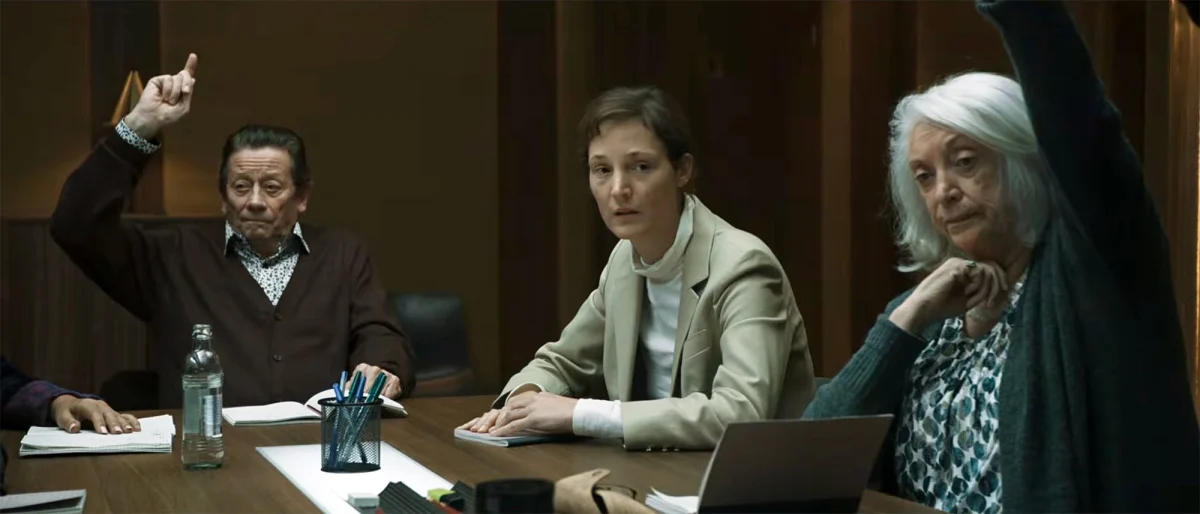
The ensemble cast is anchored by acclaimed Luxembourgish-German actress Vicky Krieps (Phantom Thread, Corsage), who steps into the pivotal role equivalent to Juror #8—the solitary voice of reasonable doubt who challenges her peers to look past public perception and closely inspect the evidentiary record. The ensemble also features notable performances by Aidan Gillen, Colm Meaney, John Connors, and co-director Jim Sheridan himself, lending an authentic gravitas to the cinematic experiment.
Rather than functioning as a standard investigative documentary, Re-Creation utilizes dramatic scripting and performance to deconstruct the psychological environment of a jury room. The film interrogates how personal biases, societal pressures, media saturation, and circumstantial gaps shape collective judgments, prompting viewers to weigh the evidence alongside the fictional jurors.
Chronology of the Real-Life Case
To fully understand the weight of Re-Creation, it is necessary to examine the decades-long legal and investigative timeline surrounding the murder of Sophie Toscan du Plantier. The tragedy and its subsequent fallout remain one of the most visible and contentious criminal mysteries in modern Irish and French legal history.
- December 23, 1996: Sophie Toscan du Plantier, a 39-year-old French television producer, is found murdered near her isolated home in Toormore, near Schull, County Cork. Her body bears severe injuries inflicted by a concrete block and a blunt instrument.
- February 1997: Ian Bailey, an English journalist living locally who was among the first reporters on the scene, is arrested by the Garda Síochána (Irish police) for the first time. He is released without charge, vehemently denying any involvement.
- 1997–2010: The Garda investigation continues, marked by intense media scrutiny, allegations of police malpractice, and witness recantations. Bailey remains the prime suspect in the eyes of investigators and the victim’s family, though Irish prosecutors consistently decline to bring formal domestic charges, citing a lack of sufficient corroborating forensic evidence.
- May 2010: French authorities issue a European Arrest Warrant for Ian Bailey, seeking his extradition to stand trial in France. A protracted legal battle ensues in the Irish courts.
- March 2012: The Irish High Court rules against extradition, a decision upheld by the Supreme Court in 2012, which notes that extradition would be unjust given that Bailey had not been charged in Ireland and that the alleged offenses occurred outside French territory under standard jurisdictional rules at the time.
- May 2019: In absentia, a French court in Paris tries Ian Bailey and finds him guilty of the voluntary homicide of Sophie Toscan du Plantier. He is sentenced to 25 years in prison. Ireland subsequently refuses a second French extradition request in late 2020, with the High Court ruling that surrendering him would violate his constitutional rights and European human rights frameworks.
- January 2022: The Director of Public Prosecutions in Ireland confirms that no prosecution will be initiated against Bailey, solidifying a legal stalemate.
- January 2024: Ian Bailey passes away from a heart attack in Bantry, County Cork, at the age of 66, maintaining his innocence until his death without ever having faced trial in an Irish court.
- June 2025: Re-Creation has its world premiere at the Tribeca Film Festival, bringing renewed artistic and public attention to the unresolved complexities of the case.
- October 2026: Kino Lorber releases the official trailer and launches the film across major VOD platforms in North America.
Background Context and Creative Collaboration
Re-Creation is co-directed and co-written by David Merriman, recognized for his work on projects such as Rock Against Homelessness, and legendary Irish filmmaker Jim Sheridan. Sheridan, a six-time Academy Award nominee renowned for defining contemporary Irish cinema through masterpieces such as My Left Foot (1989), In the Name of the Father (1993), The Field (1990), and In America (2002), conceived the original idea for the film.

Sheridan’s artistic footprint has long been defined by examinations of justice, systemic error, wrongful conviction, and the friction between individual liberty and state power. In Re-Creation, Sheridan and Merriman shift the lens from a traditional biographical or investigative format toward a metatheatrical exploration of legal truth. Produced by Fabrizio Maltese and Tina O’Reilly, the film reflects a growing cinematic trend of questioning true-crime narratives by placing the apparatus of judgment directly under scrutiny.
The structural inspiration drawn from 12 Angry Men is deliberate and apparent. Where Sidney Lumet’s film utilized a sweltering New York City jury room to expose racial, class, and psychological prejudices in a murder trial, Re-Creation applies the same claustrophobic, intense deliberative format to a real-world transnational legal controversy that defied conventional resolution.
Industry Implications and the VOD Strategy
The decision by distributor Kino Lorber to bypass a traditional theatrical release in favor of an immediate VOD rollout aligns with evolving distribution models for mid-budget, high-concept indie cinema and hybrid documentary-dramas. While theatrical windows remain vital for blockbuster franchises, niche psychological thrillers and specialized courtroom dramas frequently find more agile, targeted audiences through digital platforms where viewers can engage with complex, dialogue-driven narratives at their own pace.
Furthermore, the release of Re-Creation arrives shortly after the cinematic discourse generated by other jury-centric thrillers, most notably Clint Eastwood’s Juror #2 (2024). Both films tap into a persistent public fascination with the moral burdens placed upon ordinary citizens summoned to dispense legal justice. By utilizing a real-world tragedy involving a high-profile unsolved murder, Re-Creation introduces ethical complexities that extend beyond standard fiction.

Legal analysts and media commentators have noted that projects revisiting historical crimes without closed judicial resolutions inevitably spark renewed public debate regarding presumption of innocence, journalistic ethics, and the rights of surviving family members. For the family of Sophie Toscan du Plantier, the decades-long quest for accountability has been marked by repeated legal blocks across international jurisdictions. Re-Creation does not offer definitive closure or claim to uncover new forensic evidence; instead, it reframes the tragedy as an inquiry into how society processes unresolved trauma and assigns culpability in the absence of absolute certainty.
Broader Impact on True-Crime Media Literacy
In an era dominated by sensationalized true-crime docuseries across streaming platforms, Re-Creation offers a self-aware counterweight. By explicitly dramatizing the interior mechanics of a jury room rather than relying on sensationalized archival footage or partisan interviews, the film challenges audiences to reflect on their own consumption of crime media.
The inclusion of international star Vicky Krieps alongside veteran Irish actors like Colm Meaney and Aidan Gillen elevates the project beyond standard genre exercises. Through its cerebral pacing, moody cinematography, and uncompromising refusal to offer neat resolutions, Re-Creation stands as a distinct entry in modern legal cinema—one that uses the language of fiction to interrogate the limits of historical truth.
Re-Creation is currently available to stream via major VOD services through Kino Lorber. Additional information, promotional stills, and digital screening details can be accessed directly through the official Kino Lorber distribution portal.