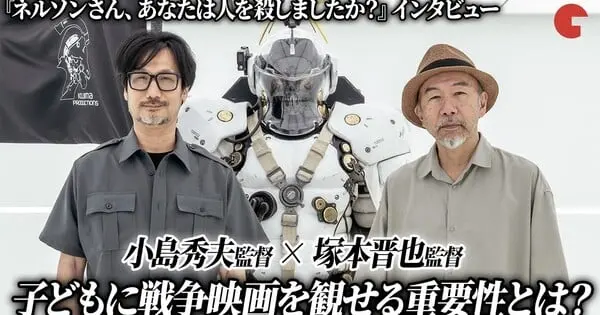
In a joint interview published on September 10, 2026, by the Japanese cinema news outlet Cinema Today, legendary video game director Hideo Kojima and acclaimed filmmaker Shinya Tsukamoto engaged in a sobering discussion regarding the current state of global geopolitical stability and its specific resonance within Japan. The dialogue, which touched upon the intersection of art, war-themed media, and national policy, centered on a shared apprehension that the contemporary political environment in Japan bears striking, concerning similarities to the nation’s trajectory during the lead-up to the Second World War.
Kojima, renowned for his visionary work on the Metal Gear franchise and the 2019 title Death Stranding, initiated the conversation by highlighting the prevalence of global conflict. He observed that the proliferation of wars across the globe has created a climate of uncertainty, suggesting that Japan is increasingly susceptible to being drawn into these external conflicts. "So many wars are breaking out," Kojima remarked. "It looks like Japan might get pulled into a war too, and there’s no one speaking out against it. The world is slowly being damaged. It floods when it rains, and there are so many earthquakes, too. It’s terrible."
Shinya Tsukamoto, an influential director known for the Tetsuo: The Iron Man series and his prolific acting career in films such as Shin Godzilla and Ichi the Killer, echoed these sentiments, focusing on the agency of those in power. Tsukamoto stated, "There are many adults intent on creating the environment for war," emphasizing a perceived shift in societal and political attitudes that favors militarization over diplomatic restraint. Kojima expanded on this critique, adding, "It’s like pre-WWII Japan. During desperate times, what people with the reins of power do is go to war."
Historical Context and Sociopolitical Climate
The comparison to the pre-WWII era carries significant weight in Japanese discourse, given the country’s post-war constitutional commitment to pacifism under Article 9 of the Japanese Constitution. This article renounces the right to belligerency and prohibits the maintenance of armed forces for the purpose of potential war. However, in recent years, the administration has navigated a complex path toward strengthening the Japan Self-Defense Forces (JSDF) in response to regional tensions, particularly concerning territorial disputes and the shifting balance of power in the Indo-Pacific.
The commentary from Kojima and Tsukamoto reflects a growing segment of Japanese society that views these shifts—specifically the increase in defense spending and the reinterpretation of constitutional constraints—as a departure from the pacifist identity forged in the late 1940s. While proponents of the current government’s policies argue that these measures are essential for deterrence and national survival in an increasingly volatile region, critics maintain that such actions invite the very instability they seek to prevent.
Chronology of Recent Political and Cultural Developments
The interview arrives at a time of heightened regional tension. A brief chronology of the factors influencing this national conversation includes:
- 2022: The Japanese government announces a historic shift in defense policy, pledging to double defense spending to approximately 2% of GDP by 2027, moving closer to NATO-standard expenditures.
- 2023: Continued regional instability, including increased naval activity in the Taiwan Strait and escalating missile tests in the region, prompts public debate regarding the necessity of "counter-strike" capabilities.
- 2024–2025: Civil society organizations and various artists begin to voice concerns regarding the normalization of military rhetoric in mainstream media and government communications.
- September 10, 2026: The Cinema Today interview between Kojima and Tsukamoto is released, synthesizing these cultural and political anxieties into a critique of contemporary leadership.
Professional Perspectives and Media Influence
The inclusion of Hideo Kojima in this political discussion is notable due to his life’s work. The Metal Gear series is fundamentally a meditation on the horrors of nuclear proliferation, the futility of war, and the influence of the military-industrial complex. By utilizing video games as a medium for social commentary, Kojima has long challenged his audience to consider the human cost of global power dynamics.
Shinya Tsukamoto, similarly, has utilized his platform to explore the psychological impact of violence and trauma. His transition from experimental filmmaking to mainstream roles—such as his work in Shin Godzilla—has allowed him to bridge the gap between niche intellectual cinema and mass-market entertainment. His collaboration with Kojima, including his voice acting performance as the character Vamp in Metal Gear Solid 4, underscores a long-standing creative partnership predicated on a shared vision of the world’s fragility.
Business Implications and Industry Speculation
While the primary focus of the discussion was socio-political, the timing of the interview coincides with significant professional developments for Kojima. His production company, Kojima Productions, recently underwent a high-profile shift in publishing strategy for its upcoming title, Physint. Originally slated to be published by Sony Interactive Entertainment, the project moved to Xbox Game Studios, triggering widespread speculation regarding the financial viability and strategic direction of the project.
Kojima Productions issued an official statement following the announcement to address rumors concerning budget concerns and exclusivity, noting that the partnership with Xbox was intended to broaden the scope and reach of their creative vision. Despite the shift in corporate strategy, the discourse surrounding Kojima’s public statements remains focused on his willingness to engage with controversial topics, an attribute that has distinguished him from many of his peers in the high-stakes video game industry.
Analysis of Implications
The remarks made by Kojima and Tsukamoto serve as a bellwether for a specific, albeit vocal, portion of the Japanese creative class. The concern that a government might use "desperate times" to justify war is a historical argument that resonates deeply in a nation where the memory of total war remains a cornerstone of the national education system.
From an analytical standpoint, the implications of these statements are twofold. First, they indicate that high-profile figures in Japan are becoming increasingly comfortable with leveraging their fame to address sensitive political issues, potentially emboldening other artists to step outside the bounds of traditional entertainment. Second, the dialogue highlights the friction between the state’s security-focused agenda and the public’s desire for a policy of non-intervention.
As Japan continues to increase its defense capabilities and integrate further into global military alliances, the skepticism voiced by figures like Kojima and Tsukamoto is unlikely to subside. Instead, it suggests a growing divide in the public perception of what constitutes "national security." Whether these cultural critiques will influence policy or merely serve as a reflection of broader societal anxiety remains to be seen. However, the resonance of the interview within both the gaming community and the general public underscores a critical reality: the debate over Japan’s role in the world is no longer confined to the halls of government, but has firmly entered the cultural consciousness of the nation’s most prominent creators.
In conclusion, the discourse presented by Kojima and Tsukamoto provides a significant insight into the anxieties of contemporary Japanese society. By drawing direct parallels between the past and the present, they have highlighted the perceived risks of current political trajectories. As the global landscape continues to shift, the intersection of art, personal ethics, and national policy will undoubtedly remain a focal point of public debate, driven by the voices of those who, through their art, have spent decades exploring the very nature of conflict and peace.