The Season 1 finale of HBO Max’s critically acclaimed science fiction series Lanterns, titled "Dirt and Stars," brought a deeply personal and high-stakes conclusion to its debut run. Airing amid significant industry speculation regarding upcoming media mergers between Paramount and Warner Bros. Discovery, the eight-episode arc successfully carved a distinct identity within the broader DC Universe. Rather than relying solely on massive cosmic battles, the finale anchored its narrative on themes of accountability, intergenerational trauma, and the complex psychological weight carried by law enforcement figures operating within corrupted systems of power.
Chronology of Events in Rushville
The narrative timeline of "Dirt and Stars" shifts between the decimated landscape of Rushville in 2016 and the fraught contemporary setting of 2026. In the immediate aftermath of the 2016 catastrophe, John Stewart attempts to mediate with Lianna, while Kerry navigates the debris of the local motel to locate Hal Jordan. Confronted by Kerry regarding the staggering death toll and the cost of the disaster, Hal acknowledges that the Guardians of the Universe will inevitably weaponize the event to terminate his commission.
A decade later, in 2026, the series focuses heavily on the societal fallout of Hal’s release from prison. Waiting at the correctional facility gates, Kerry offers a subdued welcome with flowers and beer, signaling an uneasy reconciliation. Their return to local public spaces highlights deep-seated community hostility, culminating in a graphic act of vandalism on Hal’s property. Demonstrating fierce loyalty, Kerry publicly defends Hal in a crowded local restaurant, asserting that while forgiveness cannot be demanded, he is entitled to a peaceful existence.
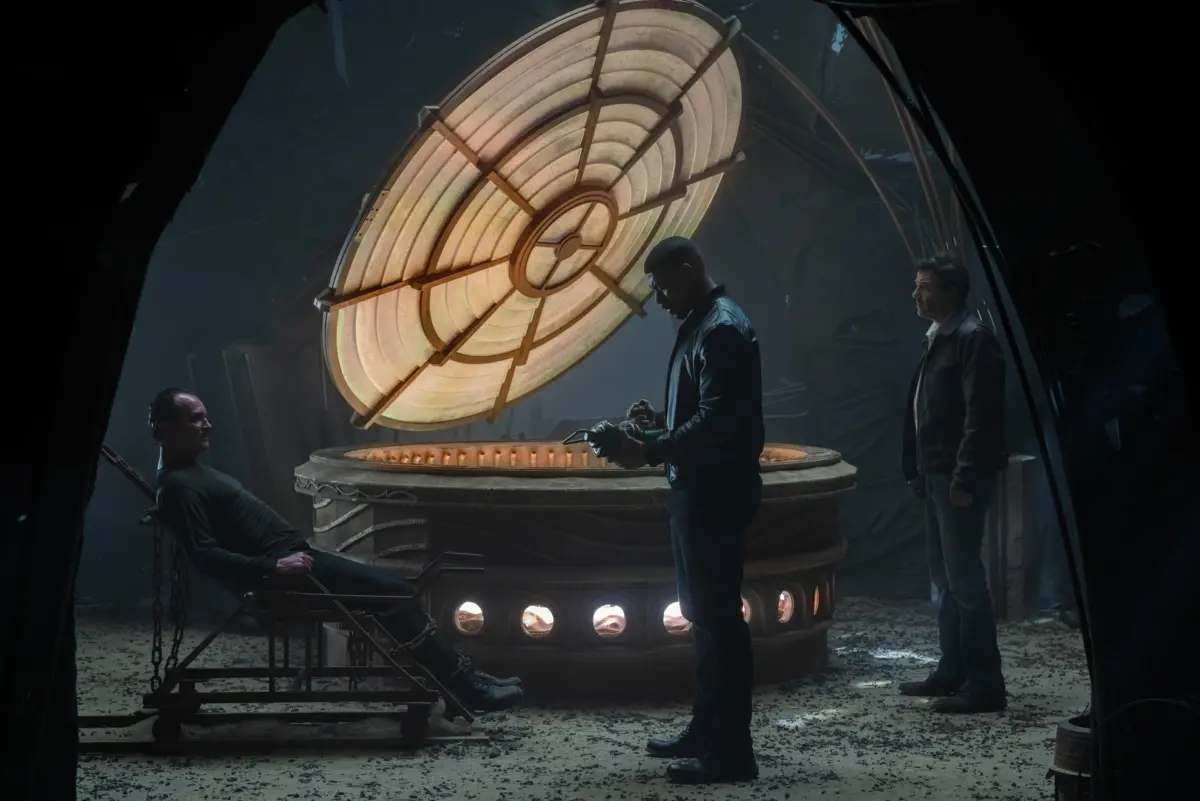
The domestic tranquility is short-lived. That same night, Hal’s residence is targeted in a devastating firebombing. Surviving the collapse, Hal is secreted away to a subterranean medical facility established by Zoe. There, Noah—revealed to be a Manhunter—utilizes advanced restorative technology to treat Hal’s severe epidermal injuries, binding him to secrecy under the threat of exposing his survival.
The Investigation of Hal Jordan’s Murder and Sinestro’s Interrogation
Concurrently, the narrative follows John Stewart interrogating Sinestro, who was broken out of high-security confinement by Noah Macon. Sinestro, seeking vengeance against the Guardians for his imprisonment, admits to forging a rogue power ring for Noah. During a tense interrogation involving laced aqueous solutions, Sinestro reveals that Zoe engineered the dimensional portal out of profound guilt, mirroring Hal’s reluctant return to Rushville.
The psychological chess match escalates when Sinestro tempts John with a corrupted power ring laced with the planet’s ambient fear. The holographic projection of Hal (the Halogram) intervenes, warning John that the maneuver is a tactical trap designed to deplete his vitality. Sinestro argues that Hal opposes the charging of the ring because doing so will cause the holographic construct to permanently dissipate, exposing an underlying friction between self-preservation and systemic duty.
As the investigation deepens, John confronts the agonizing truth behind Hal’s death. Confronting Kerry at the local high school football field, John pieces together the tragic sequence of events. Kerry confesses that Hal discovered Noah’s true nature as a Manhunter and urged her to flee the planet with him. Overwhelmed by panic regarding Noah’s inherent programming and her own complicated, non-consensual lineage originating from Zoe’s bio-engineering, Kerry shot Hal to protect her son.
Rather than seeking standard punitive justice, Kerry’s confession serves as a moral plea. She asks John to determine whether Noah is fundamentally irredeemable. Noah himself displays a paradoxical desire for normalcy juxtaposed with destructive ambition, ultimately choosing to surrender his power ring on John’s dashboard and asking for a peaceful execution before playing his final high school football game. Respecting this nuanced boundary, John chooses to spare Noah and protect Kerry from immediate incarceration, prioritizing long-term community stability over retributive justice.
Structural Implications and the Reimagining of the Green Lantern Corps
The resolution of Lanterns Season 1 offers a profound critique of traditional hierarchical power structures. By establishing John Stewart as an independent entity operating outside the direct oversight of the Guardians of the Universe, the series departs from conventional superhero mythos. Instead of participating in a totalizing nihilistic destruction of the existing order—a common trope in contemporary media—John adopts a strategy of parallel institution-building. Recognizing that Guy Gardner holds the official sector commission, John elects to secure Earth independently, challenging the Guardians to accept a decentralized model of peacekeeping.
This structural independence is mirrored in the metaphorical evolution of the emotional electromagnetic spectrum. Traditionally, DC Comics canon segregates emotions strictly into distinct colored corps, such as rage (Red) and fear (Yellow), while categorizing willpower (Green) as a non-emotional discipline. Lanterns subverts this dichotomy by reframing fear not as an adversary to be conquered, but as a vital interpretive signal. John’s acceptance of fear informs his revised oath:
"In brightest day, in darkest night
I’ll embrace my fear, I’ll do what’s right
I choose this ring, I choose this fight
In service to this lantern’s light"
This rewritten oath serves as a philosophical rejection of the stoic, emotionless detachment historically demanded by the Guardians. By integrating fear into his operational framework, John crafts a more empathetic and sustainable foundation for justice.
Industry Context and Future Outlook
The critical success of Lanterns Season 1 arrives at a precarious juncture for Warner Bros. Discovery and its streaming architecture. With ongoing industry restructuring and corporate merger discussions creating operational uncertainty across several major intellectual property pipelines, the continuation of the series remains officially unconfirmed by network executives.
Industry analysts note that high-budget, serialized comic book adaptations face rigorous financial scrutiny in the current streaming economy. Despite these macro-level uncertainties, the creative team—led by showrunners and the primary ensemble cast—has delivered a self-contained narrative arc that addresses generational accountability, familial reconciliation, and institutional reform. The finale’s closing montage, featuring John making amends with cafe owner Maggie, reconciling with his estranged family, and finally embracing his mother before taking flight, provides a resonant emotional closure regardless of future renewal prospects.
Ultimately, Lanterns has demonstrated that superhero television can successfully prioritize character-driven psychological depth and sociopolitical allegory. Whether the series returns for a sophomore season or remains a singular eight-episode miniseries, its deconstruction of the Green Lantern mythology stands as a significant achievement within modern speculative fiction.