The 83rd Venice International Film Festival served as the backdrop for one of the season’s most anticipated cinematic pairings, as veteran actors Sam Rockwell and John Malkovich united to promote their latest project, Wild Horse Nine. Directed by acclaimed filmmaker Martin McDonagh, the feature-length drama brings together two distinct acting styles within a narrative that blends dark political history with existential reflections on aging, mortality, and geopolitical disillusionment. Ahead of the film’s premiere—which ultimately garnered a prolonged, 13-minute standing ovation—the principal cast and director sat down to discuss the creative process, the weight of historical memory, and the thematic evolution of McDonagh’s filmography.
A Convergence of Distinct Cinematic Forces
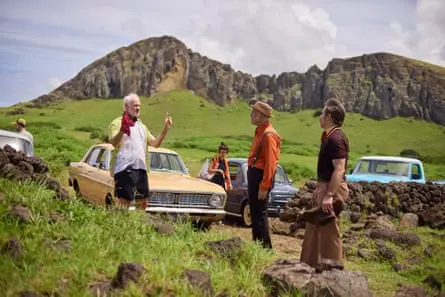
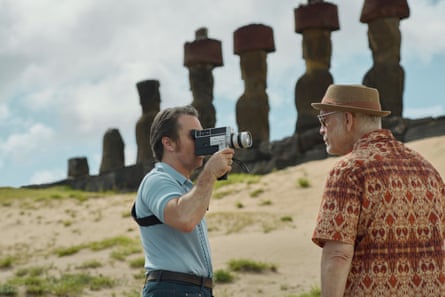
The dynamic between Rockwell and Malkovich off-screen mirrors the volatile yet deeply loyal relationship of their characters, CIA agents Chris and Lee. Set against the turbulent historical backdrop of the 1973 Chilean coup and the isolated landscapes of Rapa Nui (Easter Island), Wild Horse Nine explores the terminal decline of intelligence operatives grappling with the moral fallout of Cold War interventions.
Rockwell, known for his kinetic energy and expressive delivery, described his co-star with profound professional admiration during the press engagements in Venice. Recalling Malkovich’s unique screen presence, Rockwell characterized his counterpart as a rare blend of contrasting elements—simultaneously charismatic and dangerous, commanding and understated. Yet, maintaining a lighthearted rapport, Rockwell frequently interjected with humorous caveats during the interview to deflect what he perceived as excessive praise directed at the notoriously self-effacing Malkovich.

Malkovich, approaching the project with his signature intellectual containment, reflected on the intense preparation required for the roles. The production necessitated weeks of rigorous rehearsal on location in the South Pacific, an environment defined by its geographical isolation. According to the actors, the grueling rehearsal schedule—running scenes repeatedly to achieve the desired cadence—was both a professional necessity and a practical antidote to the monotony of remote island living.
Thematic Depth and Historical Resonance
Wild Horse Nine represents a notable tonal shift for director Martin McDonagh. Having established his reputation as a theatrical enfant terrible before transitioning into celebrated black comedies such as In Bruges (2008) and The Banshees of Inisherin (2022), McDonagh’s latest work leans heavily into melancholy and retrospection. The filmmaker, now 56, acknowledged that the project reflects a changing perspective on life and historical culpability.
Upon initiating the script, McDonagh famously inscribed the words “GUILT” and “REGRET” at the top of the first page, establishing a thematic compass for a narrative steeped in the shadows of mid-century intelligence operations. The storyline heavily features Malkovich’s character, Chris, a terminally ill veteran of covert operations whose memories extend from the Bay of Pigs invasion to Dealey Plaza. In a desperate bid for absolution or notoriety, Chris threatens to expose long-buried state secrets regarding the assassination of President John F. Kennedy.
The inclusion of Kennedy assassination mythology is not merely a narrative device but a deliberate engagement with what sociologists term a foundational trauma in American political consciousness. McDonagh openly expressed skepticism regarding the official conclusions of the Warren Commission, aligning himself with a long-standing tradition of public doubt surrounding the events of November 22, 1963. This skepticism permeates the film, framing government institutions not as infallible protectors, but as leaking repositories of unresolved historical violence.
Geopolitical Context and Modern Parallels
Although Wild Horse Nine was conceived primarily as a character-driven drama examining personal accountability, its production fortuitously intersected with contemporary shifts in international relations. Filming coincided with heightened military and economic interventions in Latin America, prompting discussions among the creative team regarding the evolution of foreign policy execution.
In interviews surrounding the film, McDonagh contrasted the covert, proxy-driven nature of Cold War-era interventions with the more overt, transactional approach characteristic of modern statecraft. Rather than focusing solely on contemporary political figures, the director placed current events within a broader historical continuum, noting that executive administrations across decades have routinely engaged in contentious foreign entanglements. However, McDonagh highlighted a distinct stylistic shift in contemporary political communication: where historical administrations maintained strict plausible deniability, modern governance often dispenses with the veneer of secrecy entirely.
This critical view of state authority resonates with the personal philosophies of the film’s lead actors. Malkovich, who has famously abstained from participating in presidential elections since the 1972 contest between George McGovern and Richard Nixon, articulated a deep-seated skepticism toward institutional authority and conventional democratic participation. Citing a lifelong detachment from formal political systems, Malkovich emphasized a focus on individual creative output over systemic engagement. Rockwell, by contrast, expressed a more conventional, albeit world-weary, approach to civic participation, joking about casting ballots with faint hopes for political reform.
Production Insights and Festival Reception
The grueling six-week shoot on Rapa Nui presented unique logistical and personal challenges for the cast and crew. Surrounded by the monumental moai statues and the vast expanse of the Pacific Ocean, the production relied heavily on mutual support and camaraderie to endure the isolation. Rockwell credited the local culinary traditions—specifically the regional pisco sours—as a vital morale booster during the demanding evening hours following extensive location shoots.
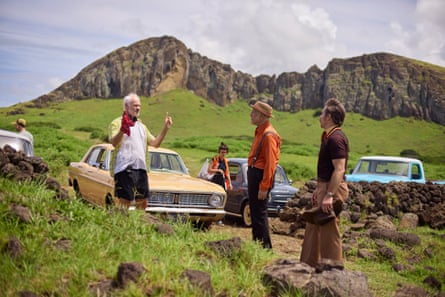
The rigorous preparation paid immediate dividends upon the film’s arrival at the Venice Film Festival. Industry analysts noted that Wild Horse Nine immediately positioned itself as a major contender for the festival’s top honors, driven by stellar performances from both leads. Malkovich’s portrayal of Chris—a character oscillating between tragic vulnerability and caustic defiance—was singled out by critics as a masterclass in theatrical restraint, utilizing his signature enigmatic delivery to anchor the film’s heavier philosophical inquiries.
As the press conference drew to a close, the conversation characteristically pivoted toward existential themes, mirroring the film’s preoccupation with mortality. Asked to contemplate an ideal, cinematically scripted conclusion to life, Malkovich recounted amusing anecdotes from his theatrical touring days, specifically recalling operatic productions where simulated medical emergencies routinely triggered genuine panic among unsuspecting audience members.
Wild Horse Nine is slated for a wider theatrical release later in the year, distributed by Searchlight Pictures. As the film prepares to engage broader audiences, its blend of sharp dialogue, historical interrogation, and powerhouse performances ensures that it will remain a central fixture in discussions surrounding contemporary auteur cinema.