The modern television landscape is saturated with legacy revivals, reboots, and nostalgic cash grabs, leaving audiences to perpetually ask a single, nervous question whenever an old favorite returns: Is it good? This inquiry weighs heavily over the latest iteration of Mystery Science Theater 3000, widely known within fan communities as MST3K: The RiffTrax Experiments. Featuring core franchise veterans Michael J. Nelson, Kevin Murphy, and Bill Corbett, this high-profile return brings back the foundational architects of the series’ "Golden Age" on Comedy Central and the Sci-Fi Channel. While these creators have spent the past two decades successfully honing their comedic timing through the independent RiffTrax enterprise, stepping back onto the Satellite of Love introduces a distinct set of stylistic expectations, network pressures, and audience demands.
The Genesis and Background of the Revival
To understand the weight of this new production, one must examine the chronology of Mystery Science Theater 3000 since its humble inception in 1988 at KTMA in Minneapolis, created by Joel Hodgson. Over multiple eras—spanning Hodgson’s tenure, Michael J. Nelson’s subsequent takeover as host, the Sci-Fi Channel era, and later crowdfunding-driven revivals on Netflix led by Jonah Ray and Emily Marsh—the format has remained remarkably durable.
The introduction of RiffTrax in 2006 by Nelson, Murphy, and Corbett allowed these performers to sidestep traditional television structures entirely, delivering feature-length commentary tracks and live-broadcast cinematic events directly to a dedicated subscriber base. However, the appetite for a formal return to the original narrative framework—complete with host segments, mad scientists, and handcrafted robot companions—never truly dissipated. Funded by a combination of targeted fan investments and independent backing, this latest project aims to bridge the gap between their modern digital enterprise and the classic television structure that launched their careers.
Navigating the Rust: Early Deliveries and Stylistic Adjustments
Upon initial viewing, the reboot exhibits a certain degree of roughness. Even though Nelson, Murphy, and Corbett are seasoned professionals with thousands of hours of riffing experience, the early moments of the premiere reveal a subtle, palpable nervousness. The opening sequence hustles viewers back to the iconic spacecraft with minimal exposition, accompanied by a tongue-in-cheek weariness encapsulated by the unspoken sentiment of returning to a familiar routine.
Early comedic beats, particularly those relying on timely pop-culture references, occasionally miss their mark. The conversational banter between the hosts occasionally carries the awkward cadence of old friends reconnecting after a prolonged absence. This cautious approach stands in fascinating contrast to the energetic, high-budget Netflix revival spearheaded by Joel Hodgson in 2017. While the Netflix iteration favored rapid-fire joke delivery and elaborate overarching plots, the RiffTrax-led experiment leans into a more deliberate, exploratory pace. Rather than coasting entirely on frictionless nostalgia, the hosts appear to be actively discovering how their distinct comedic identities fit into the contemporary media landscape.
The Perfect Cinematic Canvas: Dissecting Sting of Death
No episode of Mystery Science Theater 3000 can succeed without a suitably baffling cinematic disaster, and the revival strikes gold with its selection of the 1965 Florida horror feature Sting of Death. Directed by William Grefe, the film provides an ideal foundation for comedic deconstruction. The narrative follows a group of vacationing youths—portrayed predominantly by actors old enough to qualify for AARP memberships—whose beachside revelry is disrupted by a mysterious creature and its purported army of jellyfish.
Even by the eccentric standards of the series, Sting of Death represents a staggering collection of baffling narrative and technical choices. The film features an inexplicable subplot involving a bizarre facial mark on a professor that is introduced and subsequently abandoned. It presents protagonists who subject a social outcast to extreme, unprovoked harassment before he ultimately transforms into the creature itself. The production relies heavily on underwater camera footage captured from airboats, featuring haphazardly tied plastic bags representing deadly jellyfish attacks and a rubber monster suit constructed from readily available Halloween accessories.
Industry analysts and long-time followers of the franchise have frequently debated the structural differences between a standard RiffTrax release and a traditional MST3K episode. Sting of Death proves that the distinction lies not merely in the absence of a visible host, but in the specific marriage of tone, narrative momentum, and cultural exploitation. The film maintains just enough forward momentum to keep audiences engaged while offering a masterclass in unintentional cinematic incompetence, easily meeting the elevated expectations of franchise traditionalists.
Host Segments and Narrative Continuity
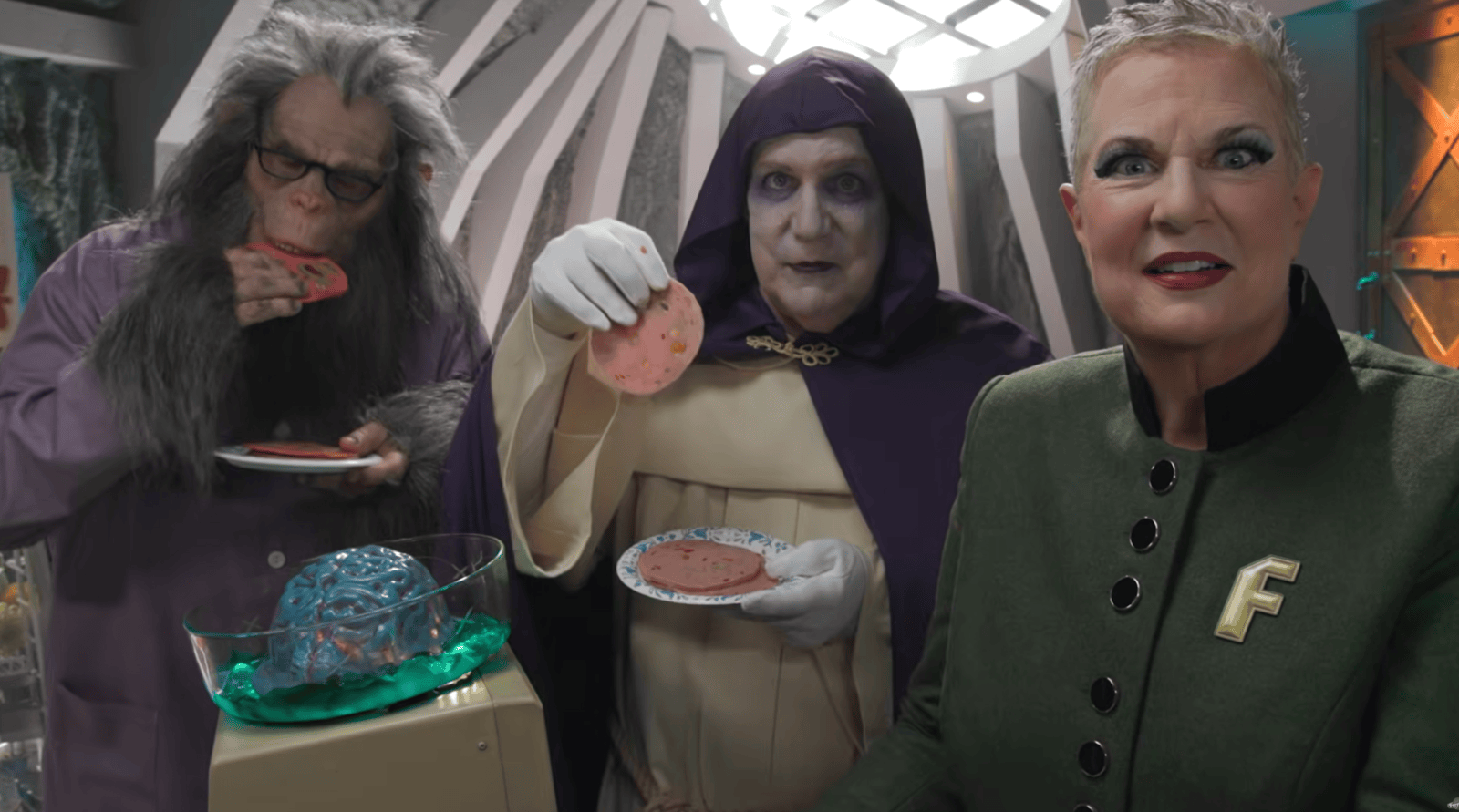
While modern streaming formats often minimize non-movie segments to maintain pacing, this revival incorporates targeted host sketches that evoke the classic era while exploring new comedic territory. The return of classic villainous archetypes—specifically Pearl Forrester (Mary Jo Pehl), Professor Bobo (Kevin Murphy), and Brain Guy (Bill Corbett)—adds an immediate layer of comforting familiarity. The mad scientists surface briefly to introduce a corporate sponsor, Syd’s Olive Loaf, while outlining Pearl’s dubious ambitions to monetize the experimental data through artificial intelligence.
A standout musical number involves Nelson, Crow T. Robot, and Tom Servo performing a choreographed routine as tardigrades, proving that the team’s penchant for elaborate, absurd theatricality remains undiminished. The episode opens with Michael J. Nelson working a mundane shift at the Moose Lick County Dairy Co-op before being abruptly abducted back into servitude. While this narrative bridge lightly brushes aside decades of established lore, it underscores a fundamental truth about the franchise: the overarching plot has always served merely as a gateway to the primary objective—delivering comedy inside the theater.
Inside the Theater: The Mechanics of the Riff
Once the film begins, the underlying friction of the premiere evaporates, revealing the timeless chemistry that made the original series a cult phenomenon. The timing of the jokes demonstrates expert pacing, knowing precisely when to punctuate a scene with a sharp one-liner and when to let the absurdity of the source material speak for itself.
Comedic highlights are distributed evenly across the trio. Tom Servo casually suggests that the cliché cinematic line "Take it easy, tiger" served as a character’s dying words, while sargassum weed is rebranded as the "weed of deceit." Subtle background chuckles from the robot companions and Nelson’s characteristically deadpan delivery—steeped in a quiet bewilderment regarding his recurring imprisonment—reinforce the unique comedic rhythm of this specific creative lineup.
According to statements from the creators during promotional interviews surrounding the release, the enduring appeal of the franchise stems from a broader cultural fatigue with heavily commercialized, formulaic entertainment. In an era dominated by multi-million-dollar superhero franchises designed for passive, widespread acknowledgement, Mystery Science Theater 3000 offers the straightforward novelty of genuine, communal laughter. Limited theatrical screenings held prior to the digital release demonstrated that audiences are eager to share this experience in communal spaces, though the sensation translates effectively to home viewing.
Broader Implications and Industry Legacy
Evaluating Mystery Science Theater 3000: The RiffTrax Experiments within the broader ecosystem of television revivals reveals a surprising artistic parallel. Rather than functioning as a direct continuation of 1990s television, the production shares a spiritual kinship with prestige revivals like David Lynch’s Twin Peaks: The Return. It does not blindly duplicate past triumphs; instead, it acknowledges the passage of time, embracing its own structural imperfections while remaining faithful to its idiosyncratic roots.
For an industry increasingly reliant on algorithmic predictability and risk-averse franchising, the success of this independent revival highlights the enduring viability of creator-led, fan-funded models. By refusing to coast entirely on greatest-hits complacency, Nelson, Murphy, and Corbett have crafted a project that honors its legacy while validating the ongoing cultural appetite for intelligent, joyful cinematic mockery. While it may not rewrite the rules of modern television production, it successfully restores a cherished comedic voice to a world that continues to manufacture an endless supply of cinematic misfires.