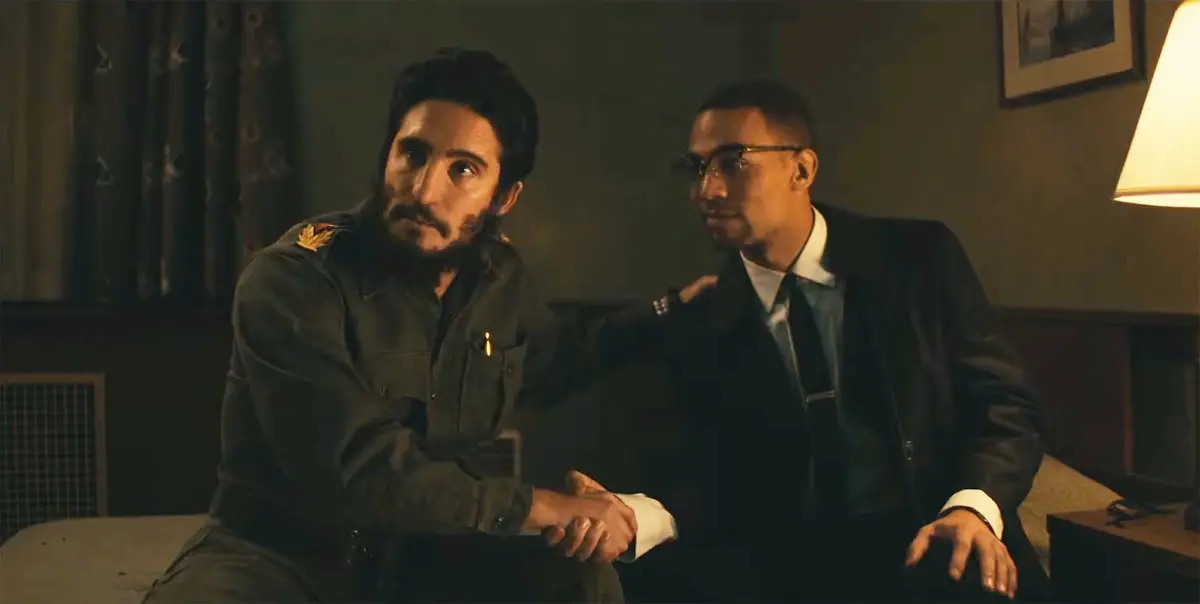
Lionsgate has officially released the first teaser trailer and promotional artwork for Killing Castro, an upcoming political thriller directed by acclaimed music video and television director Eif Rivera. Set against the volatile backdrop of the early 1960s Cold War, the feature-length film examines a little-known, high-stakes chapter of American and Cuban history when Fidel Castro arrived in New York City in 1960 to address the United Nations General Assembly. The project, backed by high-profile executive producers including Curtis "50 Cent" Jackson and DJ Khaled, is scheduled for a hybrid release strategy, arriving in select United States theaters on December 11, 2026, before expanding to video-on-demand (VOD) platforms on December 18, 2026.
The narrative centers on the immense geopolitical friction generated by Castro’s historic visit. After seizing power in Cuba in 1959, Castro’s revolutionary government rapidly strained relations with the United States, prompting intense scrutiny, intelligence operations, and covert hostility from Washington. The newly released teaser highlights the mounting paranoia of the era, underscored by the film’s tagline: "Don’t be afraid… I’m with the US government. We have some things to discuss." As chronicled in the film, the diplomatic visit took an unexpected turn when civil rights leader Malcolm X invited Castro to stay at the iconic Hotel Theresa in Harlem, moving the Cuban leader out of midtown Manhattan and directly into a bustling, politically charged urban community under the watchful eyes of multiple intelligence agencies.
Historical Context and Chronology of the 1960 Visit
To fully understand the premise of Killing Castro, it is necessary to examine the historical timeline of September 1960. Fidel Castro traveled to New York City to attend the 15th Session of the United Nations General Assembly. Initially, his delegation booked rooms at the midtown Shelburne Hotel. However, following a dispute over financial demands and management concerns, hotel officials pressured the Cuban delegation to leave.
Sensing a profound political opportunity and wishing to forge solidarity with marginalized communities, Malcolm X—then a prominent minister and national spokesman for the Nation of Islam—extended an invitation for Castro and his delegation to stay at the Hotel Theresa in Harlem. The move created an extraordinary media spectacle and a monumental security challenge. Over the following days, the Hotel Theresa became a nexus of international diplomacy and radical politics. Castro famously met with several world leaders during his Harlem stay, including Soviet Premier Nikita Khrushchev, Egyptian President Gamal Abdel Nasser, and Indian Prime Minister Jawaharlal Nehru.

Simultaneously, the convergence of foreign dignitaries in Harlem alarmed American authorities. The Federal Bureau of Investigation (FBI), under the direction of J. Edgar Hoover, and the Central Intelligence Agency (CIA) closely monitored the delegation. Compounding the threat matrix, organized crime syndicates—who had lost lucrative gambling, hotel, and prostitution interests in Havana following the Cuban Revolution—were also actively plotting against Castro’s life.
Cinematic Premise and Fictionalized Perspectives
While rooted in documented historical friction, Killing Castro dramatizes the tense atmosphere through a combination of real historical figures and fictionalized or composite characters. The film focuses on a tightening web of surveillance, political machinations, and covert operations.
Diego Boneta stars as Fidel Castro, capturing the revolutionary leader’s charismatic yet polarizing persona during a pivotal moment in his political career. Kendrick Sampson portrays Malcolm X, highlighting the strategic alignment between the burgeoning American civil rights movement and anti-imperialist international leaders.
Surrounding these historical titans are figures representing the ground-level cogs of the intelligence and hospitality apparatus. Academy Award winner Al Pacino stars as a mysterious senior CIA operative, lending gravitas to the clandestine orchestration of American foreign policy. The ensemble cast also features Xolo Maridueña as a young translator caught in the crossfire of international espionage, and KiKi Layne as a hotel worker at the Hotel Theresa whose life is upended by the sudden influx of global surveillance and danger.
The supporting cast features a wealth of recognizable talent, including Alexander Ludwig, Ron Livingston, Nicole Beharie, Titus Welliver, Frankie Faison, Paul Ben-Victor, and Logan Marshall-Green. This expansive roster underscores the studio’s confidence in the project’s commercial and dramatic viability.

Production Background and Creative Team
Killing Castro marks a significant narrative feature milestone for director Eif Rivera. Known primarily for his prolific work directing visually striking music videos for major hip-hop and pop artists, as well as directing episodes across the expansive "Power Book" television universe, Rivera brings a dynamic, fast-paced visual style to historical drama.
The screenplay was penned by Thomas V. DeGrezia and Leon Hendrix III, building upon an underlying script originally developed by Colin Bateman. Production duties are handled by Christina Weiss Lurie and Brad Feinstein, with the backing of prominent entertainment figures such as Curtis "50 Cent" Jackson and DJ Khaled, whose involvement signals a cross-pollination of urban music culture and prestige historical filmmaking.
The distribution strategy chosen by Lionsgate reflects modern cinematic distribution trends for mid-budget adult dramas and thrillers. By deploying a theatrical run limited to select markets on December 11, 2026, followed quickly by a wide VOD release on December 18, 2026, the studio aims to capture year-end prestige viewing while capitalizing on home-entertainment demand during the holiday season.
Broader Industry Trends and Historical Thrillers
The release of Killing Castro coincides with a noticeable resurgence in Hollywood productions examining mid-century American political conspiracies and historical flashpoints. The film shares thematic DNA with other recent cinematic projects exploring the turbulent political landscape of the 1960s, such as high-profile thrillers centered around the John F. Kennedy assassination era.

Industry analysts note that studios are increasingly turning to historical revisionism and conspiracy-adjacent dramas to attract adult audiences who have largely migrated away from traditional theatrical viewing for original mid-budget content. By blending well-documented historical facts with heightened, character-driven espionage narratives, films like Killing Castro seek to bridge the gap between educational history and pulse-pounding commercial entertainment.
Implications for the Cast and Future Projects
For lead actor Diego Boneta, Killing Castro represents another major step in expanding his international filmography, following acclaimed performances in biographical and dramatic television projects. Meanwhile, the inclusion of screen legend Al Pacino continues his decades-long exploration of complex crime, political, and thriller narratives, adding significant weight to the film’s marketing campaign.
As the December release date approaches, audience anticipation will likely hinge on how effectively the film balances its commercial thriller elements with the delicate political and racial complexities of 1960s Harlem. With a stacked ensemble cast, a unique historical premise, and high-energy direction, Killing Castro aims to position itself as one of the more provocative conversational pieces of the late 2026 film calendar.