The animation landscape has long whispered of Brad Bird’s elusive passion project, Ray Gunn, a gritty, futuristic noir feature that predates some of the acclaimed director’s most celebrated theatrical releases. Conceived more than three decades ago, long before Bird helmed critical darlings such as The Iron Giant, The Incredibles, and Ratatouille, the script first began circulating within Hollywood circles in 1996. Turner Feature Animation initially placed the project into active development during the mid-1990s, only for it to be sidelined when Bird transitioned to Warner Bros. Animation to direct The Iron Giant. Over the subsequent decades, Ray Gunn languished in development limbo, experiencing intermittent periods of revival and corporate turnaround. Throughout the 2000s, collaborators such as composer Michael Giacchino familiarized themselves with the script—Giacchino first read it around 2009—while Bird continually prioritized other high-profile studio obligations.
Now, through a collaborative venture between Skydance Animation and Netflix, the decades-old vision has finally been brought to fruition. Ahead of its anticipated world premiere at the upcoming London Film Festival, select media outlets were invited to Netflix Animation Studios for an exclusive, behind-the-scenes preview of the film. The event featured early footage screenings and in-depth discussions with key creative personnel, including Bird, Giacchino, Art Director Wendell Luebe, Animation Director Jason Ryan, and Visual Effects Supervisor Adel Abada. While the production journey spanning thirty years necessitated certain structural evolutions—most notably a shift from Bird’s original vision of 2D hand-drawn animation to modern CGI—the foundational narrative and script have largely remained intact.
Unpacking the Narrative: A Hard-Boiled Sci-Fi Noir
Film noir is historically anomalous within the realm of mainstream family-friendly animated entertainment, a factor that heavily contributed to the project’s prolonged incubation period. However, with Netflix providing substantial financial backing, the production has embraced higher creative risks, pushing the boundaries of traditional PG-rated storytelling. Ray Gunn establishes its tone immediately in its opening sequence, which features a visceral, hard-boiled office brawl. The titular protagonist, a down-on-his-luck private investigator voiced by Sam Rockwell, is brutally thrown through walls by a towering multi-armed alien adversary while attempting to resolve a routine case.

Set within the sprawling, stratified mega-city of Metropia, the narrative follows Ray as a moderately recognized but perpetually struggling operative who relies heavily on his network of underworld informants. Assisting him is Eyera, a gruff, world-weary alien partner voiced by Tom Waits. The plot thickens significantly when Ray is approached by the husband of Venus Nova—portrayed by Scarlett Johansson and recognized as Metropia’s preeminent cinematic superstar—who hires the detective to uncover evidence of corporate or personal malfeasance.
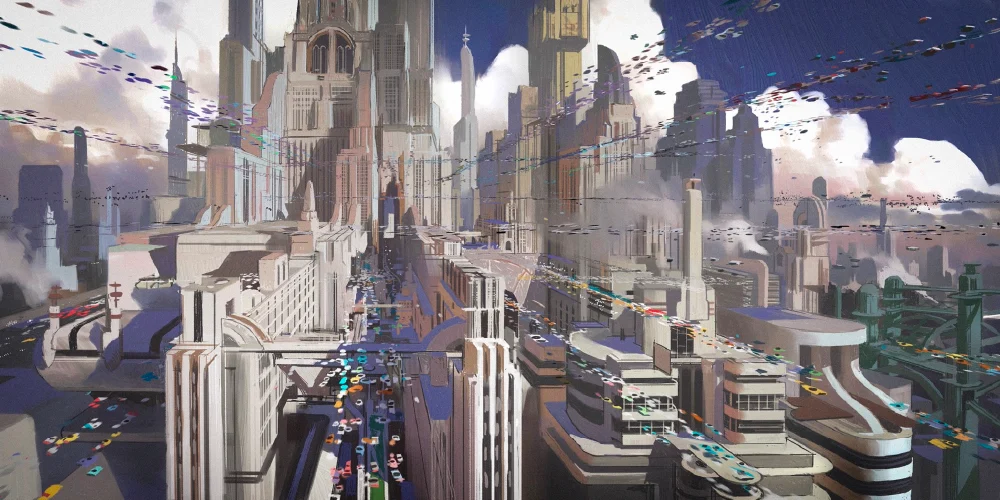
The aesthetic framework of Ray Gunn recontextualizes classic 1930s and 1940s detective tropes through a retro-futuristic lens. Bird conceived the universe as a futuristic society envisioned directly through the architectural and cultural imagination of 1939. Metropia itself is designed as a vertical metropolis featuring towers scaling a mile into the clouds, blending the monumental, blocky massing of architectural illustrator Hugh Ferriss with the sleek, aerodynamic curves of the Streamline Moderne design movement. While the city presents an outwardly utopian veneer of light and progress, it masks a seedy, fog-soaked underworld defined by high-contrast lighting, harsh shadows, and deep silhouettes.
The Production Pivot: From Two-Dimensional Vision to CGI Scale
The long-standing ambition of director Brad Bird was to execute Ray Gunn utilizing traditional, hand-drawn 2D animation techniques, a creative standard he maintained even after Netflix agreed to resurrect the property. Nevertheless, financial and logistical realities ultimately forced a pivot. Animating a production of this magnitude and spatial complexity in a traditional 2D medium proved cost-prohibitive, exceeding even the robust production budgets available through streaming platforms.
Faced with the binary choice of scaling down the narrative scope to accommodate traditional methods or transitioning the production to Computer-Generated Imagery, Bird elected to preserve the grand scale of the universe. Explaining the difficult compromise, Bird noted that the realized scale aligns precisely with his initial design parameters, asserting that computer-generated graphics offered the only viable technological pathway to accurately render the sprawling cityscapes and complex character choreography as originally conceptualized. While the finished product showcases technical mastery, the transition away from hand-drawn aesthetics introduces a distinct visual stylistic shift for followers of traditional animation.

A Jazz-Infused Soundscape and Evolving Musical Collaboration
The stylistic ambition of Ray Gunn extends into its sonic architecture through a long-standing creative partnership between Brad Bird and composer Michael Giacchino. The duo originally bonded over a shared affinity for Henry Mancini’s iconic, jazz-driven theme music for Peter Gunn, which provided the exact gritty, evocative atmosphere desired for the animated feature. Discussing the broader stylistic influences behind the score—which draws inspiration from Mancini as well as unconventional sources like The B-52’s track "Planet Claire"—Giacchino emphasized the cyclical, evolutionary nature of artistic creation.
The relationship between the director and composer spans more than two decades, originating when Bird entrusted Giacchino with his first feature-film scoring assignment. Their professional rapport remains tightly knit, underscored by mutual creative deference. During press interactions, when Giacchino referred to the project as "Brad’s movie," the director routinely interjected to correct the terminology, insisting on collective authorship under the banner of "our movie."
Modern Socio-Political Subtext in a Retrofuturistic Setting
Beneath its classic hard-boiled detective exterior, Ray Gunn incorporates contemporary socio-political themes. Metropia is populated by a diverse array of human and extraterrestrial citizens, yet the societal hierarchy remains sharply divided along species lines. Aliens within the metropolis are predominantly relegated to low-wage service and janitorial occupations, systematically denied the socioeconomic privileges and legal recognition of full personhood.
While the protagonist demonstrates moral clarity by treating his partner Eyera as an equal regardless of his origins, the script does not shy away from mirroring contemporary xenophobic rhetoric. Characters within the film occasionally utilize derogatory nomenclature, labeling alien residents with terms equivalent to "illegals," prompting internal verbal reprimands from characters like Eyera. Bird has clarified that the film is not intended to function as an overt sociological treatise, but rather as an entertaining cinematic experience that resonates with authentic human dynamics and contemporary societal tensions. Because press screenings were limited to the film’s first act, critics and audiences await the full feature to evaluate how deeply these allegorical themes are integrated into the overarching narrative structure.

Industry Implications and the Competitive Animated Feature Landscape
As Ray Gunn prepares for its international debut at the London Film Festival, industry analysts are positioning the film within a uniquely crowded and competitive theatrical and streaming window for feature-length animation. The upcoming awards cycle features a diverse roster of critical contenders across both major studio pipelines and independent distributors, including high-profile projects such as Pixar’s Toy Story 5, Laika’s Wildwood, Tangles, and Netflix’s alternative awards contender In Waves.
In recent years, voting bodies within the animation branch have increasingly recognized auteur-driven, distinctive filmmaking over conventional studio models, opening a viable pathway for unconventional projects like Ray Gunn to capture critical momentum. With the film’s official premiere scheduled to arrive in a matter of weeks, the industry will soon discover whether a thirty-year incubation period has successfully birthed a landmark achievement in adult-leaning, stylistically daring animation.