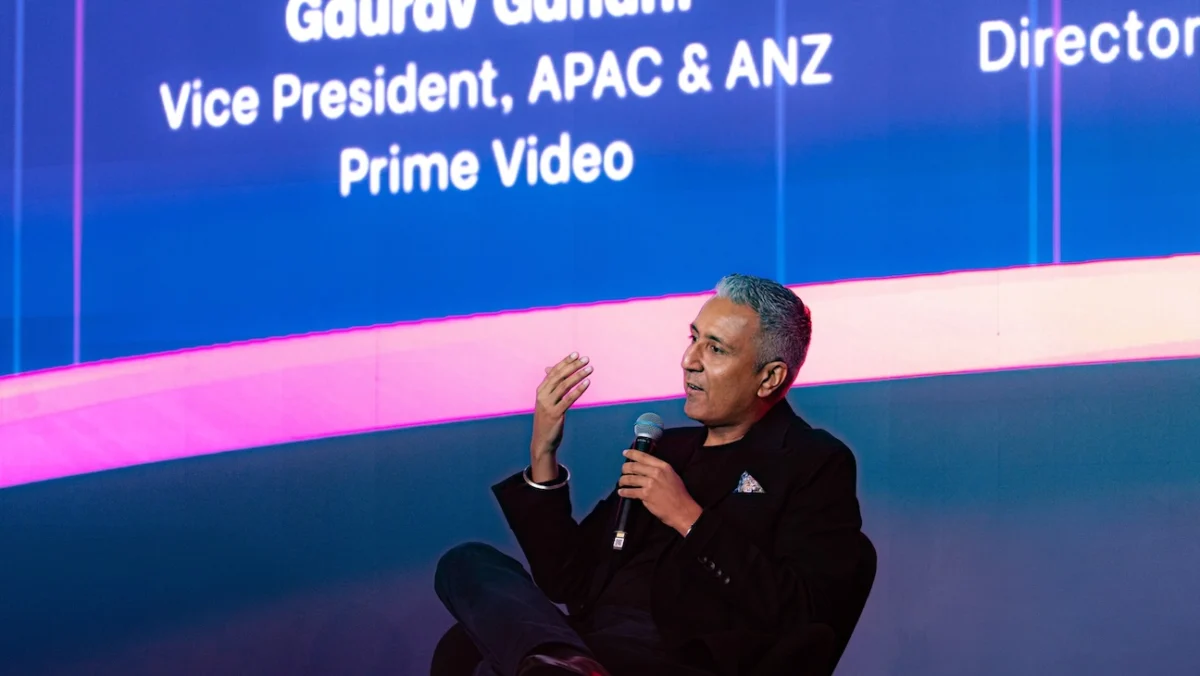
Amazon’s Prime Video used the APOS media conference in Bali to argue that the future of streaming in the Asia-Pacific (APAC) region lies not in a single subscription but in an “entertainment hub”—a one-stop platform tying together originals, partner channels, rentals, and add-on subscriptions behind a single log-in. This vision, shared by the company’s regional leadership in a session titled “The APAC Playbook: How Prime Video Is Shaping Streaming’s Future,” follows a broader industry transition away from stand-alone applications toward aggregation, partnerships, and bundling. This shift has been a recurring theme throughout the APOS summit, organized by Media Partners Asia (MPA), as platforms seek sustainable profitability in a maturing digital landscape.
Speaking alongside Media Partners Asia’s Vivek Couto, Gaurav Gandhi, Prime Video’s vice president for Asia-Pacific, Australia, and New Zealand, described the region as a complex patchwork that defies a singular approach. Gandhi emphasized that while the underlying business model remains consistent globally, the execution must be tailored to the unique cultural and economic nuances of individual markets. Across its core Asian territories, two foundational elements remain constant: the streaming service operates within the broader Amazon Prime membership program, and it functions as a comprehensive hub, layering third-party add-on subscriptions and transactional video-on-demand (TVOD) rentals on top of the core subscription video-on-demand (SVOD) tier.
The Architecture of the Entertainment Hub
The hub model, as Gandhi articulated, represents a strategic push for scale on both sides of the digital transaction. For consumers, the value proposition lies in convenience and variety, offering the “widest selection” of content through a single application and a unified billing relationship. This reduces “subscription fatigue,” a phenomenon where users become overwhelmed by managing multiple accounts and payment cycles across different services. For content partners, the platform provides a ready-made distribution network and access to a massive, pre-existing audience without the prohibitive costs of building and maintaining an independent technological and payment infrastructure.
Prime Video’s ecosystem now encompasses more than 600 content partners worldwide. In the APAC region specifically, the platform has established significant footprints: over 70 partners in Japan, 50 in Australia, and 30 in India. Many of these partners now view Prime Video as their primary route to market, leveraging Amazon’s reach to bypass the traditional hurdles of customer acquisition and retention. This strategy, while not entirely new to the Amazon playbook, arrives at a critical juncture as the streaming business in Asia enters a phase of maturation. The initial "streaming wars," characterized by aggressive, head-to-head competition for subscriber numbers, are giving way to an era of consolidation and strategic alliances.
Market-Specific Maturity and the Move Toward Bundling
The necessity of the hub strategy is underscored by the diverse economic realities of the APAC region. In developed markets like Japan and Australia, the landscape is increasingly crowded, making organic growth more difficult and expensive. Conversely, in emerging markets across Southeast Asia and the Indian subcontinent, low-margin realities and fragmented payment systems necessitate efficient distribution models.
The trend toward aggregation was a dominant topic at APOS this year. Other major players are following similar paths: Viu and iQIYI International recently unveiled a Southeast Asian bundle, and Disney+ announced a partnership with CJ ENM’s Tving in Japan late last year. Amidst this consolidation, Amazon is positioning itself as the central aggregator—the "super-app" of entertainment—that other content creators can simply "plug into" to reach viewers.
India: A Decade of Multilingual Innovation and AVOD Integration
The strategy is perhaps most advanced in India, which currently stands as Prime Video’s largest Asian market. Marking ten years of operation in the country, Shilangi Mukherji, head of Prime Video India’s subscription business, highlighted the service’s multilingual, originals-first approach. India serves as a laboratory for Amazon’s most ambitious streaming experiments, including the integration of a free, ad-supported (AVOD) tier into its paid service.
Through the integration of Amazon MX Player, Prime Video now bills itself as India’s largest streaming service for exclusive originals. By marrying its premium subscriber base with the expansive reach of MX Player’s free content, Amazon is creating a dual-layered ecosystem. This combination offers a scale that few competitors can match, with the newly formed JioStar—a joint venture between Reliance Industries and Disney—being the only realistic rival in terms of sheer volume and market penetration.
Data shared during the conference revealed the depth of Prime Video’s engagement in India:
- Multilingual Reach: More than 60 percent of Indian customers stream content in four or more languages.
- Localized Programming: The platform currently programs in 10 different Indian languages, with heavy investments in Hindi, Tamil, and Telugu.
- Content Pipeline: India hosts the largest slate of Prime Video originals outside the United States. To date, the company has launched over 100 titles, with another 100-plus currently in development or production.
- Retention and Success: Approximately 60 percent of Prime Video’s Indian series have been renewed for subsequent seasons, a high success rate in a competitive market.
Mukherji also noted that the recent arrival of Amazon MGM Studios’ local operations and a rising demand for movie rentals indicate that Indian viewers are increasingly willing to pay for premium cinema experiences at home, signaling a shift in consumer behavior toward higher-value transactions.
Japan: From Free-to-Air Tradition to Digital Dominance
In Japan, Prime Video’s second-largest APAC market, the journey has been one of fundamental behavioral change. Keisuke Oishi, country manager for Prime Video Japan, recalled the challenges of launching in 2015 in a market that was historically anchored to free-to-air television and physical media. The company essentially had to build a subscription-streaming habit from the ground up.
Over the past decade, Prime Video Japan has diversified its offerings across four strategic pillars:
- Anime: Leveraging Japan’s global leadership in animation to drive local and international viewership.
- Scripted Entertainment: Investing in high-quality local dramas and films.
- Unscripted Programming: Developing unique Japanese variety shows and reality formats.
- Live Sports: A burgeoning sector that launched in 2022 with live boxing events. The sports portfolio has since grown to 15 major events, proving that live "appointment viewing" is a significant draw for digital subscribers.
Additionally, the platform’s focus on manga adaptations has resonated deeply with local audiences, bridging the gap between traditional Japanese pop culture and modern streaming delivery.
Implications for the Global Streaming Landscape
The insights shared at APOS suggest that the Asia-Pacific region is no longer just a target for subscriber growth, but a primary engine for global innovation within Amazon’s entertainment division. Gaurav Gandhi described APAC as a "key driver of growth" where new ideas are generated and tested before being exported to other parts of the world.
Examples of these APAC-born innovations include:
- Tiered and Mobile-First Plans: Specifically designed for the price-sensitive and mobile-heavy demographics of India and Southeast Asia.
- Multilingual Interface and Dubbing: Advanced localization techniques developed for the Indian market are now being applied to global content to increase accessibility.
- Hybrid AVOD/SVOD Models: The success of integrating free, ad-supported content with premium subscriptions in India provides a blueprint for Amazon’s global strategy as it seeks to maximize ad revenue alongside subscription fees.
Chronology of Prime Video’s APAC Evolution
The current "Entertainment Hub" strategy is the result of a decade of incremental growth and strategic pivots:
- 2014-2015: Launch of Prime Video in key Asian markets, including Japan, focusing on establishing the Prime membership value proposition.
- 2016-2018: Heavy investment in local original content, particularly in India, to compete with local players and Netflix.
- 2019-2021: Introduction of the "Channels" and "Store" (TVOD) features in select markets, beginning the transition from a single-service app to an aggregator.
- 2022-2023: Expansion into live sports and the formalization of the "Hub" model. Strategic acquisitions, such as MGM, begin to influence local production slates.
- 2024: Integration of MX Player in India and the public positioning of Prime Video as an "Entertainment Hub" at APOS Bali, signaling a move toward market consolidation and partnership-led growth.
Conclusion and Industry Outlook
As the APOS conference concluded, the consensus among industry leaders was that the "wild west" era of streaming is over. The focus has shifted to "unit economics," churn reduction, and ecosystem loyalty. Amazon’s strategy in the Asia-Pacific region reflects this new reality. By positioning itself as an essential infrastructure provider for other content creators while simultaneously producing high-budget local originals, Prime Video is attempting to build an unassailable moat around its entertainment business.
The success of this "hub" approach will likely depend on Amazon’s ability to maintain a seamless user experience while managing an increasingly complex array of partnerships. If the APAC model continues to show the high retention and engagement rates reported in India and Japan, it is highly probable that this integrated, partner-heavy strategy will become the standard for Prime Video operations globally, fundamentally altering how audiences discover and consume digital media in the decade to come.